



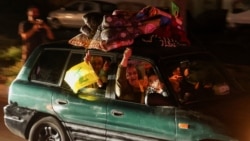
Iran's Internet Blackout Enters 47th Day
The Netblocks Internet connectivity monitor says the digital blackout in Iran has now passed 1,104 hours, meaning that it has now entered its 47th day.
Iran Acquired Chinese Spy Satellite To Monitor US Bases, Says FT Report
Iran secretly acquired a Chinese-built spy satellite, giving it new capabilities to monitor and potentially target US military bases across the Middle East, the Financial Times reports.
Citing leaked Iranian military documents, the report said the Islamic Revolutionary Guards Corps obtained the TEE-01B satellite in 2024 and used it to track bases in Saudi Arabia, Jordan, Bahrain, Iraq and elsewhere, with imagery captured around the time of missile and drone strikes.
The satellite’s high-resolution capability marks a major upgrade over Iran’s domestic systems. Analysts say access to Chinese-operated ground stations allows Iran to operate the satellite globally, complicating efforts to disrupt it.
Reuters said it could not independently verify the report, and officials in Washington and Beijing declined to comment on the matter.
With reporting by Reuters
US CENTCOM Says Blockade Against Iranian Maritime Trade 'Fully Implemented'
US Central Command (CENTCOM) says a blockade of Iranian ports has been "fully implemented," cutting off vital trade for the country's economy.
"A blockade of Iranian ports has been fully implemented as US forces maintain maritime superiority in the Middle East," Brad Cooper, commander of CENTCOM, said in a post on X late on April 14. "In less than 36 hours since the blockade was implemented, US forces have completely halted economic trade going into and out of Iran by sea."
The US implemented the blockade after peace talks with Iran last weekend failed to reach a deal.
Earlier in the day, CENTCOM said that during the first 24 hours of the blockade, no ships made it out of the region, adding that six vessels complied with directions from US forces to turn around to re-enter an Iranian port after setting sail.
Russia Can Help China With Energy Supply Shortage Sparked By Iran War, Lavrov Tells Beijing
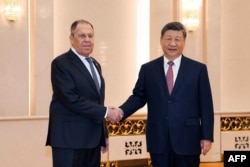
Foreign Minister Sergei Lavrov says Russia is able to make up for an energy shortage in China caused by the blockade of the Strait of Hormuz during the US-Israeli war with Iran.
"Russia can, without a doubt, compensate for the shortfall in resources that has arisen" for China and "other countries that are interested in working with us," Russia's top diplomat told a news conference during a trip to Beijing on April 15.
A US naval blockade on ships entering Iranian ports and coastal areas took effect this week after peace talks between US and Iranian negotiators over the weekend failed to end the war, which began on February 28.
Trump Says He Has No Plans To Extend Cease-Fire With Iran
US President Donald Trump says he has no plans to extend the two-week cease-fire with Iran.
"It could end either way, but I think a deal is preferable because then they can rebuild," Trump told ABC News reporter Jonathan Karl in an interview late on April 14.
The two sides reached a deal to halt the war on April 7 to allow for peace talks that were held in Islamabad last weekend.
The April 11-12 negotiations failed to produce an agreement to end the war, which began with US and Israeli air strikes on Iran on February 28.
Earlier on April 14 Trump suggested that a new round of talks with Iran could resume in a day or two.
We are now closing the live blog for the day. We'll be back tomorrow at 7:30 a.m. Central European time to cover the latest events across the Middle East.
Report: US To Let Iran Oil Sanctions Waiver Expire
The administration of US President Donald Trump will allow a 30-day waiver on sanctions covering Iranian oil shipments to expire later this week, as Washington intensifies pressure on Tehran alongside a naval blockade, according to Reuters
One official told the news agency that the US Treasury "is going full force on Economic Fury,” an apparent reference to Operation Epic Fury, the US-led military campaign against Iran.
The move underscores a renewed push in the United States' long-running “maximum pressure” campaign over Iran’s nuclear program and Tehran's support for its proxies in the Middle East.
The waiver, issued on March 20 and due to expire April 19, allowed about 140 million barrels of oil onto global markets, easing supply strains during the recent US-Israeli war with Iran, according to US Treasury Secretary Scott Bessent.
US Lawmakers have criticized the temporary easing of sanctions on both Iran and Russia.
Reuters said one US official also warned that with the “snapback of UN sanctions” and Iran’s “history of trying to hide behind seemingly legitimate activity,” any dealings with Tehran may trigger further penalties.
Washington also did not renew the waiver on Russian oil at sea, which expired on April 12, according to one of Reuters' sources.
With reporting by Reuters
US Military Says 'No Ships Made It Past' Naval Blockade Targeting Iran
- By Ray Furlong
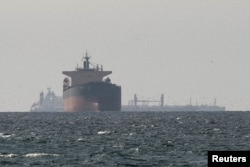
The US military said that no ships slipped through a naval blockade targeting vessels headed to or from Iran in the first 24 hours of the restrictive measure, while tracking-service data indicated that a few Iran-linked ships exited the Strait of Hormuz during that time period.
"During the first 24 hours, no ships made it past the US blockade and 6 merchant vessels complied with direction from US forces to turn around to re-enter an Iranian port on the Gulf of Oman," the US Central Command, which is responsible for operations in the region, said in a post on X.
"The blockade is being enforced impartially against vessels of all nations entering or departing Iranian ports and coastal areas, including all Iranian ports on the Arabian Gulf and Gulf of Oman," CENTCOM said. "U.S. forces are supporting freedom of navigation for vessels transiting the Strait of Hormuz to and from non-Iranian ports."
Data from ship tracking services listed at least four ships, two of which had recently called at Iranian ports, that had passed or were passing through the 30-kilometer-wide Strait of Hormuz in the hours after the blockade came into force at 10 a.m. US Eastern Time on April 13.
A Liberian-flagged ship that had delivered corn to the Iranian port of Bandar Imam Khomeini passed Iran's Larak Island in the strait a few hours after that, and a Comoros-flagged tanker that was carrying methanol and had left the Iranian port of Bushehr on March 31 exited the strait around the same time, the AFP news agency reported, citing data from Kpler.
Also citing tracking services, Reuters separately reported that three Iran-linked vessels that transited the strait were not headed for Iranian ports and were not affected by the blockade. Two of the three vessels are under US sanctions and one of those two is Chinese-owned, Reuters reported.
US President Donald Trump ordered the blockade after US-Iranian peace talks in Islamabad on April 11-12 failed to produce an agreement to end the war, which began with US and Israeli air strikes on Iran on February 28. Washington and Tehran agreed to a two-week cease-fire on April 7.
Trump suggested on April 14 that negotiations could resume in Islamabad in the next couple of days.
"You should stay there, really, because something could be happening over the next two days, and we're more inclined to go there [than to another location]," an Islamabad-datelined story in the New York Post quoted Trump as saying.
Read more here.
Trump Slams Italian PM Over Iran War Stance
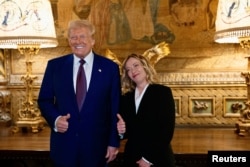
US President Donald Trump has sharply criticized Italian Prime Minister Giorgia Meloni for refusing to join the war against Iran, straining ties with one of his closest European allies.
“I'm shocked at her. I thought she had courage, but I was wrong,” he said in an interview with Corriere Della Serra, published on April 14.
Trump added that “she doesn't help us with NATO” and “doesn't want to help get rid of a nuclear-weaponed Iran,” calling her stance “very sad” and saying she was “much different than I thought.”
The remarks come after Meloni said Trump’s criticism of Pope Leo after the pontiff's calls for an to the war was "unacceptable."
The Italian far-right leader has been one of Trump's closest allies in Europe and has often sought to act as a mediator between diverging US and European views.
Trump also criticized Europe’s broader stance on security, including reluctance to defend the Strait of Hormuz.
Italian officials, including Foreign Minister Antonio Tajani, defended Meloni, stressing national interests and calling for unity "built on mutual loyalty, respect, and honesty."
With reporting by AFP
CENTCOM: Says 6 Ships Returned To Iranian Port
The US Central Command said on April 14 that no ships have made it past the US blockade of Iranian ports and that six merchant vessels "complied with direction from U.S. forces to turn around to re-enter an Iranian port on the Gulf of Oman."