


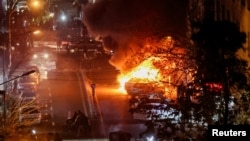
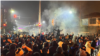
Iran has witnessed the biggest protests against the country’s clerical rulers since the Islamic Revolution in 1979.
In response, the authorities have waged their deadliest-ever crackdown on street protests, killing thousands of people, according to human rights groups.
The widespread killing of protesters has led to the United States threatening possible military action against the Islamic republic.
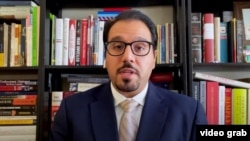
RFE/RL’s Kian Sharifi interviewed Behnam Ben Taleblu, senior director of the Iran program at the Washington-based Foundation for Defense of Democracies, about whether Iran’s clerical rulers will survive this latest round of protests and Washington’s possible response to the unrest.
RFE/RL: You’ve said these protests are different. What makes them stand out?
Behnam Ben Taleblu: It’s the latest incarnation of anti-regime protests that are trying to push past the paradigm of the Islamic republic in its entirety, but very acutely different: The nationalism in them has grown significantly, with crowds calling for exiled Crown Prince Reza Pahlavi by name; these are the first multiday, multicity nationwide uprisings months after the [Israel-Iran] 12-day war, when external observers predicted [that Iranians would] rally around the flag. Instead, you see regime flags taken down and even burned, alongside other symbols.
The situation on the ground is very fluid, and much rides on the nature, if any, of external intervention..."Behnam Ben Taleblu
Protester resiliency persists despite violent crackdowns after the [2022] Woman, Life, Freedom movement and the inability of the diaspora to organize. Many thought this combination would have a chilling effect on the will of Iranian protesters to risk coming out onto the streets again for years to come.
I think the level of discontent coupled with the failures of the government on the economic front and on the environment front across 2025 plus the military defeat in the 12-day war really was a cocktail of forces that made the current round of protests qualitatively different. And I think we can analytically say [this is] the most potent challenge from the street against the state in the past four decades [since] the Islamic Revolution.
RFE/RL: This round of protests has seen the deadliest crackdown yet on street protesters. Do you see the Islamic republic surviving this, or is this it?
Taleblu: No doubt there's been boom-and-bust cycles of protests in years past, but it's still too soon to tell. The situation on the ground is very fluid, and much rides on the nature, if any, of external intervention and how it's read as dampening or driving future rounds.
But make no mistake. The social revolution has already happened against the Islamic republic. All that Iranians are waiting for is commensurate political change in Tehran. When and how [that happens] remains unclear. What is clear is the bravery of the Iranian people and their willingness to bear high levels of violence from this state, including at rates never before seen in four-plus decades of protests against this regime.
RFE/RL: US President Donald Trump has warned of a “very strong action” against the Islamic republic and has not ruled out military strikes. How do you see the US responding?
Taleblu: If Washington is able to somehow work to restore Internet access in a sustained manner, to kind of take out the spinal cord of command-and-control between the regime's security forces -- perhaps on the cyber side, perhaps on the kinetic side -- then that could put wind beneath the wings of Iranian protesters.
But if this is simply used as an opportunity to, you know, resume the 12-day war, it’s highly likely that Iranians will revert to the behavior we saw during that period -- namely withdrawing and focusing on individual survival. That, in turn, could have a negative effect on protesters’ morale. So much is riding on the nature of US involvement.


But I have to say, having lived and worked in Washington on these issues for many years, Washington should not have been caught flat-footed. This is not the first time there has been a national Internet outage in Iran, and in every round of protests the best, brightest, and bravest Iranians continue to go out unarmed into the streets against the state.
Now is the time to think about how Washington -- on the high side, on the intelligence side -- can develop and craft a defector strategy. A way to encourage security forces to defect or to create fissures and cracks within those forces. These efforts need to be operating in the background before protests ever begin, so that whenever people do go out again -- and if this round is curtailed, there is no doubt they will go out again -- Washington is not once more caught flat-footed.
RFE/RL: Are these protests leaderless?
Taleblu: No doubt there is no domestic political organization inside the Islamic republic because of the high cost. What I see in the multiple rounds of anti-regime protests since 2017 that have been seeking a wholesale change of government is brave revolutionaries, brave Iranians, risking life and limb, without political cohesion, without political structure on the ground. Increasingly, as the nationalist tone and tenor of those protests have grown, they've drifted toward seeking, identifying, and aligning the majority of themselves, at least anecdotally, with exiled Crown Prince Reza Pahlavi.
I think even when you had a regime like the shah's regime, prior to 1979 with its very different method of pushback against the street from the state, there was exiled opposition. So, in a regime that is qualitatively so much more repressive… political leadership would have to come from the outside. But what is coming from the inside is bravery that we see on a day-to-day basis from what I call revolutionaries, average protesting Iranians.
RFE/RL: Trump has mentioned possible talks with Iranian officials. What’s your assessment? Would they help the Islamic republic?
Taleblu: I think it’s high time Washington -- and the Trump administration, in particular -- turned the page on US-Iran negotiations in their Iran policy playbook.
Politically, for the president, the most important approach would be to draw a meaningful contrast to [former] President [Barack] Obama’s Iran policy, rather than repeating past mistakes. Even President Obama, along with senior members of his staff like former Secretary of State Hillary Clinton, have acknowledged that their approach [during mass street protests] in 2009 -- prioritizing nuclear diplomacy over standing with the protesting Iranian street -- was a mistake.
For President Trump in 2026 to make that same mistake, especially after having course-corrected during his first term with respect to Iran policy, would be a grave error politically for him and his legacy, strategically for America, morally for the American national interest, and harmful to the brave Iranian protesters.
Why is that? This is a regime that for over four decades has chanted “Death to America,” yet has been able to negotiate, limp along, and survive to fight another day. It would be a mistake for President Trump to assume that the path to being a peacemaker in the Middle East lies in locking in and legitimizing the Islamic republic’s government or helping it survive the current round of anti-regime protests.
*This interview has been edited for length and clarity.