


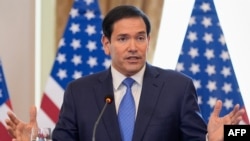
US Secretary of State Marco Rubio has emphasized a diplomatic approach to Iran, saying he wasn't going to speak about a military attack and that President Donald Trump "has made it clear he prefers diplomacy."
Speaking at a joint press conference in Bratislava with Slovak Prime Minister Robert Fico on February 15, Rubio said that "no one has ever been able to do a successful deal with Iran, but we are going to try."
Rubio is in Slovakia for one day as part of a broader European tour focused on strengthening ties with key allies.
"Right now, we are talking about negotiations, we are focused on negotiations," Rubio said. "The president has made that clear. If that changes, it will be obvious to everyone."
The secretary of state's remarks come amid continued US attempts to negotiate with Iran over its nuclear program, ballistic missiles, and regional proxies.
At the same time, Iran has opened the possibility of striking a deal over its nuclear program, provided that Washington lift its sanctions imposed on the regime.

In a BBC interview in Tehran on February 15, Iranian Deputy Foreign Minister Majid Takht-Ravanchi said: “We are ready to discuss this and other issues related to our [nuclear] program provided they are ready also to talk about the sanctions.”
“Those sanctions have to be also on the table,” he said, adding that the ball was “in America's court to prove that they want to do a deal.”
Takht-Ravanchi didn’t specify whether he meant some or all of the sweeping US sanctions, which target banks and oil exports among other sectors, imposed in recent years.
Geneva Talks
Their remarks comes ahead of new US-Iran talks in Geneva on February 17.
The US delegation will include envoys Steve Witkoff and Jared Kushner, with Omani representatives acting as mediators. Oman hosted indirect talks between Tehran and Washington earlier in February.
According to the BBC, Takht-Ravanchi cited Iran’s offer to dilute its 60 percent-enriched uranium as a sign of willingness to compromise and said zero enrichment -- something the US has pushed for -- “wasn’t on the table anymore.”
Western countries have long suspected Iran of seeking a nuclear weapon, while Tehran insists its program is for civilian purposes only.
World powers struck a landmark nuclear deal with Tehran in 2015, the Joint Comprehensive Plan of Action (JCPOA), to prevent an Iranian bomb. Western economic sanctions were eased at the time, but Iran began reneging on commitments after Donald Trump, in his first term as US president, withdrew from the JCPOA in 2018 and reimposed sanctions.
Second Aircraft Carrier Headed Arabian Sea
President Trump has called the initial US-Iran talks “positive” but over the weekend said regime change is the “best thing that could happen” in Iran. He also confirmed that a second aircraft carrier, the USS Gerald R. Ford, would soon join a “massive” US armada in the Arabian Sea.
The American president has previously threatened strikes against Iran if no deal curbs its nuclear program. The US and Israel targeted the country’s nuclear and military sites in a 12-day bombing campaign in June.
At a panel discussion at the Munich Security Conference on February 13, Rafael Grossi, head of the International Atomic Energy Agency (IAEA), said Iran’s nuclear landscape had changed drastically after the US attacks, adding that “the physical infrastructure of Iran's nuclear program has been largely damaged and that future monitoring would need to focus not only on what remains but on how Tehran's nuclear capabilities could evolve going forward.”
IAEA inspectors have returned to Iran but still lack access to sites targeted during the bombing.
The upcoming talks also come weeks after the regime’s violent crackdown on anti-government protests across Iran earlier this year. Iranian security forces killed thousands of demonstrators, and more than 53,000 people have been arrested, according to rights groups.

