




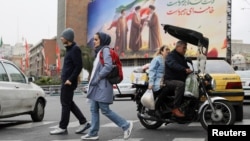
Iranian officials went on the offensive on March 11 to knock down rumors over newly appointed Supreme Leader Mojtaba Khamenei's state of health, saying he was injured in the air strikes that killed his father and other family members but is "safe and sound."
Mojtaba Khamenei was announced as the country's new supreme leader on March 8 following the death of his father in a bombing raid on February 28.
The 56-year-old has not been seen since the United States and Israel launched air strikes on Iran, nor has he made any public statements, giving rise to speculation he too may have died or been seriously injured in the attacks.
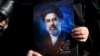
"His Eminence Ayatollah Seyyed Mojtaba Khamenei is today the heir to the blood of his martyred father, his martyred mother, his martyred sister, and his martyred wife," a state television presenter said on March 11, using Khamenei's full and honorary titles.
"He, who is a janbaz of the Ramadan War, inherits the path of the proud and steadfast martyrs of this land," the anchor added. Janbaz is an Iranian term for a wounded veteran. Iranian officials are calling the current conflict the Ramadan War because it is happening during Islam's fasting month.
No details were given by state television on Khamenei's current state of health, and the whereabouts of the hard-liner who is seen as being close to Iran's powerful Islamic Revolutionary Guards Corps (IRGC) were not disclosed.
The younger Khamenei's selection by the Assembly of Experts, a clerical body, was seen by many as an attempt to bring continuity to Iran at a time of uncertainty.
At the same time, the choice, experts say, also revealed a system under acute internal strain, one in which the powerful IRGC -- the elite branch of Iran's armed forces and the backbone of the country's theocracy -- has displaced the clerically dominated political establishment as kingmakers in the country of some 90 million people.
As part of the offensive to reinforce that Mojtaba Khamenei indeed holds power in Iran, Yousef Pezeshkian, a government adviser and son of Iranian President Masud Pezeshkian, said in a social media post that he had heard from friends "with connections" that Khamenei had been injured in the attacks that killed his father but "thank God, he is safe and sound."
The Iranian ambassador to Cyprus, Alireza Salarian, told The Guardian newspaper on March 11 that Mojtaba Khamenei "was also there and he was injured in that bombardment but I haven't seen that reflected in the foreign news."
“I have heard that he was injured in his legs and hand and arm…. I think he is in the hospital because he is injured," he added.
In an explanation as to why Khamenei had yet to appear in public or made any statements since succeeding his father, Salarian said, "I don't think he is [in any condition] to give a speech."
While the younger Khamenei spent two decades at the center of his father's office, the Beyt, coordinating between the clerical establishment and the IRGC, some analysts said his lack of experience makes him entirely dependent on Iran's so-called deep state, which is dominated by the IRGC.
Speaking to RFE/RL in Tel Aviv on March 11, Raz Zimmt, who is head of the Iran program at the Institute for National Security Studies, said the question was whether Khamenei would be capable of maintaining "daily contacts with the political and security establishment" to preserve "the ability of the regime to function."
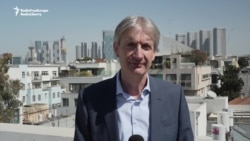

"It's very obvious that the Iranian regime is fighting for its survival. They know very clearly that Mojtaba Khamenei might become the next target by either Israel or the United States, and so he should hide," Zimmt said.

