




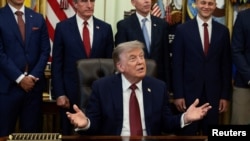
US President Donald Trump said Washington and Tehran were still conducting negotiations to end their conflict -- even as attacks intensified throughout the region, further threatening to widen the conflict into a full-blown Middle East war.
"We are talking to them. I think they're being serious,” Trump told reporters at the White House, referring to Iranian negotiators.
“I think...they are being by far the most serious that we've seen them, but that doesn't mean we get there. We'll see what happens," he added in the July 24 comments.
Trump has often spoken of negotiations between the US and Iran, occasionally claiming a peace deal was imminent, only to have talks falter and military action to resume.
Asked if he had made a decision about resumption of full-scale attacks amid media reports that he was meeting with advisers on the subject, Trump responded, “No, I haven’t.”
“We're locked and loaded and ready to go. But we're talking to them, so I think while we're talking, we'll see what comes of it. I believe...They're very serious. They should be," Trump said without specifying how the talks were being conducted.
The remarks came after a day in which US forces struck targets across Iran as Trump earlier vowed "major military punishment" for Iran after three US service members were killed in Jordan and another died in Iraq.
Saudi-Led Forces Strike Houthi Sites
Trump's comments also came as attacks widened throughout the region early on July 25, with Saudi-led forces targeting Iran-backed Houthi sites in Yemen after the rebel group struck Saudi shipping in the Red Sea -- actions that threatened to pull Saudi ally Pakistan into the conflict.
"The terrorist Houthi military...targeted commercial ships in the Red Sea," Saudi military spokesman Turki al-Maliki said on X.
He added that the coalition had "carried out a decisive and strong response" targeting Houthi military sites used to threaten Red Sea shipping and that the "military response is now over."
The strikes targeted sites in and around Hodeida, including a naval base at Ras al-Kathib, a military camp on Kamaran island and a telecommunications building near the port, according to a Yemeni security source. Houthi media said two civilians were wounded.
The US ally said it would continue to take necessary steps to protect its shipping assets and other interests. It didn't specify the members of its coalition, although it often consists of Riyadh's regional allies.
After the Saudi strikes, Houthi rebels claimed they had launched a missile attack on the southern Saudi city of Jizan as the kingdom's authorities issued brief warnings to residents there.
Pakistan condemned the attacks by the Houthi rebels on Saudi-linked vessels. It also warned that any aggressive actions toward Pakistan-flagged vessels or the country's maritime interests would be regarded as a “grave threat” that may result in “lawful use of force.”
Pakistan, a key mediator in the US-Iran conflict, is also an ally of Saudi Arabia. A Strategic Mutual Defense Agreement signed between Saudi Arabia and Pakistan in September 2025 states that “any aggression against either country shall be considered aggression against both countries.”
The Saudi attacks came after the Houthi rebel group said it was imposing a maritime blockade on Saudi-flagged ships in the Bab al-Mandeb Strait in the Red Sea.
The rebels struck two Saudi tankers on July 23, then reportedly hit another late on July 24.
Trump Holds Iran Responsible
Prior to the latest attack on shipping, Trump said Iran would be held responsible for any future Houthi attacks.
"If they do this again, the US will hold Iran responsible, in that the Houthis are a Surrogate and/or Proxy of Iran, and major military punishment will be inflicted upon Iran and, of course, the Houthis," he wrote in a Truth Social post on July 23.
Yemen, the poorest country in the Middle East, descended into civil war in 2014 when the Houthis seized the capital, Sanaa, ousting the internationally recognized, Saudi-backed Sunni government.
The group now controls much of the northwest, including Red Sea ports like Hodeidah that are lifelines for food and fuel.
Sunni-led Saudi Arabia and Shi'ite-majority Iran have long been bitter rivals seeking geopolitical and religious influence in the Middle East.
Elsewhere, sirens were reported early on July 25 in Bahrain following suspected Iranian attacks, while the US military fired on and disabled a tanker in the Gulf of Oman that was attempting to evade its blockade of Iran's ports, a US military spokesman said.
"The crew was repeatedly warned, didn’t comply, and US forces on scene disabled the ship after firing into its engine room. The ship is no longer transiting to Iran,” Central Command (CENTCOM) spokesman Tim Hawkins said.
Secret Attacks?
Meanwhile, unconfirmed but persistent reports indicate that Bahrain and Kuwait, also both US allies, have secretly sent jets to attack sites inside Iran.
The Wall Street Journal, citing people familiar with the matter, on July 25 reported that the two Arab nations struck back after frequent Iranian missile and drone strikes since the start of the US-Israeli war with Iran on February 28.
The WSJ report said the United Arab Emirates, which it said previously also secretly conducted strikes of its own in Iran, provided Kuwait and Bahrain with intelligence on targets.
None of the countries has confirmed the actions.
Iran's Islamic Revolutionary Guards Corps (IRGC) on July 24 said it struck a US-operated base in Kuwait, although neither US or Kuwaiti officials confirmed the claim.
Separately, the British government said its forces were prepared to defend the country after the IRGC warned that US bombers should not be allowed to operate from U.K. bases.