



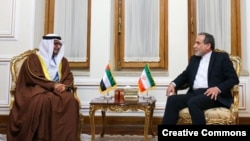
Anwar Gargash, a senior official in the United Arab Emirates, said a resumption of hostilities in the Iran war would be “catastrophic” for the Middle East, which has been embroiled in the US-Israeli conflict with the Islamic republic.
In an interview with RFE/RL on May 22 at the annual Globsec security conference in Prague, the diplomatic adviser to the UAE president said only a “political resolution” could end an 11-week war that has disrupted international oil and gas supplies and upended the global economy.
In response to the US-Israeli bombing campaign launched on February 28, Iran fired hundreds of drones and missiles at its neighbors in the Persian Gulf, including the UAE, an ally of the United States and Israel, which has borne the brunt of Tehran’s retaliation.
The UAE has been the most hawkish country in the region toward Iran. Recent US media reports suggest the oil-rich country carried out secret attacks on Iran during the US-Israeli military campaign.
Pakistan is mediating talks between Washington and Tehran over a deal to end the war. President Donald Trump has warned the United States could resume military action if the sides cannot reach a negotiated settlement.
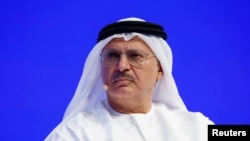
RFE/RL: Does the UAE support the renewed negotiations with Iran aimed at ending the war? Or would the UAE prefer to see the United States and Israel hit Iran even harder and “finish the job,” as some have called for?
Anwar Gargash: We worked very hard to avoid war because our relations with Iran have been complicated for the last 40 years. We're neighbors, we had trade, we had investments, and a lot of links. So, our position stays the same. Our position is the resolution of this issue must be a political resolution. Military resolutions are going to bring a lot of complications as we have seen. We continue to support the political resolution of the conflict. However, a political resolution should not be used as a pretext for future conflict.
RFE/RL: As you know, US Secretary of State Marco Rubio said yesterday that there has been some progress in peace talks. Do you think that the negotiations will result in a deal or are we likely to see another round of fighting?
Gargash: Well, they have to reach a deal. I don't think either the United States or Iran wants a resumption of hostilities. The region and the UAE do not want a resumption of hostilities. But I think what is important here -- and it's one of my concerns -- is that Iranian negotiators have always overplayed their hands. We have a regional issue and a global issue with Iran's nuclear program.
The requirements for a deal are known. They deal with the nuclear program and [uranium] enrichment. Right now, Iran wants to also bring about a change in the use of the Strait of [Hormuz]. That change will actually [cause] serious issues. And we worry [the strait] might be weaponized [again] in a future conflict.

RFE/RL: You've said that a cease-fire alone is not enough -- that the region needs a broader security framework. What would such a framework look like in practice?
Gargash: We really need to see more of a deep dive in order to ensure that out of this conflict we have a period of stability in the region. I think a regional pact, a regional construct always makes sense. I mean Iran and Iraq, and the Gulf states share a history, they share a geography, they share a body of water. But I think… trust has been undermined by Iranian attacks on the Gulf.
I mean let's remember this is an American-Israeli war with Iran. The Gulf was not part of this war. But I think the Iranian reading was that we cannot deal with the American threat and the Israeli threat. They are insulated. So let us try and sort of engulf the whole area into a bigger conflict. Now this strategy might have seemed attractive tactically for Iranian commanders but strategically I think it really has created long-term issues with regards to the trust that needs to be rebuilt with the Islamic republic.
RFE/RL: What needs to be done? What steps should be taken to rebuild that trust?
Gargash: I think to start with we need to reach a political solution. I think Iran has to hear it loud from us in the United Arab Emirates that we don't want escalation. We don't want to fight. But we will defend ourselves. I think this is our message to Iran. But we want ultimately to start with a political solution, a political solution that addresses our core concerns, Iranian core concerns, and international core concerns. Once this starts, in my opinion, then the long road to healing starts.
Beyond that, we have to come to an understanding through various confidence building measures that Iran will not be belligerent against us. I mean we've never really seen any attack on Gulf countries [before], and this has been our worst-case scenario and unfortunately, it's come from our northern neighbor. So, I have to say very clearly that we're very much [in support of] a political agreement within these next few days that will sort of turn the page, but as I said, it should not sow the seeds for future instability in the region.

RFE/RL: Looking ahead, how do think this conflict will impact Iran’s regional influence?
Gargash: I think in many ways it's going to weaken Iran's regional influence. First of all, [Iran] will be seen as a threat from the perspective of all its southern neighbors. [Its] southern neighbors will see Iran as a core threat and [defense spending] will be geared toward that. I think also the influence of the United States in the Gulf will actually become more prominent because of these attacks [on the Gulf].
Iran also has a long road to recovery in terms of its own infrastructure, economy, currency. So, Iran really needs to address its relations with the region. It needs to act as an important regional power. But acting like an important regional power means acting as a responsible important regional power.
RFE/RL: Another important country is Israel. Has the war brought Israel and the UAE closer?
Gargash: Well, we have an open relationship with Israel. It's a formal relationship. We have embassies and so on. The Israelis have been quite helpful in our defense against Iranian missiles and drones and that's a fact. I think what has happened is the Iranian attacks on the Gulf countries in a certain way helped further detach Gulf security from Arab security. So, Gulf security for example is more focused now on Iran.
I think ultimately this is another area where Iran's strategy of attacking the Gulf countries has failed strategically and has created in my opinion more opportunities not less for Israel in the Gulf. I mean these opportunities might be covert in terms of political channels in terms of defense procurement. But it definitely has not in any way created less opportunity for Israel. It's created more.
RFE/RL: What do you see as the long-term implications of this war?
Gargash: A much more difficult strategic landscape in my opinion. It'll depend also what we will see in Iran. What are the lessons learned for the current regime in Iran? Are these lessons to recreate the last 30 years and then be in sort of perpetual conflict or are the lessons to basically concentrate more internally for example? It'll depend on what sort of agreement is reached also between Iran and the United States.
I think also in the Gulf one of the lessons very clearly is that we are facing an immediate danger [from Iran]. This is not a theoretical threat, and we have to be ready for it. I think defense spending will increase in many ways. I think also the relationship with United States will become, in my opinion, more organic. At the same time, we will also have to rebuild in terms of the what the war damaged. There will be a lot of spending on logistical infrastructure that doesn’t go through the Strait of Hormuz. The dependence on certain critical infrastructure will no longer be there.
RFE/RL: If the United States and Israel were to strike Iran again, how concerned would the UAE be about the risk of a broader regional conflict directly involving the Gulf states? There were also reports during the previous round of fighting that the UAE and Saudi Arabia carried out strikes on Iranian sites in response to Iran’s attacks. How do you respond to those reports?
Gargash: Well, again, our position has been very clear from day one. Our position is that we will not take any hostile action, but we will defend ourselves. We have the right to defend ourselves. Looking at that, a round two of war will be catastrophic because Iran is in a very weak position. We don't want to see round two. The United States doesn't want to go that route. But again, I think it'll all depend on the flexibility of the Iranian negotiators. I mean, the Iranian negotiators have been known over the years to miss a lot of opportunities. So, I hope that this doesn't happen this time.
RFE/RL: We’ve received reports that the UAE has imposed visa and residency restrictions on Iranian nationals. Why target ordinary Iranians, many of whom have no influence over the policies of the Islamic republic? As you know, a large number of Iranians oppose the regime.
Gargash: Well, the UAE has about 100,000 Iranian residents and has never asked about their political allegiances. I don't think we ever asked an Iranian: are you with this regime or are you against it, or what are your political leanings? I think certain measures that we take are necessary measures because we are at a time of war. So, in many ways, Iranian residents who were abroad have been denied entry back to the UAE. But I think we are also addressing [specific] cases.
On the other hand, the majority of the population has been assured of their status. They have been assured of their livelihood. We have taken [measures against] certain institutions. These were institutions that have been long in the UAE but have been directly linked to the Iranian state. So, I have to differentiate, for example, between a school that teaches Farsi but that is privately owned and a school that teaches Farsi but is linked to the Iranian government.