




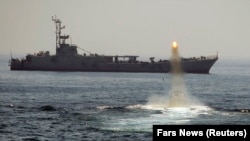
To pressure Iran into a peace deal, the United States has imposed a naval blockade on the Middle Eastern country’s ports and vessels since April 13.
While it has intensified pressure on Iran’s already battered economy, the US blockade has yet to force Tehran into making concessions to end the nearly two-month-long war, experts say.
Iran has refused to come to the negotiating table unless the United States lifts the barricade, which targets Tehran’s lucrative oil revenue. Washington has insisted that the blockade will only end when a peace deal is signed.
The US embargo came in response to Iran’s effective closure of the Strait of Hormuz, a key artery for global energy supplies, to international shipping since the war began on February 28. The move has rattled international markets, upended the global economy, and handed Tehran new leverage in the war.
“If the primary goal of the blockade is to stop vessel traffic to and from Iran, and most importantly the flow of Iranian crude exports, then the blockade has been a success,” said Nader Itayim, a Middle East energy expert.
“But if Washington expects the blockade to swiftly put Iran in a position where it will have no choice but to deal, then it might be disappointed,” added Itayim, who works at the UK-based Argus Media, which provides market intelligence to global energy and commodity markets.
Iranian Oil Exports ‘Clearly Down’
Iran exported an estimated 1.8 million barrels of oil per day in March. But the figure has plummeted to a “literal trickle” in recent days as the effects of the blockade intensify, said Itayim.
Still, he said, the Islamic republic should be able to ride out the blockade for another two months, pointing to the up to 130 million barrels of Iranian oil that were already out at sea before the barricade came into effect.
To enforce the blockade, the US Navy fired on and seized an Iranian cargo vessel on April 19 in the Gulf of Oman. Two days later, the US military seized a second ship -- a tanker suspected of smuggling oil -- in the Indian Ocean.

US forces have also "directed 31 vessels to turn around or return” to Iranian ports as part of the blockade, according to US Central Command.
US President Donald Trump has declared the blockade a “tremendous success” and repeated that he would not lift the US embargo until Washington reached a “final deal” with Iran. The US military has claimed that it has “completely halted” Iranian trade.

But dozens of Iran-linked tankers have managed to bypass the barricade, according to cargo-tracking group Vortexa.
Vortexa said at least 34 Iran-linked tankers have circumvented the barricade, adding that around 10.7 million barrels of Iranian oil crossed through the Strait of Hormuz and exited the area blockaded by the US Navy between April 13 and 21. The US military rejected the data.
Maritime data company Lloyd's List said at least 26 Iranian shadow fleet vessels have bypassed the US blockade. “Lloyd’s List Intelligence shows a steady flow of shadow fleet traffic in and out” of the Persian Gulf, it said on April 20.
“Compared to the number of ships that transited before the blockade -- something like six or seven ships per day -- the volume is clearly down,” said Rosemary Kelanic, director of the Middle East Program at Defense Priorities, a Washington-based think tank.
“But the bigger problem for the US is that there's no way to make a blockade of a continental country airtight -- Iran can still conduct significant trade overland, including in oil, albeit at lesser amounts than by sea,” she said.
Trump has claimed that the blockade is costing Iran around $500 million a day. But experts said calculating the costs was difficult.
Estimates suggest that Iran received around $45 billion in annual revenue from its oil exports before the war, accounting for roughly 10 percent of the country’s GDP.
“Even if the blockade severs all oil trade -- it won't -- the maximum damage might be a 10 percent GDP loss,” said Kelanic. “That's a big loss for peacetime conditions -- but not so bad considering Iran is at war.”
In comparison, Ukraine has lost 20 percent of its GDP after Russia’s full-scale invasion in 2022, she said. That has not stopped Ukrainian forces from fighting Russia to a near stalemate.
“So, I'm skeptical that the costs imposed by Trump's blockade will break Iran's resolve to continue resisting US demands,” said Kelanic.

‘Restart The War’
The United States and Israel's bombing campaign has imposed enormous material costs on Iran, devastating its military, decapitating much of its leadership, and destroying critical infrastructure.
Yet Tehran still believes it is winning the weeks-long confrontation. That perception of victory has extended to the negotiating table, where it is aiming to end the war on its own terms.
A first round of peace talks in Pakistan ended on April 11 with no deal. Still, Trump unilaterally extended the cease-fire that was due to expire on April 22, and the sides are in indirect talks to hold a second round of negotiations in Islamabad.
“Economic pressure alone will not push Iran toward concessions that it hasn’t already made during military pressure,” said Hamidreza Azizi, a fellow at the German Institute for International and Security Affairs.
“If anything, Iran might restart the war,” he added. “Iran sees this situation of no war, no peace as the most destructive scenario.”
Iran is already under crippling US sanctions, and the blockade has further squeezed the country’s economic resources. The barricade has also prevented Iran from imposing tolls on international shipping using the Strait of Hormuz, another source of revenue since the war began.
Iran fired on three ships and seized two of them in the Strait of Hormuz on April 22, suggesting Tehran is willing to use force to end the US blockade.
“This situation is not tolerable for the Islamic republic,” said Azizi. “As a result, I would expect them to act militarily.”

