



Iran's foreign minister has signaled a readiness to resume nuclear talks with the United States, while once again drawing firm red lines around Tehran's missile program and defensive capabilities, as regional mediation efforts accelerate amid escalating threats from President Donald Trump.
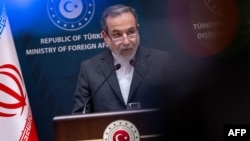
Speaking on January 30 in Istanbul, Foreign Minister Abbas Araqchi said Tehran would be prepared to re-enter negotiations with Washington if talks were conducted on what he described as a "fair and equitable" basis.
At a joint press conference with his Turkish counterpart, Araqchi said Iran was open to "confidence-building" measures related to its nuclear program, but stressed that Iran's military posture was non-negotiable.
"Iran's defensive capabilities and missiles will never be the subject of any negotiation," he said, adding that no direct talks between Tehran and Washington are currently planned.
The remarks come as diplomatic activity across the region intensifies to prevent a direct US–Iran confrontation.
Turkish President Recep Tayyip Erdogan, in a phone call with Iranian President Masud Pezeshkian, offered Ankara's services as a "facilitator" between Iran and the United States.
According to Turkey's presidency, Erdogan said Ankara was ready to help reduce tensions and resolve disputes, an offer that was followed by an in-person meeting later on January 30 between Erdogan and Araqchi.
Iran's presidency said Pezeshkian told Erdogan that any successful negotiation would depend on the abandonment of "warmongering and threatening actions in the region."
The presidency later said Pezeshkian told Egyptian President Abdel Fatah El-Sisi in a call that Iran "has never sought, and in no way seeks, war and it is firmly convinced that a war would be in the interest of neither Iran, nor the United States, nor the region."
Meanwhile, Qatari Prime Minister Sheikh Muhammad bin Abdulrahman al-Thani met with Ali Larijani, a top Iranian security official, in Tehran and "reviewed ongoing efforts" to de-escalate tensions in the region, Qatar's Foreign Ministry said.
Still, analysts say Tehran's position reflects longstanding rigidity rather than a meaningful shift.
Ali Vaez, Iran project director at the International Crisis Group, argues that Iran's negotiating posture has remained unchanged since early 2025, despite mounting pressure.
"The Islamic republic is neither able nor willing to learn how to deal with Donald Trump," Vaez told RFE/RL's Radio Farda, noting that other countries -- from NATO members to regional states -- have adapted their approach to Trump's confrontational negotiating style to advance their interests.
Trump, for his part, has raised the stakes. On January 29, he said Iran must halt its nuclear program and stop "killing protesters," claiming those demands had already been conveyed to Iranian officials.
Two days earlier, he announced that a "massive armada" was moving toward Iran, warning it could act with "speed and fury" if necessary, while expressing hope for a "fair deal" that would leave Iran without nuclear weapons.
Germany-based political analyst Mehran Barati sees Washington pursuing a longer-term strategy aimed at weakening the Islamic republic rather than delivering a single decisive blow.
"The United States wants to move forward step by step and weaken the establishment," Barati told Radio Farda, arguing that sustained military pressure, financial tracking of state assets abroad, and coordinated diplomatic action point to an effort to force change from within the system.
Barati is skeptical that Turkish mediation or similar regional initiatives can prevent escalation. He argued that regional actors are driven primarily by their own interests, including fears of refugee flows and instability, rather than confidence that Tehran will alter its behavior.
"Each has entered this affair with its own distinct aim," he said. "I do not think it is possible to prevent yet another confrontation."
Vaez similarly warns that both sides are cornered. Trump's method, he says, is to apply maximum pressure and then settle for less while declaring victory. However, "there is no good option available to the United States, and no good option available to the Islamic Republic either." For now, he added, that leaves both locked in a stalemate.

