




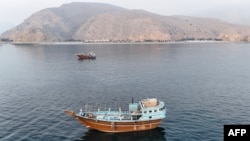
Iran’s Foreign Minister Abbas Araqchi claimed Tehran had regained sole control over shipping in the Strait of Hormuz for the next 30 days, warning against any attempt to bypass Iranian-approved routes, as a fragile US truce looked increasingly shaky amid renewed missile, drone and air strikes across the Persian Gulf on June 28.
Speaking at a press conference during a visit to Baghdad, Araqchi said the waterway would be “once again placed entirely under Iranian administration.”
“Any interference or attempt to create parallel structures would further complicate the situation, generate additional tensions and delay the reopening of this strategically vital waterway,” Araghchi said, reiterating the claim that responsibility for the strait lies solely with Iran.
Araqchi’s comments came as the tenuous truce between Iran and the United States appeared to be fraying early on June 28, with both sides accusing each other of violating an interim agreement aimed at ending months of fighting.
Iran launched missiles and drones targeting US military sites in Kuwait and Bahrain shortly after US President Donald Trump warned Washington could escalate its military campaign if Tehran failed to abide by the cease-fire.
“There may come a point when we are no longer able to be reasonable,” Trump said in a social media post, adding that the United States could “militarily complete the job” it began earlier this year.
Within hours, Kuwaiti and Bahraini authorities reported that their air defenses were responding to incoming projectiles.

Kuwait’s armed forces said two hostile ballistic missiles were intercepted in its airspace with no reported damage or casualties.
Bahrain’s military said it intercepted and destroyed several missiles and drones, while sirens sounded across the Gulf country. Bahrain’s Interior Ministry reported damage to a residential building but said no one was injured.
Regional reactions to Iran’s strikes were swift. Saudi Arabia, Qatar, and Jordan all condemned the missile and drone attacks on Kuwait and Bahrain, calling them violations of international law and threats to regional stability.
Iran’s Islamic Revolutionary Guards Corps (IRGC) said it carried out the attacks in retaliation for fresh US strikes on Iranian territory.
In a statement carried by Iranian state media, the IRGC said that US military infrastructure in Bahrain and Kuwait had been targeted, including facilities linked to the United States Fifth Fleet.
In a comment to Reuters, a US official confirmed attacks on American facilities but said there were no reported US casualties or major damage. The official added that the situation remained under review.
The overnight escalation followed US strikes on Iranian military sites hours earlier, which Washington said were carried out in response to Iranian attacks on commercial shipping in the Strait of Hormuz, a critical global energy corridor.
United States Central Command, said its forces targeted Iranian drone storage facilities, radar installations, and coastal surveillance infrastructure after a tanker was hit by an Iranian drone on June 27.
"Iran was given a chance to honor the ceasefire agreement but elected not to," Central Command said in a statement. It said the strikes were "in direct response to continued Iranian aggression against commercial shipping.”
Iran denied responsibility for endangering shipping and accused Washington of violating the truce.
Iran’s Foreign Ministry said that US air strikes on surveillance facilities along Iran’s southern coast were “terrorist acts” and vowed to defend the country’s sovereignty. The ministry warned that continued US attacks could derail ongoing diplomatic efforts.

The interim agreement, signed earlier this month, was intended to halt fighting that erupted after US and Israeli strikes on Iran on February 28 and to reopen the Strait of Hormuz to commercial traffic while broader negotiations continued.
The accord bars Iran from charging fees for ships transiting the waterway during the 60-day negotiations.
One round of mediated talks was held in Switzerland last week, and Washington later temporarily waived some sanctions on Tehran.
Araqchi told reporters in Baghdad that Iran would hold talks with Oman on how to proceed in accordance with international law and in coordination with neighboring states, though analysts have warned the question of potential transit fees could become a sticking point.
Araqchi also called for the establishment of a regional security framework involving Gulf states, Iran, and Iraq, without the presence or interference of countries from outside the region. He welcomed Iraq’s proposal to host a regional meeting.
Persistent Violence
Despite the deal, violence has persisted. Iran and the United States have repeatedly accused each other of undermining the truce, while attacks on shipping and military assets have continued.
Beyond the Gulf, tensions also flared along Israel’s northern border. The Israeli military said on June 28 that it killed several fighters from the Iran-backed Hezbollah in southern Lebanon, despite a separate cease-fire framework between Israel and Lebanon.
The Israeli military said the militants were armed with anti-tank weapons and operating near a self-declared security zone.
Hezbollah is both a militant group and political party that controls much of southern Lebanon. It is considered a terrorist organization by the United States, while the European Union has blacklisted its armed wing.
Hezbollah has rejected the Israel-Lebanon framework agreement, calling it a surrender of Lebanese sovereignty and refusing to disarm while Israeli troops remain on Lebanese territory.

