





White House special envoy Steve Witkoff and Iranian Foreign Minister Abbas Araqchi will meet on February 6 in a last-ditch attempt to strike a deal aimed at averting war.
US President Donald Trump has deployed major military assets to the Persian Gulf as his administration weighs possible strikes against Tehran.
Iran is attempting to limit the scope of the talks to its nuclear program. But the United States is seeking a deal that would also restrict Iran’s ballistic missiles program and end Tehran’s support for armed groups in the Middle East.
Trump wants a deal because “he prefers it to a war with a large country like Iran,” said Damon Golriz of The Hague University of Applied Sciences.
“If an agreement is reached, it will be in the Islamic republic’s interest -- even an agreement in which the Islamic republic appears, in the public eye, to have surrendered,” he added.

To reach a deal, US and Iranian envoys will have to navigate several sticking points that have scuttled previous negotiations.
No Enrichment, No Stockpile
The United States is demanding that Iran entirely stop enriching uranium and give up its stockpile of around 400-kilograms of highly enriched uranium, steps that would prevent Tehran from building a nuclear weapon.
Iran has previously refused those demands but could make concessions given its weak bargaining position, experts say.
Iran's clerical establishment is at its weakest point in decades, facing unprecedented unrest and an economic collapse at home and a massive US military buildup on its doorstep.
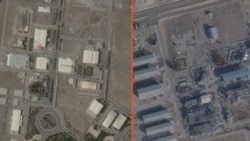
Iran’s nuclear program is also in tatters. The United States bombed Tehran’s key underground enrichment sites in Fordow and Natanz during the 12-day war between Iran and Israel in June.

One potential hitch is recovering Iran’s stockpile of highly enriched uranium, which is “mixed with rubble” following US air strikes on underground nuclear sites last year, said Tariq Rauf, former verification chief at the International Atomic Energy Agency (IAEA), the UN nuclear watchdog.
Rauf also pointed out that one of the US "Bunker Buster" bombs used in the bombing failed to explode.
"There is still 2,000-plus kilograms of high explosives sitting down there in Natanz... which could be very unstable and could explode if disturbed," he told RFE/RL’s Radio Farda.
One way to address the enrichment issue is going back to a proposal from May 2025 -- a regional enrichment consortium, allowing Iran to continue enriching uranium but only to low levels suitable for civilian energy purposes.
A consortium is usually established in a country that already has a nuclear program. The only country in the Middle East with an official nuclear program is the United Arab Emirates, but the Gulf state surrendered its right to enrich uranium and imports nuclear fuel from abroad.
Missiles And Proxies
The United States also wants to impose limits on the range and number of Iran’s ballistic missiles that would make it impossible for Tehran to hit Israel.
Iran currently has a 2,000-kilometer limit on the range of its missiles. Its medium-range missiles can hit Israel, while its close-range missiles can strike US military bases in the Persian Gulf region.
The number of Iran’s medium-range missiles is unknown. Israel targeted Iran's missile-production facilities and missile launchers during the war in June. But Iran is believed to still have several thousand close-range ballistic missiles.
Iran has categorically refused any limits on its missile program, which it says is pivotal to its defense.

The Islamic republic has also rejected abandoning armed proxies and Tehran-backed militant groups in Lebanon, Iraq, and Yemen. Iran considers its so-called axis of resistance a key part of its deterrence against Israeli and US aggression.
The network largely stayed on the sidelines during Israel’s aerial campaign in June, but analysts suggest it might come to Iran's aid should the talks fail and war with the US breaks out.