




As its cease-fire with Iran falters, the United States is significantly expanding its military capabilities in the Middle East, giving Washington the option of escalating the two-month-long conflict.
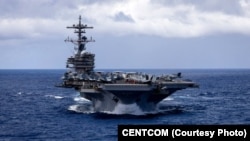
The US military deployed a third aircraft carrier strike group with thousands of elite troops to the region on April 24, marking the largest buildup since the invasion of Iraq in 2003.
In force since April 8, the truce paused a costly war that has rattled international energy markets and upended the global economy. But Washington and Tehran have accused each other of violating the cease-fire and attempts to negotiate an end to the war are deadlocked.
President Donald Trump said the United States has used the cessation of hostilities to "restock" and warned that the American military was "ready to go" if peace efforts fail. Trump has previously threatened to wipe out Iran's civilian infrastructure if a deal is not reached.
Experts say the expanding US military deployment is intended to serve two purposes: Send a political message to Tehran and give Trump options to widen the scale of military action against the Islamic republic.
"It's meant to increase the credibility of US threats, and therefore its leverage in negotiations," said Farzan Sabet, an Iran expert at the Geneva Graduate Institute. "It's also meant to better position the US should it restart hostilities to further weaken Iran and reopen the Strait of Hormuz."
The US-Israeli bombing campaign launched on February 28 has devastated Iran's military, decapitated much of its leadership, and destroyed critical infrastructure. But Tehran still believes it is winning the war. Iran's theocracy has survived and obtained a new and powerful card: control of the Strait of Hormuz, a key artery for global oil and gas supplies.
In response to Iran's effective closure of the Strait of Hormuz, the United States has imposed a naval blockade on the Middle Eastern country's ports and vessels since April 13. While the move has intensified pressure on Iran's already battered economy, the barricade has yet to force Tehran into accepting a peace deal on US terms.
'A Lot Of Concern'
Carrying over 5,000 elite troops, the USS George HW Bush significantly boosts the US military's capabilities in the region. Able to support over 80 aircraft, the carrier is powered by nuclear reactors.
It joins two other carriers: the USS Abraham Lincoln, which has been positioned in the Arabian Sea south of Iran since the start of the war, and the USS Gerald R Ford, the US Navy's most powerful transporter.
Besides sending a third carrier group to the Middle East, the US military has also deployed thousands of additional troops to the region in recent weeks. Thousands more Marines, paratroopers, and sailors are expected to arrive by the end of the month.
Iranian officials have not publicly commented on the expanding US military buildup. But experts say Tehran believes the United States is preparing to resume hostilities.
"The Iranian regime is viewing the continuing US military deployments to the region with a lot of concern," said Farzin Nadimi, an Iran defense expert at the Washington Institute.
"The mere fact that the Iranians agreed to talk with the Americans despite their increasing military posture shows how vulnerable they are feeling right now."
Still, he added, Iran is "continuing to prepare for the next fight, and it will hardly be surprised" if the United States restarts the war.
Tehran, too, has been signaling it could use military action to end the US naval blockade, which has disrupted Iran's vital exports.
The Khatam Al-Anbiya Central Headquarters, which serves as Iran's joint military command, on April 25 warned that it would respond if the United States continued its blockade.
The US Navy has seized an Iranian cargo vessel and a tanker suspected of smuggling Iranian oil in recent weeks. On April 22, Tehran responded by firing on three ships and seizing two of them in the Strait of Hormuz, through which 20 percent of the world's oil usually passes.
Holding Off The Houthis
If hostilities break out again, Yemen's Houthi rebels could attempt to close the Bab al-Mandab Strait, another crucial shipping route in the Middle East.
Accounting for around 6 percent of the world's seaborne-traded oil, Bab al-Mandab is a narrow passage for ships entering or exiting the Red Sea, whose Yemeni coastline is largely controlled by the Houthi rebels, a US-designated terrorist organization and armed group backed by Iran.
In a statement on April 18, the Houthis threatened to close the strait and called on Trump to stop "all peace-obstructing practices and policies."
If the Houthis close the strait, experts say, there will be even more shock waves on global energy markets. The militant group entered the war last month when it fired missiles at Israel.

The deployment of the USS George HW Bush, experts say, is intended to deter the Houthis from closing the strategic waterway.
"With the arrival of a third carrier strike group, the US aims to reassure global shipping while maintaining a two-carrier force ready to engage Iran if needed," said Sascha Bruchmann, a military and security affairs analyst at the London-based International Institute for Strategic Studies.
To bypass the Strait of Hormuz, Saudi Arabia, the world's largest exporter of oil, has been redirecting millions of barrels of oil from the Persian Gulf to the Red Sea via its East-West pipeline.
The United Arab Emirates, another major exporter, has been shipping oil through its Fujairah port located in the Arabian Sea.
"The USS George HW Bush seems postured to make it clear that targeting the oil infrastructure in western Saudi Arabia and the closure of Bab al-Mandab will have consequences," added Bruchmann.

