




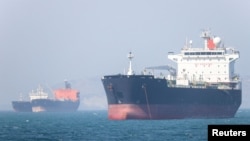
US military forces said they destroyed six Iranian small boats and intercepted Iranian missiles and drones as a new American effort to get commercial shipping traffic flowing through the critical Strait of Hormuz got underway.
Iran, meanwhile, launched at least four missiles across the Persian Gulf at the United Arab Emirates on May 4, prompting an angry response and a threat of retaliation from the Gulf nation. The US ally said three of the missiles were shot down.
With fears that an already shaky US cease-fire was on the verge of outright collapse, US authorities launched an effort to get ships -- including oil tankers -- moving through the Strait of Hormuz again.
More than two months after US and Israeli forces began striking Iran, the strait remains bottlenecked amid Tehran’s threats, which have sent energy prices skyrocketing and rattled the global economy.
Washington has retaliated by imposing a naval blockade on Iranian ports.
Hundreds of ships and thousands of seamen have been stranded in the area since Iran threatened shipping in the wake of the US-Israeli offensive. As of last week, more than 900 commercial vessels were located in the Persian Gulf, according to the maritime intelligence firm AXSMarine.
Over the weekend, US President Donald Trump announced that US warships would help escort ships that have been “locked up” and unable to transit the strait, beginning May 4.
Two US-flagged merchant vessels passed through the strait "as a first step,” US Central Command, which oversees Washington’s forces in the region, said on May 4.
US Admiral Brad Cooper, the head of Central Command, said the Islamic Revolutionary Guard Corps, known as the IRGC, was seeking to "interfere" with Trump's efforts open the waterway.
He declined to comment on whether he thought a cease-fire remained in effect.
"The IRGC has launched multiple cruise missiles, drones, and small boats at ships we are protecting. We have defeated each and every one of those threats through the clinical application of defensive munitions," he said.
Cooper said he "strongly advised" Iranian forces to remain well clear of US forces, which he said involved 15,000 US troops, destroyers, and dozens of aircraft and submarines.
Earlier, Iran claimed its missiles hit a US warship trying to enter the Strait of Hormuz, a claim rejected by US officials.
“No US Navy ships have been struck,” US Central Command, said in a post on X.
In a statement, the Joint Maritime Information Center -- a coalition of nearly four dozen countries that aims to share information about shipping routes in the Middle East -- said that the US had established an “enhanced security area” to the south of usual shipping routes in the strait to support transit.
The IRGC released a new navigational map that outlined a new stretch of water that it said was under Iranian control.
The IRGC, a powerful branch of Iran’s military, also threatened ships that don't comply with the new navigational directives.
Noncompliant ships would face “serious risks,” including being stopped by force, it said.
Cease-Fire. Peace Negotiations.
A cease-fire announced by Trump on April 7 remains in place amid efforts to negotiate a wider peace deal. However, fears remain for a resumption of hostilities, as both sides issue threats.
Iran has targeted US military facilities and US allies around the Gulf region, including the UAE, which Washington considers a key ally.
Of the four missile fired at UAE by Iran on May 4, air defenses intercepted three of the missiles and a fourth crashed into the sea, that country's military said.
UAE has US-made Patriot anti-missile defense systems.
An Iranian drone also hit the UAE port of Fujairah, sparking a fire, and injuring three Indian nationals working there, authorities said.
"These attacks represent a dangerous escalation and are unacceptable, constituting a direct threat to the security, stability, and safety of the state and its territory," the Foreign Ministry said in a statement. The UAE "will not hesitate to protect its security and sovereignty against any threat, and that it reserves its full and legitimate right to respond to these attacks."
Located on the Gulf of Oman, the port has become even more crucial after the effective closure of the Strait of Hormuz.
Among the biggest obstacles in the broader peace negotiations between Washington and Tehran is the fate of Iran’s nuclear ambitions.
Washington wants Tehran to give up its uranium, including its highly enriched uranium, which can be used for building a weapon.
Tehran said on May 3 that it was reviewing the latest US proposal for a peace deal.
Foreign Ministry spokesperson Esmail Baqaei was quoted as saying there were no talks over Iran's nuclear capabilities at this stage.
Speaking on Fox News on May 4, US Treasury Secretary Scott Bessent said the naval blockade was part of a broader economic embargo.
"We are suffocating the regime, and they are not able to pay their soldiers," he claimed. "This is a real economic blockade, and it is in all parts of government."

