



US Intercepts Vessel Linked To Iran's 'Shadow Fleet'
US Central Command (CENTCOM) said it intercepted and sent back to an Iranian port a vessel linked to Iran's so-called "shadow fleet," as the US military continues to enforce a blockade of ships entering or exiting the country's ports.
"Earlier today, Sevan was intercepted in the Arabian Sea by a US Navy helicopter from guided-missile destroyer USS Pinckney...and the merchant vessel is currently complying with US military direction to turn back to Iran under escort," CENTCOM -- responsible for US military operations in the Middle East -- said on April 25.
The M/V Sevan was among 19 shadow fleet vessels sanctioned by the US Treasury a day earlier "for activities related to transporting billions of dollars' worth of Iranian energy, oil and gas products, including propane and butane, to foreign markets," CENTCOM said.
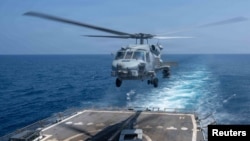
The latest Treasury Department sanctions targeted ships in Iran's shadow fleet, which the US says plays a key role in raising funds from Iranian oil and gas exports.
"US forces continue to enforce US sanctions and fully implement the blockade against ships entering or departing Iranian ports. Thirty-seven vessels have been redirected since the start of the blockade," CENTCOM said.
A "shadow fleet" generally refers to an illegal network of ships operating under false flags to circumvent international sanctions.
US Intercepts Vessel Linked To Iran's 'Shadow Fleet'
US Central Command (CENTCOM) said it intercepted and sent back to an Iranian port a vessel linked to Iran's so-called "shadow fleet," as the US military continues to enforce a blockade of ships entering or exiting the country's ports.
"Earlier today, Sevan was intercepted in the Arabian Sea by a US Navy helicopter from guided-missile destroyer USS Pinckney...and the merchant vessel is currently complying with US military direction to turn back to Iran under escort," CENTCOM -- responsible for US military operations in the Middle East -- said on April 25.
The M/V Sevan was among 19 shadow fleet vessels sanctioned by the US Treasury a day earlier "for activities related to transporting billions of dollars' worth of Iranian energy, oil and gas products, including propane and butane, to foreign markets," CENTCOM said.
The latest Treasury Department sanctions targeted ships in Iran's shadow fleet, which the US says plays a key role in raising funds from Iranian oil and gas exports.
"US forces continue to enforce US sanctions and fully implement the blockade against ships entering or departing Iranian ports. Thirty-seven vessels have been redirected since the start of the blockade," CENTCOM said.
A "shadow fleet" generally refers to an illegal network of ships operating under false flags to circumvent international sanctions.
Israel Blasts Southern Lebanon After Alleged Cease-Fire Violations
A series of Israeli strikes has been reported in at least four locations in the south of Lebanon on April 25 after Israeli Prime Minister Benjamin Netanyahu ordered the military to attack Hezbollah targets following alleged cease-fire breaches.
Iran-allied Hezbollah is a militant group and political party that controls much of southern Lebanon. It is considered a terrorist organization by the United States, while the European Union has blacklisted only its armed wing.
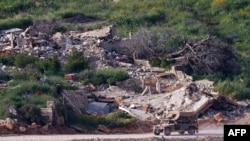
The Lebanese state-run National News Agency reported two strikes in succession in a town in Bint Jbeil district, another on a town in Tyre district, and strikes on two towns in Nabatieh district.
The Israeli military said it had "struck Hezbollah terrorist infrastructure used for military purposes across southern Lebanon" and would "continue to operate decisively against threats."
Hezbollah said it targeted an Israeli army vehicle in southern Lebanon in retaliation for an earlier attack.
US President Donald Trump had on April 23 announced that a 10-day cease-fire that had begun in Lebanon on April 17 had been extended for three weeks.
With reporting by AFP
Iranian Media Say Foreign Minister To Return To Pakistan Before Heading To Russia
Iranian state media are reporting that Foreign Minister Abbas Araqchi is due to make a return visit to mediator Pakistan after completing a trip to Oman and before traveling on to Russia.
Iran's top diplomat -- a member of Tehran's negotiating team in peace talks with the US -- earlier left the Islamabad without any sign of a breakthrough in discussions with Pakistani Prime Minister Shehbaz Sharif and other senior officials.
The IRNA news agency reported that part of Araqchi's delegation had returned to Tehran "to consult and obtain the necessary instructions on issues related to ending the war and is scheduled to rejoin Araqchi in Islamabad on Sunday night [April 26]."
It was not immediately clear when Araqchi would arrive back in the Pakistani capital.
Hours earlier, US President Donald Trump canceled a planned trip to Pakistan by special envoy Steve Witkoff and Jared Kushner for peace talks with Iran.
"Too much time wasted on traveling, too much work! Besides which, there is tremendous infighting and confusion within [the Iranian] 'leadership," Trump said after Iran said its team would not be meeting with US negotiators and instead would pass messages through Pakistan.
Trump Cancels Witkoff, Kushner Trip To Islamabad
A senior US official has confirmed to RFE\RL that a planned trip by special envoy Steve Witkoff and President Donald Trump’s son-in-law, Jared Kushner, to Pakistan for peace talks with Iran has been called off. The comments come after Iran's foreign minister, Abbas Araqchi held what he called a "timely tour" to the Pakistani capital on April 25 to coordinate on "bilateral matters" with Pakistani officials before proceeding to Oman and Russia. Several media outlets have reported that Araqchi and his delegation have left Islamabad. Iran has conditioned its return to the negotiating table on the lifting of a US naval blockade of its ports, a demand Trump has so far rejected. Tehran has also dismissed Trump's unilateral extension of the cease-fire as "meaningless" so long as the blockade remains in effect.
Further developments here.
Macron Continues To Push Goal Of Reopening Strait Of Hormuz

French President Emmanuel Macron has reiterated that his focus is on efforts to reopen the Strait of Hormuz.
Speaking at a news conference in Athens alongside Greek Prime Minister Kyriakos Mitsotakis, Macron said that panic caused by geopolitical uncertainties could itself lead to shortages.
"Our goal is to achieve a full reopening in the coming days and weeks, in accordance with international law, so that freedom of navigation is guaranteed without tolls in the Strait of Hormuz. Then the situation can gradually return to normal," Macron said.
This strategic waterway has been effectively closed since the start of the US-Israeli war with Iran. About a fifth of the world's oil and gas passes through the Strait of Hormuz.
More than a dozen countries have said they are ready to join an international mission, led by France and Britain, to protect shipping in the strait if conditions allow, even though US President Donald Trump has said he does not need help from allies.
"We are all in the same boat, and I must say it is not a boat that we chose. We are victims of geopolitics and we are victims of this war that started a few months ago," the French president said.
A day earlier, the CEO of the French oil company TotalEnergies also emphasized the importance of the Strait of Hormuz.
"If this situation continues for another two or three months, we will enter a world of energy shortages, something that Asian countries have already experienced. You cannot stop 20 percent of the world's oil and gas and make it inaccessible without major consequences," Patrick Pouyanné told a global policy conference in Chantilly, outside Paris.
Iranian Foreign Minister Meets Pakistani Army Chief
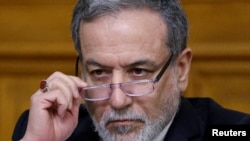
Abbas Araqchi met with Pakistani Army chief Field Marshal Asim Munir and separately with Prime Minister Shehbaz Sharif, though no details of the latter meeting have emerged.
In his talks with Munir, Araqchi conveyed Iran's "views and considerations for ending the war" as well as its reservations about US demands, according to Reuters, which cited an unnamed Pakistani source involved in the talks.
More from our news desk.
Tehran's Imam Khomeini Airport Resumes International Flights
The Imam Khomeini International Airport in Tehran resumed international passenger flights on April 25, with several departures operating, according to Iranian state media.
Iranian airports had been largely closed since late February due to the war with Israel and the United States. Limited domestic and some regional operations began resuming in mid-April.
Iranian media reported initial flights from Tehran to Medina, Istanbul, and Muscat, operated by domestic airlines.
A departure board at the airport also showed a flight to Muscat.
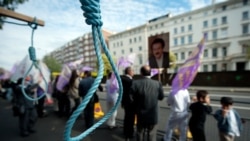
Iran Executes Another Protester
Erfan Kiani, who was reportedly arrested during the nationwide anti-government protests in January in the central city of Isfahan, was executed on April 25, according to Mizan, the news agency affiliated with Iran's judiciary.
Mizan reported that the protester, whose age was not reported, was executed after the Supreme Court upheld the verdict. Authorities accused Kiani of leading a group that attempted to destroy public property at the city's Piroozi intersection on the evening of January 8.
The charges against him included "destroying public and private property, setting fires, carrying and using Molotov cocktails, carrying weapons, blocking the path of vehicles, attacking officers, and creating fear and panic among citizens."
No details about the trial proceedings, evidence presented, or access to a lawyer have been made public. There had been no prior independent reporting on Erfan Kiani before the execution announcement. RFE/RL is unable to independently verify the full details of the case.
Mass protests in Iran in January were brutally suppressed by security forces. The US-based human rights monitoring group HRANA verified thousands of deaths during the crackdown, with figures for confirmed protester deaths reaching over 6,000. Many more arrests occurred across the country.
Since the protests, Iran has carried out multiple executions of individuals arrested in connection with the unrest, with a noticeable surge in recent weeks. Rights groups have warned of an alarming increase in executions overall -- with Iran already recording one of the world's highest rates -- and have expressed concern that the authorities are using the death penalty to instill fear and suppress dissent following the protests.
We are now closing the live blog for the day. We'll be back at 7:30 a.m. Central European time to cover the latest events across the Middle East.
US Treasury Chief Says No Plans To Renew Waiver On Iran Petroleum Purchases
US Treasury Secretary Scott Bessent confirmed to The Associated Press that Washington does not plan to renew a waiver allowing the purchase of Iranian oil and petroleum products that are currently at sea after an initial waiver expired five days ago.
“Not the Iranians,” Bessent said in comments to AP on April 24. “We have the blockade, and there’s no oil coming out.”
“And we think in the next two, three days, they’re going to have to start shuttering production, which will be very bad for their wells,” he told the news agency.
There had been some speculation that the waiver on Iranian products could be extended after the US renewed a similar waiver on Russian petroleum products already at sea. That renewal came two days after Bessent said the administration had no plans to do so.

In his April 24 comments, Bessent also told AP that the waiver on Russian sales and purchases would not be renewed again.
The original waiver for Russian products was announced in March as part of efforts to stabilize global energy markets thrown into disarray with the US-Israeli air strikes on Iran and Tehran's retaliatory attacks on Gulf Arab states.
Oil prices surged further after Iran blocked the Strait of Hormuz, the waterway that carried some 20 percent of the world's oil and natural gas supplies before the war.