



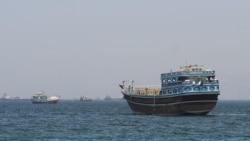
Bessent Urges China To Persuade Iran To Open Strait Of Hormuz
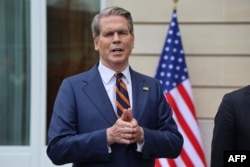
US Treasury Secretary Scott Bessent has urged China to contribute to diplomatic efforts to convince Iran to open the Strait of Hormuz, as President Donald Trump and his Chinese counterpart, Xi Jinping, are scheduled to meet next week.
"China, let's see them step up with some diplomacy and get the Iranians to open the strait," Bessent said in an interview with Fox News on May 4, adding that Beijing was purchasing as much as 90 percent of Tehran's energy resources. "They are funding the largest state sponsor of terrorism."
A day earlier, Trump announced that US forces will begin guiding stranded "neutral" ships out of restricted waters near the Strait of Hormuz. Iran reacted, warning that maritime activity in the waterway must comply with Tehran's naval protocols or face enforcement action.
In the interview, Bessent said that Trump and Xi have been discussing the situation in Iran and plan to talk about it in person at their upcoming summit in Beijing on May 14–15.
War Pushes Iran's Economy Even Further Toward The Brink
- By Kian Sharifi

For years, Iran's economy has struggled as international sanctions and administrative mismanagement took their toll. Since US and Israeli air strikes hit the country on February 28, the situation has grown markedly worse.
Already decrepit infrastructure has been targeted in the strikes, knocking out factories, steel mills, bridges, and ports. Even worse, oil and gas facilities have been struck, while a US blockade on all traffic calling at Iranian ports still functioning has all but cut off Tehran's main lifeline: oil money.
With the currency at historic lows against the dollar and an Internet shutdown crippling businesses, analysts say Iran's economy is now in uncharted territory.
"So, unless the regime seeks concessions from the US to lift the blockade, the economy will have to remain extremely depressed," said Jason Tuvey, deputy chief Emerging Markets economist at the London-based Capital Economics.
Read more here
UAE Reports Fresh Iranian Attacks
Authorities in the United Arab Emirates' major port city of Fujairah reported a drone strike that targeted an energy installation and caused a fire.
"Fujairah Civil Defense teams immediately responded to the incident and are continuing their efforts to control it," the Fujairah media office said in a statement on May 4, following multiple air alerts.
Fujairah, on the shore of the Arabian Sea, has been a key exporting hub of the UAE.
The port facility there has become even more crucial after the effective closure of the Strait of Hormuz, as it has allowed the UAE to access global shipping without using the waterway.
Minutes later, the UAE's Defense Ministry said Iran had targeted the country with four cruise missiles.
"Three were successfully engaged over the country's territorial waters, while one fell in the sea," it said.
With reporting by Reuters
Bessent Urges China To Persuade Iran To Open Strait Of Hormuz
US Treasury Secretary Scott Bessent has urged China to contribute to diplomatic efforts to convince Iran to open the Strait of Hormuz, as President Donald Trump and his Chinese counterpart, Xi Jinping, are scheduled to meet next week.
"China, let's see them step up with some diplomacy and get the Iranians to open the strait," Bessent said in an interview with Fox News on May 4, adding that Beijing was purchasing as much as 90 percent of Tehran's energy resources. "They are funding the largest state sponsor of terrorism."
A day earlier, Trump announced that US forces will begin guiding stranded "neutral" ships out of restricted waters near the Strait of Hormuz. Iran reacted, warning that maritime activity in the waterway must comply with Tehran's naval protocols or face enforcement action.
In the interview, Bessent said that Trump and Xi have been discussing the situation in Iran and plan to talk about it in person at their upcoming summit in Beijing on May 14–15.
CENTCOM Says 2 US-Flagged Vessels Transited The Hormuz Strait
US Central Command, which oversees American forces in the Middle East, says two US-flagged vessels have "successfully transited through the Strait of Hormuz and are safely headed on their journey."
Situation In Hormuz Still 'Critical' Says Shipping Security Monitor
The United Kingdom Maritime Trade Operations (UKMTO) shipping security monitor has issued a Joint Maritime Information Center advisory saying conditions for transiting the Strait of Hormuz remain “critical” amid ongoing regional military operations, with increased naval presence, congestion, and vessels likely to be hailed over VHF radio by security forces in the region.
The United States has established an enhanced security area south of the main shipping lanes, it said, advising ships to consider routing via Omani waters and coordinate with authorities.
Transit near the traffic separation scheme is “extremely hazardous” due to reported mines, and operators should review risks and routing carefully, according to the May 4 notice.
Earlier, the UKMTO said that an oil tanker had been targeted by "projectiles of unknown origin" 78 nautical miles north of Fujairah in the United Arab Emirates.
The alert said that all crew members on board were safe and there had been no environmental contamination.
The UAE later condemned "in the strongest terms" what it said was the targeting of a national tanker affiliated with its state oil company while passing through the Strait of Hormuz.
US Denies Ship Hit By Iranian Missiles
Iranian media said a US Navy frigate was targeted by two missiles near Jask at the entrance to the Strait of Hormuz after allegedly ignoring Iranian warnings, forcing it to turn back.
The claim, reported by the semiofficial Fars agency without citing a source, was subsequently denied by US Central Command
Amid the conflicting accounts, Iran’s navy said it had blocked “enemy” vessels from entering the strait with a “swift and decisive warning,” while US President Donald Trump has said Washington would act to free ships stranded in the vital waterway, a key route for global energy supplies.
Iran Outlines New 'Control Area' In Strait of Hormuz
Iran’s Islamic Revolutionary Guards Corps (IRGC) has warned that maritime activity in the Strait of Hormuz must comply with its naval protocols or face enforcement action.
The warning follows recent US statements -- including President Donald Trump’s plan to deploy naval forces to escort or “guide” commercial ships through the strait -- and advisories from the UK Maritime Trade Operations, a shipping security monitor, about security incidents and new restrictions affecting shipping in the area.
Responding to what it called “baseless” claims, the IRGC said there has been no change in how the strait is managed, the semiofficial ISNA news agency reported.
It added that civilian and commercial vessels following designated transit routes in coordination with its navy would remain safe, while any noncompliant movements would face “serious risks,” including being stopped by force.
In a separate statement, the IRGC outlined what it described as a new area of the strait under Iranian control, defined by two boundary lines: from Kuh-e Mobarak, on Iran’s southeastern coast near the Gulf of Oman, to waters south of Fujairah on the United Arab Emirates’ eastern coast, and from the western tip of Qeshm Island to Umm Al Quwain on the UAE’s northern Gulf coast.
Tehran Calls On US To Move Away From 'Excessive Demands'
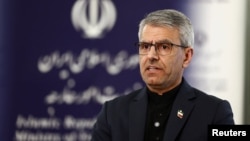
Iranian Foreign Ministry spokesman Esmail Baqaei has called on the United States to back away from its "excessive demands" to allow peace negotiations between the two countries to move forward.
"At this stage, our priority is to end the war," Baqaei told a briefing on May 4 that was broadcast by state television.
"The other side must commit to a reasonable approach and abandon its excessive demands regarding Iran," Baqaei said.
He gave no details about which demands Tehran feels are excessive.
A day earlier, Iran said it had received a response from Washington to its latest peace proposal, which Iran had earlier handed to Pakistan. Islamabad has been mediating talks between the two warring countries.
US President Donald Trump said he would probably reject the Iranian proposal because "they have not paid a big enough price."
He did not elaborate.
We are now closing the live blog for the day. We'll be back at 7:30 a.m. Central European time to cover the latest events across the Middle East.
Trump Says US To 'Guide' Stranded Neutral Ships Out Of Hormuz Starting May 4
President Donald Trump said US forces will on May 4 begin guiding stranded “neutral” ships out of restricted waters near the Strait of Hormuz, even as he asserted that Washington was having “positive discussions” with Iran about ending war in the Middle East.
Calling the effort a “humanitarian” gesture, Trump on May 3 said the US “for the good of Iran, the Middle East, and the United States,’ has told neutral countries that “we will guide their Ships safely out of these restricted Waterways, so that they can freely and ably get on with their business.”
In the Truth Social posting, Trump warned that action would be taken should Iran attempt to interfere with the US mission, potentially reigniting hostilities with Tehran that currently are paused through a cease-fire.
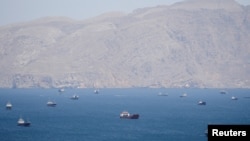
"If, in any way, this Humanitarian process is interfered with, that interference will, unfortunately, have to be dealt with forcefully," Trump said.
A senior Iranian official warned that Tehran would consider any attempt by the US to operate in the strait a breach of the cease-fire.
"Any American interference in the new maritime regime of the Strait of Hormuz will be considered a violation of the cease-fire," Ebrahim Azizi, head of the Iranian parliament's national security commission, posted on X.
The US Central Command (CENTCOM) released a statement saying that the mission "will include guided-missile destroyers, over 100 land and sea-based aircraft, multi-domain unmanned platforms, and 15,000 service members."
The statement did not specify how the assets would be utilized. A reporter for Axios, citing two US officials, said Navy ships would not escort commercial vessels but rather would be "in the vicinity" should they be needed to prevent attacks.
The US president said the action was being taken at the request of countries whose ships are stuck in the waterway as Iran has prevented most traffic through the strait in retaliation for the US-Israeli air strikes that started on February 28. The US is also conducting a blockade to prevent ships from leaving or entering Iranian ports.
“Countries from all over the World, almost all of which are not involved in the Middle Eastern dispute going on so visibly, and violently, for all to see, have asked the United States if we could help free up their Ships, which are locked up in the Strait of Hormuz,” he said.
Trump added that he has told his representatives to inform the countries "that we will use best efforts to get their ships and crews safely out of the blocked Strait of Hormuz."
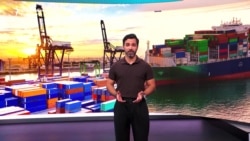

"The Ship movement is merely meant to free up people, companies, and Countries that have done absolutely nothing wrong — They are victims of circumstance.”
"Many of these Ships are running low on food, and everything else necessary for largescale crews to stay on board in a healthy and sanitary manner,” Trump added.
Peace talks between the United States and Iran – mediated by Pakistan – have faltered since a first round of discussions in Islamabad on April 11-12.
On May 3, Iranian officials said they were studying Trump’s response to Tehran's latest 14-point peace proposal handed to the US through Pakistan.
Trump on May 2 said he was preparing to review Tehran’s proposal but said he could not imagine it would be acceptable.