



Pakistan Army Chief Munir Heads To Iran Amid Peace Push
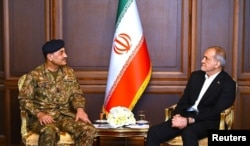
Pakistan's powerful army chief is set to visit Tehran on May 21 to discuss a framework for the revival of stalled negotiations between Iran and the United States, according to Iran's semiofficial ISNA news agency.
The report said Field Marshall Asim Munir's visit was part of ongoing discussions and consultations with Iranian officials, as part of Islamabad's mediation efforts between Tehran and Washington.
Pakistani Interior Minister Mohsin Naqvi is already in Tehran holding meetings with Iranian officials.
Naqvi, described as another key figure in Pakistan's mediation efforts, returned to Tehran on May 20, less than 30 hours after arriving back from an earlier visit.
Pakistan has hosted the only formal round of Iran-US talks since US and Israeli air strikes on February 28 and has since served as a key communication channel between the two sides.
If confirmed, this would be Munir's second visit to Tehran since April. He previously traveled to the Iranian capital with senior civilian officials on April 15.
Pakistan Army Chief Munir Heads To Iran Amid Peace Push
Pakistan's powerful army chief is set to visit Tehran on May 21 to discuss a framework for the revival of stalled negotiations between Iran and the United States, according to Iran's semiofficial ISNA news agency.
The report said Field Marshall Asim Munir's visit was part of ongoing discussions and consultations with Iranian officials, as part of Islamabad's mediation efforts between Tehran and Washington.
Pakistani Interior Minister Mohsin Naqvi is already in Tehran holding meetings with Iranian officials.
Naqvi, described as another key figure in Pakistan's mediation efforts, returned to Tehran on May 20, less than 30 hours after arriving back from an earlier visit.
Pakistan has hosted the only formal round of Iran-US talks since US and Israeli air strikes on February 28 and has since served as a key communication channel between the two sides.
If confirmed, this would be Munir's second visit to Tehran since April. He previously traveled to the Iranian capital with senior civilian officials on April 15.
20 Sailors From Seized Iranian Ship Return To Country
Tehran's ambassador to Pakistan announced the release and return to Iran of 20 Iranian sailors from a ship seized by the United States.
The Iranian ambassador to Pakistan announced on May 21 that the 20 Iranian sailors were released with the mediation and follow-up of Pakistan and returned to the country.
According to a previous announcement by the Pakistani foreign minister, 11 sailors on the ship -- which is currently being held in Singaporean waters -- are Pakistani nationals.
After US-Iran was cease-fire announced on April 8, the US military launched a naval blockade of Iran's southern ports, while the Strait of Hormuz is being blocked by Iran's Islamic Revolutionary Guards Corps.
Iran's Ongoing Internet Blackout Reaches 83 Days
The Internet blackout in Iran entered its 83rd day on May 21, with international networks largely barred for over 1,968 hours, according to the global independent Web monitor NetBlocks.
"A free and open internet is central to the protection of life, liberty and public accountability," NetBlocks said in a post on X on May 21.
The Islamic republic imposed the latest Internet shutdown on February 28 amid US and Israeli attacks on the country.
Although Washington and Tehran reached a fragile cease-fire on April 8, Internet access has still not been fully restored, leaving citizens in digital darkness for more than two months. Only those who can afford expensive anti-filtering tools -- along with individuals granted state-approved access -- are able to get online.
The Committee to Protect Journalists (CPJ) and Reporters Without Borders issued a joint statement on May 21 saying they are "deeply alarmed" by the ongoing blackout, CPJ, warning that Iran is using it to mask a broader crackdown on the press.
"What began as an effort to control information has become a sustained assault on press freedom and a daily struggle for local reporters trying to operate inside the country," the statement said.
CPJ Regional Director Sara Qudah said that "the Iranian government has created a terrifying operational vacuum where the press has been stripped of its most basic defense: public awareness."
"We are watching a deliberate attempt to make the harassment, threats, and arbitrary arrests of local journalists entirely invisible to the world -- and in doing so, they are denying the public their fundamental right to be informed," she said.

Iran Executes 2 More Prisoners
Iran's judiciary announced that it executed two men on May 21 as part of an intensified campaign of political hangings amid the ongoing conflict with the United States and Israel.
According to the Tasnim news agency, which is affiliated with the Islamic Revolutionary Guards Corps (IRGC), the men were accused of forming a group intended to disrupt country's security and of membership in what authorities described as a "separatist terrorist" organization.
Tasnim identified them as Ramin Zaleh and Karim Maroufpour.
Iran's judiciary claimed the two men confessed to collaborating in a plot to assassinate an IRGC commander in western Iran and storing weapons for the attack.
The circumstances surrounding the alleged confessions remain unclear.

Rights organizations have condemned such trials of those executed. The Oslo-based Center for Human Rights in Iran (CHRI) has said many of the trials have been marked by "torture, forced confessions, and the complete absence of due process."
The executions come amid a broader surge in hangings that has escalated since March 18, weeks after the start of the war with the United States and Israel.
Norway-based Iran Human Rights and Paris-based Together Against the Death Penalty reported that at least 1,639 people have been executed in Iran in 2025, including 48 women, marking one of the highest execution rates in the world.
FIFA's Reported Ban On Iran's Pre-1979 Flag At World Cup Stirs Controversy
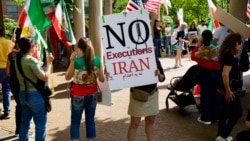
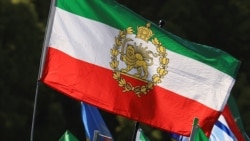
Iranian monarchist groups are voicing anger over reports that FIFA intends to ban the so-called Lion and Sun flag, often carried as a symbol of resistance to the theocratic rule that took over the country in 1979.
Called a "political" symbol by the soccer association and thus not officially allowed at matches, the Lion and Sun is still likely to be flown at World Cup matches, its defiant proponents say.


Trumps Says War Could Escalate If Tehran Doesn't Have 'Right Answers'
US President Donald Trump said on May 20 that he is willing to wait "a few days" for Iran's response to Washington's latest proposal aimed at ending the war, but warned the situation could escalate quickly if Tehran fails to provide "the right answers."
Speaking to reporters after addressing a graduating class of military cadets in New London, Connecticut, Trump said: "Believe me, if we don't get the right answers, it goes very quickly. We're all ready to go."
Asked how long he was prepared to wait, Trump replied: "It could be a few days, but it could go very quickly."
Earlier in the day, during his commencement address at the US Coast Guard Academy, Trump said the United States might carry out additional strikes against Iran if negotiations fail.
"We hit them very hard. We may have to hit them even harder -- but maybe not," he said, before reiterating his administration's stance on Iran's nuclear program. "We will not let Iran have a nuclear weapon. It's very simple."
The comments came shortly after Iran's Foreign Ministry said Tehran was reviewing a new US proposal reportedly delivered through Pakistani intermediaries during a visit to Tehran by Pakistan's interior minister.
Iran's Islamic Revolutionary Guards Corps later warned that any renewed US attacks could expand the conflict "beyond the region."
We are now closing the live blog for the day. We'll be back at 7:30 a.m. Central European time to cover the latest events across the Middle East.
Iran Says Pakistani Minister's Visit Aimed At Facilitating Communication With US
Iran's Foreign Ministry said on May 20 that Pakistani Interior Minister Mohsin Naqvi had returned to Tehran to facilitate the exchange of messages between Iran and the United States.
Ministry spokesman Esmail Baqaei told Iranian state television that message exchanges between the two sides were continuing "on the basis of Iran's 14-point text" and outlined Tehran's core demands as including an end to the war "on all fronts, including Lebanon," the release of Iran's frozen assets, and a halt to what he called "disruptive measures" against Iranian shipping.
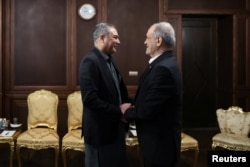
Naqvi, who visited Tehran on May 16 and met with senior Iranian officials, returned to the city just four days later.
Tasnim News Agency, which is affiliated with the Islamic Revolutionary Guards Corps (IRGC), quoted a source "close to Iran's negotiating team" as saying that the United States had sent its own text to Tehran via the Pakistani intermediary following receipt of Iran's 14-point proposal three days ago.
Iran is currently reviewing the American text and has not yet responded, the source said.
Pakistan has hosted the only formal round of Iran-US peace talks held so far and has since served as the primary channel for communications between the two sides.
CENTCOM Says US Marines Board Iranian Tanker
The US Central Command (CENTCOM) announced that US military forces boarded the Iranian-flagged commercial tanker M/T Celestial Sea in the Sea of Oman on May 20.
CENTCOM, in a post on X that included video footage of US Marines entering the tanker, said the vessel was suspected of intending to head to an Iranian port and violate the US naval blockade.
"U.S. Marines from the 31st Marine Expeditionary Unit boarded M/T Celestial Sea, an Iranian-flagged commercial oil tanker suspected of attempting to violate the U.S. blockade by transiting toward an Iranian port," CENTCOM reported.
The statement continued that US forces "released the vessel after searching and directing the ship’s crew to alter course."
"U.S. forces continue to fully enforce the blockade and have now redirected 91 commercial ships to ensure compliance.," said CENTCOM, which oversees and commands US military operations in the Middle East.
The naval blockade of Iran, ordered by US President Donald Trump, began a few days after the cease-fire was established and is still ongoing.
42 US Aircraft Lost Or Damaged In Iran War, Congressional Report Reveals
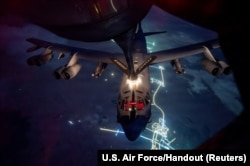
A Congressional Research Service report released on May 13 provides the first official US government accounting of aircraft losses during Operation Epic Fury, documenting 42 airframes lost or damaged since the US-Israeli war with Iran began on February 28.
The figures were compiled from Department of Defense statements, US Central Command (CENTCOM) releases, and publicly available reporting, and may be subject to revision as investigations continue.
The list includes four F-15Es, one F-35A, one A-10, seven KC-135 tankers, one E-3 AWACS, two MC-130Js, one HH-60W, 24 MQ-9 Reapers, and one MQ-4C Triton. The losses occurred through a mix of enemy action, friendly fire, and accidents -- among them three F-15Es lost on March 2 in friendly fire incidents over Kuwait and five KC-135s destroyed on the ground in an Iranian missile strike on a US airbase.
During a search-and-rescue operation for a downed F-15E on April 5, two MC-130Js were intentionally destroyed on the ground in Iran after becoming unable to depart; all aircrew were safely evacuated. One HH-60W also sustained damage from small-arms fire during the same operation.
The Department of Defense estimated the cost of aircraft losses at $2.6 billion, though acting Pentagon comptroller Jules W. Hurst declined to confirm replacement costs at the May 13 Senate hearing. The broader cost of operations, he said, has reached $29 billion, a figure that US media contend is still lower than outside projections.