



Iranian, Pakistan Ministers Meet In Tehran Over Peace Proposals

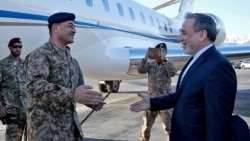
Iranian Foreign Minister Abbas Araqchi has met Pakistani Interior Minister Mohsin Naqvi in Tehran to discuss proposals aimed at ending the US-Israeli war with Iran, according to Iranian media reports.
The talks on May 22 came two days after Naqvi delivered Washington’s latest message to Tehran as efforts continued to bridge differences over Iran’s uranium stockpile and controls on the Strait of Hormuz.
Iran’s semiofficial ISNA news agency said Naqvi was helping facilitate communication to establish a framework for ending the conflict.
US Secretary of State Marco Rubio said on May 21 that there had been “some good signs” in negotiations, though he warned no agreement was possible if Tehran imposed a tolling system in the Strait of Hormuz.
A senior Iranian source told Reuters that gaps had narrowed between the two sides, but the key sticking points were still uranium enrichment and the strait, which accounted for some 20 percent of global oil and gas supplies before the war,
The conflict has disrupted global markets, driving oil prices higher and fueling inflation concerns.
With reporting by Reuters
Reports: Pakistan Army Chief Leaves For Tehran
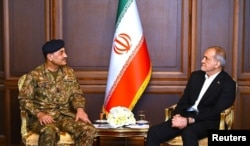
Pakistan’s powerful army chief, Asim Munir, is traveling to Tehran amid renewed peace efforts, according to media reports in Pakistan and Iran.
Munir’s visit comes as US officials voiced hope of progress on ending the 11-week war with Iran, with Washington looking to Pakistani mediators to help advance efforts to strike a deal.
The Iranian state-run IRNA news agency and Pakistan's Dawn newspaper both reported that Munir was heading to the Iranian capital on May 22 and is expected to hold talks with senior Iranian officials.
The trip is Munir’s second to Tehran since a cease-fire between the United States and Iran went into effect on April 8.
Pakistan’s Interior Minister Mohsin Naqvi has been in Tehran since May 20.
Munir’s trip has raised hopes that the United States and Iran are close to agreeing a draft peace agreement.
EU Says Hormuz Strait Closure Against International Law
Calling Iran’s actions against vessels transiting through the Strait of Hormuz a violation of international law, the Council of the European Union has decided to impose restrictions on individuals and entities involved in these “actions and policies” by the Iranian authorities.
“Such actions infringe upon established rights of both transit and innocent passage through international straits,” the council said in a press release on May 22.
In an X post on the same day, the EU Council said that from now on the bloc "will be able to sanction individuals and entities threatening freedom of navigation in the Middle East.”
Individuals and entities in violation of the freshly adopted measures will face travel restrictions as well as asset freezes in EU territory, according to the press release.
Since the start of the US-Israeli war against Iran on February 28, Tehran has practically closed the Strait of Hormuz, a key maritime chokepoint, causing a surge in oil prices across the world.
Senior UAE Official Warns Control Over Hormuz Would Set Dangerous Precedent, Sees '50-50' Chance Of US-Iran Deal
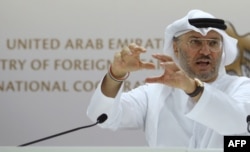
Anwar Gargash, diplomatic adviser to the president of the United Arab Emirates, said any change in the status of the Strait of Hormuz would have serious consequences for the region and even Europe, warning that any form of control over the strategic waterway would create a dangerous precedent.
Speaking on May 22 at the annual GLOBSEC security conference in Prague, Gargash also urged Europeans on behalf of Abu Dhabi to view the issue not as a distant problem but as one directly tied to their own energy supplies and trade.
He said the chances of the United States and Iran reaching an agreement that would lead to the reopening of the Strait of Hormuz were “50-50,” adding that Iranian authorities "had missed a lot of chances over the years because there's a tendency to overestimate their cards."
"I hope they don't do that this time," he added.
Gargash also stressed that any control over the Strait of Hormuz would set a perilous precedent and claimed the issue would become politicized in Iran’s hands.
Asked about the possibility of another round of war between the United States and Iran, the UAE adviser said it would make the situation even more complicated.
At the same time, he stressed that any political solution must address the root causes of the crisis and be designed in a way that avoids creating new complications in the future.
"Negotiations just to reach a cease-fire and sow the seeds for further conflict in the future is not what we're seeking," he said. "And I think that the Strait of Hormuz clearly has to go back to the status quo and this should be an international waterway."
Speaking about Tehran’s nuclear program, Gargash said the Islamic republic’s nuclear activities had previously been the UAE’s "second or third worry," but that now "it's our first worry. "
"We see that Iran is capable of using any weapon that it has in its hands, which is what we learned," he added.
The remarks came a day after a newly established Iranian government body published a map asserting control over the Strait of Hormuz that also included what the UAE described as its territorial waters, prompting a sharp reaction from Abu Dhabi.
Gargash wrote on X late on May 21 that Tehran was “trying to impose a new reality born from a clear military defeat. But attempts to control the Strait of Hormuz or violate the UAE’s maritime sovereignty are nothing more than pipe dreams."
With reporting by RFE/RL's Radio Farda and AFP
Iran War Disrupts World Wrestling Championships In Bahrain
United World Wrestling, the Switzerland-based governing body for the sport, says that the world championships scheduled to be held in Bahrain this year have been postponed indefinitely.
In a joint statement issued with the Bahrain Olympic Committee and the country’s wrestling federation on May 22, it said the 2026 World Wrestling Championships, which had been scheduled for October 24-November 1 were postponed because of the Iran war, which has directly affected countries along the Persian Gulf.
The statement referred to the “the current geopolitical situation in the region” and the “uncertainty” surrounding the future of the conflict as well as its "broader impact on regional stability and international travel"
It added that the decision had been announced early in the hope of allowing enough time to select an alternative host for this year’s championships.
Bahrain is among the countries that have been directly targeted by missile and drone attacks by Iran’s Islamic Revolutionary Guards Corps since the start of the US-Israeli war against the Islamic republic.
The country hosts one of the largest US military bases in the region.
Iran Talks See 'Slight Progress,' Says Rubio, Warns Against Toll For Hormuz Strait
US Secretary of State Marco Rubio said there has been "slight progress" in Pakistan-mediated talks to end the Iran war, while warning against what he described as Tehran's attempt to establish a tolling system in the Strait of Hormuz, which he said no country should accept.
Speaking to reporters on May 22 in Helsingborg, Sweden, where he is attending the second day of a NATO foreign ministers' meeting, Rubio said discussions mediated by Pakistan had shown limited but positive movement
"There has been some slight progress," he said. "I don't want to exaggerate it, but there's been a little bit of movement, and that's good."
Rubio also criticized Iran's reported move to introduce a tolling system for the strategically vital Strait of Hormuz.
"Iran is trying to create a tolling system. They're trying to convince Oman, by the way, to join them in this tolling system in an international waterway," he said. "There is not a country in the world that should accept that."
Iranian State Media's Foster Child Story Lands Editor In Court -- Over A Head Scarf
A state-approved photo story intended to celebrate motherhood and volunteerism became a political controversy in Iran because the images used showed a woman unveiled at home. The photos were deleted within hours, and the news agency’s boss was later summoned by the authorities.
Read Kian Sharifi's story here
Dozens Of Iran-Linked Tankers In US Naval Blockade Area, Says Shipping Tracker
TankerTrackers, a firm that monitors global oil shipments using satellite data, says that the United States Navy has halted a large number of vessels under US sanctions off the eastern coast of Oman
In the latest instance, it said the Levine tanker, which is typically used to transport Iranian oil, "was pursued by a US Navy vessel after being redirected back into the Arabian Sea."
The tanker, which was carrying no cargo at the time, was placed under US sanctions in February 2026 as part of Iran’s “shadow fleet” used to circumvent restrictions.
According to TankerTrackers, despite increased US monitoring, a number of Iran-linked tankers that have not yet been sanctioned by the US Treasury Department have entered the area of the American naval blockade against Iran. The company said the number of such vessels stood at 49.
In recent weeks, the United States has intensified pressure on Iran’s oil shipping network through a naval blockade. At the same time, the Strait of Hormuz has remained nearly closed by the Iranian government, contributing to turmoil in global energy markets.
Some media reports also indicate that, amid tightening restrictions, Iran has been storing part of its oil on aging tankers and attempting to continue exports through indirect routes or by disabling tracking systems.
Iranian, Pakistan Ministers Meet In Tehran Over Peace Proposals
Iranian Foreign Minister Abbas Araqchi has met Pakistani Interior Minister Mohsin Naqvi in Tehran to discuss proposals aimed at ending the US-Israeli war with Iran, according to Iranian media reports.
The talks on May 22 came two days after Naqvi delivered Washington’s latest message to Tehran as efforts continued to bridge differences over Iran’s uranium stockpile and controls on the Strait of Hormuz.
Iran’s semiofficial ISNA news agency said Naqvi was helping facilitate communication to establish a framework for ending the conflict.
US Secretary of State Marco Rubio said on May 21 that there had been “some good signs” in negotiations, though he warned no agreement was possible if Tehran imposed a tolling system in the Strait of Hormuz.
A senior Iranian source told Reuters that gaps had narrowed between the two sides, but the key sticking points were still uranium enrichment and the strait, which accounted for some 20 percent of global oil and gas supplies before the war,
The conflict has disrupted global markets, driving oil prices higher and fueling inflation concerns.
With reporting by Reuters
We are now closing the live blog for the day. We'll be back at 9:30 a.m. Central European time to cover the latest events across the Middle East.
US House Republicans Postpone War Powers Vote Likely To Go Against Trump
Republican leaders of the US House of Representatives suddenly canceled a May 21 vote on a resolution aimed at forcing President Donald Trump to obtain authorization from Congress to continue the Iran war.
The unexpected move came two days after a similar measure passed through the US Senate.
The vote had been scheduled to take place just before lawmakers left Washington for their Memorial Day recess.
The House had blocked three previous war powers resolutions, with near-unanimous support from Republicans.
But margins had become increasingly narrow, with the most-recent resolution failing in a tie vote. The May 21 appeared likely to pass as more Republicans were expected to vote with Democrats.
If the resolution passes both houses of Congress, Trump would still have the ability to veto to action.