





Kuwait Says Drones From Iraq Hit Northern Border Posts
Kuwait’s military said on April 24 that two explosive-laden drones arriving from the direction of Iraq struck two northern border posts, causing "material damage" but no casualties.
In a statement on X, the military described the incident as a “criminal act of aggression” and said the drones were guided by fiber-optic cables.
Since the US-Israeli war with Iran began on February 28, pro-Iranian armed groups have claimed repeated attacks on "enemy" targets in Iraq and elsewhere, though they later said operations were suspended after a cease-fire.
Persian Gulf states have nevertheless protested continued cross-border attacks.
With reporting by AFP
Mojtaba Khamenei Awaiting Prosthetic Leg And Plastic Surgery, Says NYT Report
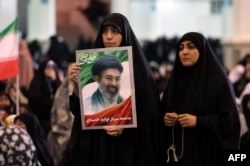
Iranian Supreme Leader Mojtaba Khamenei is facing serious medical complications after surviving an attack, leaving him awaiting a prosthetic leg and plastic surgery on his face, The New York Times reported on April 23.
Citing four officials familiar with the matter, the newspaper said he remains mentally able to make decisions but has undergone hand surgery and suffered severe facial burns.
The report said Khamenei has had limited contact with Iranian generals during negotiations to end the war, reinforcing earlier US comments that he was “wounded” and likely “disfigured.”
Analysts told the Times that Khamenei -- who succeeded his father, Ali Khamenei, after the ayatollah died in the same air strike that injured his son on February 28 -- is formally leader but not yet fully in control.
“Mojtaba is not yet in full command or control,” said Sanam Vakil, the director of the Middle East and North Africa program at Chatham House.
The Times report said day-to-day authority has shifted toward senior officials and the Revolutionary Guards while Khamenei avoids public appearances.
Is The US Naval Blockade On Iran Working? Yes And No.
- By Frud Bezhan
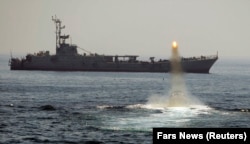
To pressure Iran into a peace deal, the United States has imposed a naval blockade on the Middle Eastern country’s ports and vessels since April 13.
While it has intensified pressure on Iran’s already battered economy, the US blockade has yet to force Tehran into making concessions to end the nearly two-month-long war, experts say.
Iran has refused to come to the negotiating table unless the United States lifts the barricade, which targets Tehran’s lucrative oil revenue. Washington has insisted that the blockade will only end when a peace deal is signed.
The US embargo came in response to Iran’s effective closure of the Strait of Hormuz, a key artery for global energy supplies, to international shipping since the war began on February 28. The move has rattled international markets, upended the global economy, and handed Tehran new leverage in the war.
“If the primary goal of the blockade is to stop vessel traffic to and from Iran, and most importantly the flow of Iranian crude exports, then the blockade has been a success,” said Nader Itayim, a Middle East energy expert.
“But if Washington expects the blockade to swiftly put Iran in a position where it will have no choice but to deal, then it might be disappointed,” added Itayim, who works at the UK-based Argus Media, which provides market intelligence to global energy and commodity markets.
Read more here
Report: US Eyes Strait Of Hormuz Targets If Iran Cease-Fire Fails
US military officials are developing new contingency plans to target Iran’s capabilities around the Strait of Hormuz if the current cease-fire collapses, sources familiar with the matter have told CNN.
Options include strikes focused on the “dynamic targeting” of small fast attack boats, minelaying vessels, and other asymmetric assets that have helped Tehran disrupt shipping through the strait, the southern Gulf, and Gulf of Oman, CNN reported on April 23.
Sources said any renewed campaign could also hit missiles, launchers and production facilities that survived earlier US-Israeli strikes, as well as dual-use infrastructure or senior Iranian figures accused of obstructing talks.
A US Defense Department official said the military continues to provide President Donald Trump with options and that “all options remain on the table.”
Trump has pressed for the reopening of the strait while signaling a preference for diplomacy.
Kallas Says Iran Nuclear Talks Without Experts Risk Weaker Deal

EU foreign policy chief Kaja Kallas said talks with Iran should include nuclear experts, warning that otherwise they would “end up with an agreement that is weaker than the JCPOA was,” referring to the 2015 nuclear pact that the United States left in 2018 during Donald Trump’s first term as president.
Speaking ahead of an informal EU leaders’ summit in Cyprus on April 24, she said negotiations should also address Iran’s missile program, regional activities, and cyber and hybrid operations in Europe, or risk producing “a more dangerous Iran.”
Kallas's remarks came after an inconclusive first round of US.-Iran talks in Islamabad on April 11-12. At mediator Pakistan’s request, Donald Trump later extended a two-week cease-fire between the warring parties that was due to expire on April 22, but the US naval blockade of Iran and Tehran’s closure of the Strait of Hormuz remain major obstacles to a second round of talks, whose timing is still uncertain.
With reporting by Reuters
US Offers $10 Million Reward For Leader Of Iran-Backed Iraqi Group
The US State Department has offered up to $10 million for information leading to Hashim Finyan Rahim al-Saraji, leader of the Tehran-backed Iraqi armed group Kataeb Sayyid al-Shuhada, which Washington designates as a terrorist organization.
US officials have accused the group of killing Iraqi civilians and attacking American diplomatic facilities, bases, and personnel in Iraq and Syria.
Al-Saraji also holds a seat in Iraq’s ruling Shi'ite Coordination Framework alliance.
Earlier this month, Washington announced a similar reward for the head of Kataeb Hezbollah, accused of kidnapping US journalist Shelly Kittleson for a week last month.
With reporting by AFP
We are now closing the live blog for the day. We'll be back at 7:30 a.m. Central European time to cover the latest events across the Middle East.
Rubio Says No US Objections To Iranian Participating in World Cup
US Secretary of State Marco Rubio on April 23 said the American government has no objections to the Iranian team participating in the 2026 FIFA World Cup despite the armed conflict being waged between the two countries.
"Nothing from the US has told them they can't come," Rubio told reporters, adding, though, that players will not be allowed to bring with them people with ties to Iran's Islamic Revolutionary Guards Corps (IRGC).
"The problem with Iran would be not their athletes. It would be some of the other people they would want to bring with them, some of whom have ties to the IRGC. We may not be able to let them in but not the athletes themselves," Rubio said.

"They can't bring a bunch of IRGC terrorists into our country and pretend that they are journalists and athletic trainers," Rubio added. Washington has designated the IRGC as a foreign terrorist organization.
Paolo Zampolli, a special US envoy to Italy, earlier suggested that the Italian team -- which did not qualify for the tournament -- should replace Iran at the World Cup.
That proposal was quickly dismissed by the Italian government and FIFA officials.
After the start of the US-Israeli war, Iran requested that FIFA move the team's three group matches from the US to Mexico, but the request was turned down.
Iran is scheduled to play its three group matches in the US -- beginning with a clash against New Zealand in Los Angeles on June 15.
With reporting by Reuters and AFP
Trump Says Israeli-Lebanese Cease-Fire Extended 3 Weeks, Even As Violence Flares
US President Donald Trump said a cease-fire between Israel and Lebanon will be extended by three weeks following his meeting with the envoys from the two countries, even as renewed violence flared along the Israeli-Lebanese border.
“The meeting went very well!,” Trump wrote on Truth Social on April 23.
“The United States is going to work with Lebanon in order to help it protect itself from Hezbollah. The Ceasefire between Israel and Lebanon will be extended by three weeks,” he added. The truce was scheduled to end on April 26.
Iran-backed Hezbollah, a militant group and political party that controls much of southern Lebanon, is considered a terrorist organization by the United States, while the EU has blacklisted only its armed wing.
The Lebanese government is not an active participant in the conflict and has vowed to disarm Hezbollah.
Trump said he looks forward “in the near future” to hosting Israeli Prime Minister Benjamin Netanyahu and Lebanese President Joseph Aoun.
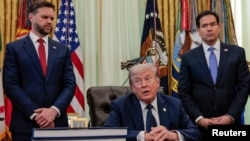
Trump, Vice President JD Vance, and Secretary of State Marco Rubio, along with the US ambassadors to Israel and Lebanon, were among those who met with “high-ranking representatives" of Israel and Lebanon, the US president said.
Lebanese Ambassador to the US Nada Hamadeh Moawad and Israeli Ambassador to the US Yechiel Leiter represented their countries in the talks.
The remarks came even as violence flared near the Israeli-Lebanese border, with both sides firing on the other after accusations of violations of the 10-day cease-fire already in place.
Trump Rules Out Use Of Nuclear Weapons Against Iran
US President Donald Trump said he has ruled out the use of nuclear weapons against Iran and also told reporters, “Don’t rush me,” when asked how long he was willing to wait for a peace deal as the war passed its 54th day.
"Why would I use a nuclear weapon? We've totally, in a very conventional way, decimated them without it," Trump told reporters on April 23 at the White House when asked if he would use such a weapon.
“No I wouldn't. A nuclear weapon should never be allowed to be used by anybody," said Trump, who has in the past threatened to wipe out the entire Iranian civilization if the country’s leaders fail to agree to a US peace deal.
Trump also said he could, if he wanted to, reach a peace agreement with Tehran “right now” but insisted he wants an deal to be one that will hold.
"I want to make the best deal. I could make a deal right now...but I don't want to do that. I want to have it everlasting," Trump said.
"Their navy is gone. Their air force is gone, their antiaircraft is gone...maybe they loaded up a little bit during the two-week hiatus, but we'll knock that out about one day, if they did," Trump said.