




Maritime Monitor Says Ship Seized Off UAE Port, Bound For Iranian Waters
The British Maritime Trade Operations Center (UKMTO) announced on May 14 that "unauthorized personnel" had taken control of a ship at anchor following an incident in the northeast of the United Arab Emirates (UAE) and that the ship was heading toward Iranian territorial waters.
UKMTO said it received a report of a maritime incident 38 nautical miles (about 70 kilometers) northeast of the UAE port of Fujairah, after which the ship was seized and its route was changed to Iran.
No further details have been released about the vessel or the identities of those onboard.
Rubio: It's In China's Interest To Pressure Iran To Open Strait Of Hormuz
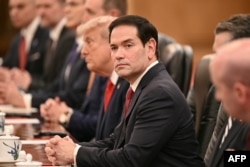
US Secretary of State Marco Rubio said it is in China's interest to pressure the Iranian government to open the Strait of Hormuz.
"We've made the argument to the Chinese, and I hope it's compelling, and they'll have a chance to do something about it at the United Nations later this week," Rubio said, according to a Fox News report on his trip to China, where he is accompanying US President Donald Trump for a two-day summit in Beijing.
Rubio also referred to the US-Israeli strikes on Iran and said the Iranian government was trying to create a kind of "military immunity" to advance its nuclear program by expanding its missile and drone arsenal. He said the Iranian government was building the capacity to disable the defense systems of regional countries with "a multitude of missiles and drones" and to respond to any potential attack on its nuclear program by threatening to inflict widespread damage on the Persian Gulf countries.
Rubio also said the situation in the Strait of Hormuz is more detrimental to China than any other country and Beijing should pressure Iran to back down from its actions.
"It's in their interest to resolve this," Rubio said, saying Chinese ships have been caught in the Persian Gulf and that a Chinese cargo ship was even targeted last week "albeit unintentionally."
"We hope to convince them to play a more active role in getting Iran to walk away from what they're doing now in the Persian Gulf," Rubio added.
UAE Denies Netanyahu Visited During Iran War
The United Arab Emirates denied on May 13 that Israeli Prime Minister Benjamin Netanyahu visited the country during the war with Iran, rejecting claims by Netanyahu’s office that he "secretly" met with UAE President Sheikh Mohammed bin Zayed Al Nahyan.
In a statement, the UAE Foreign Ministry said relations with Israel "are public" and "not based on nontransparent or unofficial arrangements."
"Any claims regarding unannounced visits or undisclosed arrangements are entirely unfounded unless officially announced by the relevant authorities in the UAE," the statement said.
Netanyahu's office said the meeting had led to a "historic breakthrough" in relations between the two countries.
However, a source familiar with the meeting told Reuters that Netanyahu and Sheikh Mohammed "met for several hours" on April 25 in the city of Al Ain near the Omani border.
The source also added that Mossad chief David Barnea also traveled to the UAE "at least twice" during the war with Iran to discuss military coordination. The Wall Street Journal first reported the Mossad chief's visit to the country.
The UAE, especially after being the target of several attacks during the war with Iran, has strengthened its relations with the United States and Israel, with which it normalized relations in the framework of the 2020 Abraham Accords.
US Ambassador to Israel Mike Huckabee said on May 12 that Israel had sent Iron Dome defense systems and related operational forces to the UAE during the war.
The UAE is one of the region's major commercial and financial centers and a key ally of Washington. It has pursued an active foreign policy and has established an independent sphere of influence in the Middle East and Africa.
Iran's attacks on Persian Gulf countries -- in response to US and Israeli strikes -- have targeted the UAE more than other neighbors, targeting the country's civilian infrastructure and energy facilities.
Unlike some other Gulf states, the UAE has a pipeline that allows it to transport some of its oil exports without passing through the blocked Strait of Hormuz, increasing its ability to withstand long-term disruptions.
However, the continuation of the war could severely undermine the UAE's role as a global economic hub that provides security and ease of economic activity in the region.
Drones Attack Kurdish Militia Camp In Iraq's Kurdistan
Two drone attacks were reported on a camp of Kurdish militias that oppose Iran north of the city of Erbil, located in the Iraqi Kurdistan region.
According to security sources, a warehouse of equipment and ammunition inside the camp was targeted. No reports of casualties or damage have been released.
Three days ago, a similar attack occurred on another camp east of Erbil.
In recent months, Iran's Islamic Revolutionary Guards Corps has repeatedly targeted the positions of Kurdish militias in the Kurdistan region with drones and missiles.
We are now closing the live blog for the day. We'll be back at 0730 CET to cover the latest events across the Middle East.
JD Vance: Progress Made In Talks With Iran

US Vice President JD Vance announced that Washington believes "progress" has been made in negotiations with Iran, but it is not yet clear whether this progress has met Donald Trump's red line.
Vance told reporters at the White House on May 13 that he had discussed Iran that morning with Jared Kushner and Steve Witkoff, the US president's envoys in peace talks, and had also been in contact with Arab officials.
"The question is whether that progress is enough to meet the president’s red line," he said.
According to Vance, Trump's "red line" is for the United States to ensure that "a number of protections" are in place to ensure Iran never obtains a nuclear weapon.
Vance's comments come after Trump had previously described Iran's new proposal in the negotiations as "totally unacceptable."
Iran and the United States held their first direct talks in Islamabad shortly after announcing a two-week cease-fire on April 8. Vance and Mohammad Baqer Qalibaf, the speaker of the Iranian parliament and Tehran's top negotiator, led the US and Iranian delegations, respectively, at the talks.
Those talks ended without reaching a conclusion. President Trump then extended the cease-fire with Iran, without announcing a deadline. Afterwards, on his orders, US military forces in the region began a naval blockade of Iran, which is still ongoing.
Iran Says It Executed January Protester For 'Murdering Security Officer'
Iran's judiciary announced on May 13, that Mohammad Abbasi, a protester arrested during the mass nationwide demonstrations that took place in January, has been executed on charges of murdering a security officer.
The judiciary's Mizan news agency said that he was "executed in retribution for the killing" after the verdict was confirmed by the Supreme Court.
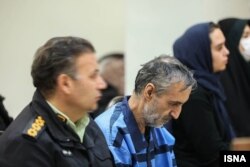
The HRANA news website, which covers human rights news in Iran from the United States, reported that Abbasi had been executed at the Qezl-e-Hesar Prison on the morning of May 13.
Citing a source close to the prisoner's family, HRANA wrote that prison officials had given Abbasi's family the chance to visit him in prison, but when they arrived, "this opportunity was denied to his relatives. After the Abbasi family left prison, they were informed in a phone call that Mohammad Abbasi's death sentence had been carried out."
Shortly after the violent crackdown on protests on January 8-9 by security forces, the judiciary released images of Abbasi's court session.
During the trial, he was accused of murdering a security force member in the city of Mallard.
The Etemad newspaper wrote in its report on the hearing that Abbasi's lawyer stated in court that the victim had suffered numerous blows, not all of which were inflicted with the defendant's weapon.
On May 13, Mizan identified the victim as Lieutenant Colonel Shahin Dehghani and claimed he had been beaten and killed with "various types of weapons and stones."
The time of the incident was announced as January 7, the day before the most intense protest rallies in several cities in the country.
The Iranian judiciary also announced on May 13 that Ehsan Afrashte, who was imprisoned on charges of "spying for Israel," had also been executed.
Israel Says Netanyahu Traveled To UAE During Iran War
The Israeli Prime Minister's Office announced on May 13 that Benjamin Netanyahu had "secretly" traveled to the United Arab Emirates (UAE) during the US-Israeli war with Iran.
Netanyahu met with UAE President Sheikh Mohammed bin Zayed, according to the statement.
"This visit led to a historic breakthrough in relations between Israel and the United Arab Emirates," the Israeli Prime Minister's Office said.
Previously, senior US officials had confirmed Israel sent an "Iron Dome" defense system to the UAE along with forces to operate it during the war with Iran.
Also, according to UAE officials and an informed source who spoke to The Wall Street Journal, Mossad chief David Barnea traveled to the UAE at least twice during the war with Iran to discuss coordination related to the conflict.
The UAE is one of the few Arab countries to have diplomatic relations with Israel, relations that were formally established in 2020 as part of the Abraham Accords. These agreements are considered one of the most important foreign policy achievements of US President Donald Trump, as well as Benjamin Netanyahu.
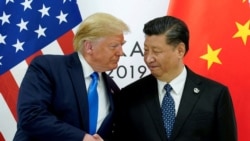
How The War In Iran Is Shaping The Trump-Xi Summit
The Iran war and its global ripple effects are a through line influencing many of the issues that the two leaders will discuss in Beijing, from rare earth minerals to Taiwan.

Lego, Hip-Hop, And Deepfakes: How Iran Uses AI To Shape Western Opinion
From viral Lego-style videos and AI-generated hip-hop tracks to fabricated battlefield imagery, the war in Iran is revealing how artificial intelligence (AI) is being weaponized in modern warfare and statecraft.
To discuss this rapid shift, RFE/RL spoke with Max Lesser, senior analyst on emerging threats at the Foundation for Defense of Democracies (FDD) Center on Cyber and Technology Innovation.
"Iran has become increasingly sophisticated in its online influence operations," Lesser says. "There's definitely been a big shift. The AI Lego videos are probably one of the most successful propaganda efforts that I've ever seen come out of Iran targeting foreign audiences."
To read the full interview, click here.