



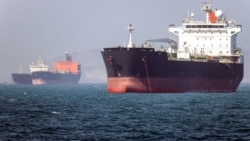
Rubio: US And China Agree Against Militarizing Hormuz
US Secretary of State Marco Rubio has told NBC News that China and the US agree that the Strait of Hormuz should not be "militarized."
Speaking on NBC Nightly News with Tom Llamas, Rubio said that President Donald Trump discussed the strait with Chinese President Xi Jinping at talks in Beijing on May 14. “The Chinese side said they are not in favor of militarizing the Strait of Hormuz, and they’re not in favor of a tolling system, and that’s our position,” Rubio said.
Since the beginning of the US-Israeli war with Iran on February 28, Tehran has effectively closed the key strait and charged tolls -- up to $2 million -- for some ships to pass through. The US has also imposed a naval blockade on ships going to and from Iran.


In addition to charging tolls on ships passing through the strait -- which Iran claims sovereignty over -- Tehran has proposed implementing a permanent tolling system on all nonhostile traffic.
Rubio denied that Trump had asked Xi for China's help with the war in Iran.“He didn’t ask him for anything. I mean, we're not asking for China's help," Rubio said. "We don't need their help.”
Rubio said the two presidents had identified common ground on Iran, with China again reaffirming its opposition to Tehran acquiring nuclear weapons.
“I don't know there's a country on the planet that is in favor of this regime and Iran having nuclear weapons. I don't know of any,” Rubio said.
There was no immediate confirmation from the Chinese side of Rubio’s remarks.
Xi 'Would Love To' Help Broker Iran Deal, Trump Says
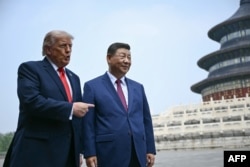
US President Donald Trump said Chinese President Xi Jinping had offered to help end the Iran war during talks in Beijing, saying Xi “would love to” assist and “would like to see a deal made”.
Trump told Fox News on May 14 that Xi also wanted the Strait of Hormuz kept open, a key concern for China as the world’s biggest buyer of Iranian oil and a major importer of energy supplies via the Persian Gulf.
Trump added that Xi had agreed to stop providing military goods to Iran, although there was no immediate confirmation from Beijing.
China is regarded as one of Iran’s most important suppliers of military equipment alongside Russia.
With reporting by dpa and The Wall Street Journal
Rubio: US And China Agree Against Militarizing Hormuz
US Secretary of State Marco Rubio has told NBC News that China and the US agree that the Strait of Hormuz should not be "militarized."
Speaking on NBC Nightly News with Tom Llamas, Rubio said that President Donald Trump discussed the strait with Chinese President Xi Jinping at talks in Beijing on May 14. “The Chinese side said they are not in favor of militarizing the Strait of Hormuz, and they’re not in favor of a tolling system, and that’s our position,” Rubio said.
Since the beginning of the US-Israeli war with Iran on February 28, Tehran has effectively closed the key strait and charged tolls -- up to $2 million -- for some ships to pass through. The US has also imposed a naval blockade on ships going to and from Iran.
In addition to charging tolls on ships passing through the strait -- which Iran claims sovereignty over -- Tehran has proposed implementing a permanent tolling system on all nonhostile traffic.
Rubio denied that Trump had asked Xi for China's help with the war in Iran.“He didn’t ask him for anything. I mean, we're not asking for China's help," Rubio said. "We don't need their help.”
Rubio said the two presidents had identified common ground on Iran, with China again reaffirming its opposition to Tehran acquiring nuclear weapons.
“I don't know there's a country on the planet that is in favor of this regime and Iran having nuclear weapons. I don't know of any,” Rubio said.
There was no immediate confirmation from the Chinese side of Rubio’s remarks.
Symbols Of The Shah's Secret Police Seen At Iranian Royalists Rallies Abroad
Some Iranians in exile who are advocating a return of the monarchy in Tehran have been displaying symbols associated with the notorious secret police, SAVAK, used by the former shah to repress political opponents before the Islamic Revolution in 1979.
That imagery has sparked outrage among fellow exiles and is complicating the position of Reza Pahlavi, the son of the shah, who hopes to return to power if the current theocratic rule in Iran should crumble.


US Admiral Says Iran No Longer Poses Same Regional Threat
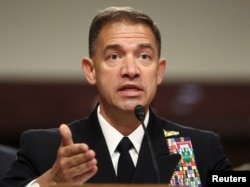
Admiral Brad Cooper said that recent US strikes have dramatically weakened Iran’s military capabilities, reducing its ability to threaten neighboring countries and American interests.
Speaking to a US Senate committee on May 14, Cooper said Iran’s defense industry had been set back by 90 percent and that Tehran no longer posed the same regional threat “across every domain.”
Cooper -- who heads US Central Command (CENTCOM), which oversees American military operations in the Middle East -- also claimed that Iran could no longer transfer weapons and resources to regional allies including Hezbollah, the Houthis, and Hamas. which is designated as a terrorist organization by the US and the EU.
Cooper did not directly address reports citing US intelligence sources that Iran still retained significant underground missile and drone capabilities.
With reporting by Reuters
No Visas Yet Issued For Iran Soccer Team To Attend World Cup, Says Head Of Iranian FA
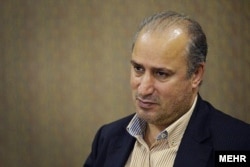
The head of Iran’s football federation says no visas have yet been issued for any members of the national team to participate in the 2026 World Cup.
"Tomorrow or the day after tomorrow, we will have a decisive meeting with FIFA." Iran’s state news agency IRNA quoted federation chief Mehdi Taj as saying on May 14. "They must give us guarantees, because the visa issue has still not been resolved. We have not received any information from the other side regarding who has been granted visas. No visas have been issued yet.”
Taj, who in recent days had laid out conditions for Iran’s participation in the World Cup -- including the requirement that visas be issued for all players and coaching staff --— also said: “We are preparing for the World Cup, but we are waiting to see how the other side behaves.”
The national football team delegation traveled to Turkey on May 13 and -- after a short training camp there -- is set to head to the United States, which will host Iran’s matches.
FIFA’s president previously said Iran would definitely participate in the World Cup. US President Donald Trump has also said he has no problem with Iran taking part.
The World Cup will be jointly hosted by the United States, Mexico, and Canada, though most matches -- including Iran’s three group-stage games -- will be played in the United States.
Iranian Foreign Minister Says Hormuz Strait 'Open' If Ships 'Cooperate' With Tehran
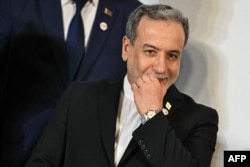
Iranian Foreign Minister Abbas Araqchi said on May 14 that the Strait of Hormuz is open to all commercial vessels as long as they "cooperate" with Iran's naval forces.
Tehran took control of the key waterway shortly after the beginning of the joint US-Israeli military effort against Iran in February, effectively closing it by threatening and attacking civilian ships.
Araqchi, however, said the strait has been suffering from "US aggression and the blockade that they have imposed on it" as he spoke on the sidelines of the BRICS summit in New Delhi, a capital that had hours earlier condemned a May 13 attack on a ship flying its flag off the coast of Oman.
It has been about a month since the United States imposed a naval blockade on vessels leaving Iranian ports in an effort to pressure Tehran's oil revenues. During this period, US Central Command has reported dozens of ships it prohibited or redirected while they were attempting to leave Iranian cities.
Following May 14 talks in China, which previously relied on the Strait of Hormuz for energy imports, the country's leader, Xi Jinping, and US President Donald Trump agreed that the waterway must remain open.
With reporting by AFP
Iran Has Carried Out Nearly 30 Political Executions Since Start Of US-Israel War
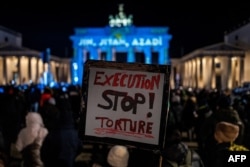
Iran executed two men on May 13 as the accelerated campaign of political hangings since the start of the war with the United States and Israel shows no signs of abating.
Ehsan Afrashteh, a cybersecurity and network specialist, was hanged on charges of espionage for Israel, Tehran's archfoe, early in the day.
By late evening, Mohammad Abbasi, who took part in mass protests in January, was executed at Ghezel Hesar Prison on charges of killing a security officer in Malard, a town near Tehran.
Abbasi's family was summoned to prison for what they were told would be a visit, only to be turned away at the gate, according to the US-based rights group HRANA. They later learned of his execution by phone.
To read the full report, click here.
India Says Sinking Of Ship Near Oman 'Unacceptable'
India's External Affairs Ministry called an attack on a ship flying its flag that it said took place on May 13 off the coast of Oman "unacceptable."
The ministry added in a statement that the targeting of commercial ships and civilian seafarers must stop and thanked Omani authorities for rescuing the crew.
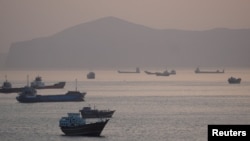
The Vanguard maritime security company has named the vessel the MSV Haj Ali and said the 54-meter wooden barge sank off the coast of Lima in Oman, south of the Strait of Hormuz, after an explosion.
According to the report, the ship was transporting livestock from the port of Berbera in Somalia to Sharjah, United Arab Emirates, when it was possibly targeted by a drone or missile attack.
The Iranian government has effectively blocked the Strait of Hormuz since the United States and Israel began their strikes on Iran. The United States has also continued its naval blockade of Iranian ports, despite a fragile cease-fire that was established on April 8.
Disruptions in shipping routes in the Persian Gulf and the Strait of Hormuz in recent weeks have caused fluctuations in global oil and gas markets and increased concerns among energy-importing countries, including India.
White House Says Trump, Xi Agree Strait of Hormuz Must Stay Open
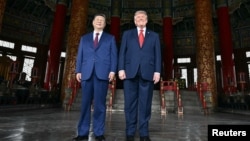
US President Donald Trump and Chinese leader Xi Jinping wrapped up more than two hours of talks in Beijing on May 14, with both sides agreeing that the Strait of Hormuz must remain open amid mounting global economic anxiety tied to Washington's standoff with Iran, according to the White House.
The summit, the first face-to-face meeting between the two leaders since October 2025, blended ceremonial pageantry with difficult negotiations over trade, Taiwan, technology, and the widening fallout from the Iran conflict.
To read the full news analysis, click here.
Takaichi Says Second Japanese-Linked Ship Passes Through Strait Of Hormuz
Japanese Prime Minister Sanae Takaichi announced the successful passage of one of the country's ships that had been stuck in the Persian Gulf through the Strait of Hormuz.
Takaichi wrote in a post on X that the ship departed the Persian Gulf on May 14 after passing through the Strait of Hormuz and is now en route to Japan. She said there are four Japanese crew members on board.
After a Japanese-linked ship passed through the Strait of Hormuz on May 29, the passage of a second ship is considered a positive development, Takaichi added.
However, she said, 39 Japanese-affiliated ships remain in the Persian Gulf, including one with three Japanese crew members.
The Japanese government had made various arrangements for the ship's passage, including directly contacting Iranian President Masud Pezeshkian.
In this post, Takaichi mentioned the great pressure on the crews of Japanese-linked ships in the Persian Gulf and the deep concern of their families.
She emphasized that the Japanese government will continue to actively pursue all necessary diplomatic efforts and coordination to ensure the passage of all ships, including those affiliated with Japan, through the Strait of Hormuz as quickly as possible.