





Iran's Book Industry Confronts War's Compounding Toll As Virtual Fair Opens
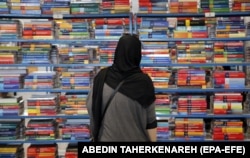
Iran's already beleaguered publishing sector is entering its seventh virtual Tehran Book Fair this week in conditions that would have been difficult to imagine even a year ago.
Physical damage to bookshops from US-Israeli strikes, a state-imposed Internet blackout approaching 80 days, a paper crisis deepened by wartime sanctions, and an economy grinding under the weight of conflict.
The virtual expo is normally held concurrently with the Tehran International Book Fair, which would have held its 37th edition this week -- but the physical fair has been ruled out this year, with organizers citing the war and its fallout as the reason the event will be held exclusively online.
The fair, which runs May 16-22 under the slogan "Read for Iran," is itself a measure of how much has changed.
To read the full report, click here.
Iran Seizes Assets Of Dozens Of People On Charges Of 'Collaborating' With Israel
Iran's judiciary announced the seizure of assets of 51 people in Yazd Province on charges of "espionage and collaboration with hostile countries and hostile groups."
The judiciary said on May 16 that the assets of these individuals had been seized "for the benefit of the people and to finance the reconstruction of war-damaged areas."
According to the statement, 20 of these people live inside the country and 31 live outside Iran.
The assets of these individuals, "including bank cash, movable and immovable property, company shares, and even attorney's fees" have been seized, it said.
The names of these individuals or evidence supporting the accusations were not provided.
Previously, numerous reports had been published about the seizure of the assets of journalists, political and civil activists, artists, athletes, and well-known figures on charges such as "treason" and "betrayal of the homeland," "dependence" on Israel, and "collaboration with hostile countries."
Iran Says It's Consulting With Oman On How To Manage Strait Of Hormuz
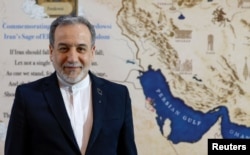
Iranian Foreign Minister Abbas Araqchi said Tehran is consulting with Oman to establish a suitable mechanism for managing the Strait of Hormuz.
Speaking to reporters in India on May 15, Araqchi said that since Iran and Oman are located on opposite sides of the Strait of Hormuz, they should decide on the management of the vital waterway.
"Iran and Oman are two coastal countries on both sides of the Strait of Hormuz, and this strait is located in the territorial waters of the two countries and there are no international waters between them. Therefore, the management of this route should be done by Iran and Oman," he said.
Oman has not yet responded to the comments.
The United States opposes Iran having control of the strait and opposes Tehran's desire to collect tolls in exchange for allowing ships to pass through, and has said Oman also agrees with this stance.
The Strait of Hormuz in southern Iran is the transit point for about 20 percent of the world's oil and gas, and in addition, the bulk of the fertilizer used in agricultural production is transported around the world through this point.
Following the joint US-Israeli strikes on Iranian territory on February 28, Iran's Islamic Revolutionary Guards Corps immediately announced that the Strait of Hormuz was closed.
Luke Coffey On How Tehran Has Adapted Kremlin Negotiation Tactics
WASHINGTON -- As Washington weighs its next steps with Tehran, some analysts see familiar patterns emerging -- not from the Middle East, but from the Kremlin's playbook.

In an interview with RFE/RL, Luke Coffey, a senior fellow at the Hudson Institute focusing on national security and transatlantic relations, said Iran appears to be borrowing directly from Russia's negotiation strategy: Prolong talks, seek concessions incrementally, and avoid making meaningful commitments while maintaining the appearance of diplomacy.
"The Iranians know what they can get away with. They know how to drag the discussions out, make it look like Trump is achieving something, when in reality, he'll achieve nothing," says Coffey. "And they have learned this from the Russians."
To read the full interview, click here.
Senior Member Of Iran Proxy Group Close to Soleimani Arrested, Transferred To US
The FBI announced that a senior member of the Iraqi Kataib Hezbollah group, one of Iran's main proxy groups, named Mohammad Baqir Saad Dawood al-Saadi has been arrested and transferred to the United States for trial.
The New York State Attorney General's Office posted a photo on X on May 15 of the Kataib member alongside Qasem Soleimani, the former commander of the Quds Force who was killed in a US strike during President Donald Trump's first term. Reports say he identified himself as Mohammad Baqir Soleimani.
The United States considers Kataib Hezbollah a terrorist group. Before the Iran war, the group had declared it would fight on behalf of the Islamic republic if war were to break out.
Al-Saadi faces six terrorism-related charges for his activities as a member of Kataib Hezbollah and the Quds Force, the international branch of Iran's Islamic Revolutionary Guards Corps.
He is said to have been arrested in Turkey after traveling outside Iraq.
Trump Says Iran Has Been Close To A Deal '4 Or 5 Times'
US President Donald Trump said that Iran has come close to reaching a full agreement with the United States "four or five times" but repeatedly reversed course at the last minute.
"Every time they agree, the next day it's like we didn't even talk," Trump told Fox News on May 15. "And this has happened four or five times. There's something wrong with them. Honestly, they're crazy."
He added: "And because they're crazy, they can't have a nuclear weapon."
Trump also claimed Iran had previously agreed to hand over its enriched uranium stockpile during negotiations with the United States.
"No nukes," Trump said. "They were going to give us the nuclear dust. Whatever we wanted."
In another appearance, Trump said: "Iran told me very strongly...they intend to give us the nuclear dust, as I call it," referring to enriched uranium allegedly buried at bombed nuclear sites.
He also said Iranian officials had told the United States: "You will have to take it out. We don't have the capability of doing it."
Trump made similar comments to reporters before departing for China, saying Iran had at one point agreed to surrender enriched nuclear material as part of a broader settlement.
Iranian officials, including Foreign Minister Abbas Araqchi, have denied accepting US conditions.
"The issue of enrichment is complicated, and in order to reach a conclusion with the American side, we proposed that this discussion be postponed," Araqchi said on May 15.
Trump also told Fox News in the interview that Chinese President Xi Jinping agreed with him that the war should end.
We are now closing the live blog for the day. We'll be back at 7:30 a.m. Central European time to cover the latest events across the Middle East.
Amid Disagreements Over Iran War, BRICS End Summit Without Joint Statement
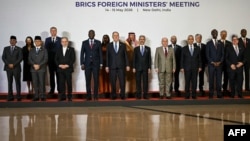
Top diplomats from BRICS grouping of nations -- including bitter enemies Iran and the United Arab Emirates -- did not issue a joint statement on May 15 after a two-day summit in Delhi.
Tehran had sought to have the grouping of emerging economies condemn the US-Israeli war with Iran and accused the UAE, a US ally, of direct involvement in military operations against the Islamic republic.
"There were differing views among some members as regards the situation in the West Asia/Middle East region," India said in a statement and outcome document.
BRICS consists of Brazil, Russia, India, China, South Africa, Ethiopia, Egypt, Iran, and the UAE.
Tehran has launched missiles and drones at the UAE in retaliation for the US-Israeli air strikes that began on February 28. The fighting is mostly paused with the introduction of a cease-fire agreed to by the US and Tehran.
The Wall Street Journal, citing sources, on May 11 reported that the UAE had carried out military operations on Iran in early April.
The UAE did not confirm the report, but on May 16 it said all actions taken came within its framework of defensive measures aimed at protecting its sovereignty, civilians, and vital infrastructure.
Despite Cease-Fire Extension, Deaths Reported In Lebanon Air Strike
At least six people were killed in a suspected Israeli strike in southern Lebanon, according to Lebanon's state news agency NNA, just hours after the US announced that a cease-fire in the country had been extended for 45 days.
NNA on May 15 said the attack targeted a civil defense center in the Nabatieh district. It added that 22 people were wounded.
The Israeli military did not immediately comment.
Washington earlier announced that the current cease-fire between Israel and the Iran-allied Hezbollah militia would be extended by 45 days. The cease-fire has been fragile since it was first announced on April 16, with both sides claiming that the other had violated the truce.
A militant group and political party that controls much of southern Lebanon, Hezbollah is considered a terrorist organization by the US, while the EU has blacklisted its armed wing but not its political branch.
Authorities in Lebanese say some 2,900 people have been killed since fighting resumed in early March, including about 200 children.
With reporting by dpa
China Says Content, Timing 'Not Right' On US-Backed UN Hormuz Resolution
China's ambassador to the UN on May 15 criticized a proposed US-Bahraini resolution on the Strait of Hormuz, that would have demanded that Iran cease attacks and mining in the crucial waterway.
Diplomats have said it is likely to meet vetoes by Russia and China if it comes to a vote. Both countries vetoed a similar US-backed resolution in April, claiming it was biased against Iran.
"We don't think the content is right, and the timing is not right," China's UN envoy,
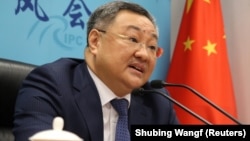
, said in a video clip posted by the Pass Blue news portal, which focuses on UN news.
"What we need is to urge both sides to engage in serious and good-faith negotiations that can resolve the issue. So passing a resolution at this stage, we don't think is going to be helpful," he said.
The remarks came after US President Donald Trump visited Beijing to meet with Chinese leader Xi Jinping in which they agreed that the strait must remain open. Xi made clear China's opposition to the militarization of the waterway and any effort to charge a toll for its use.
In retaliation for US-Israeli air strikes -- now paused as part of a cease-fire -- Tehran effectively closed the strait and has said it will begin charging tolls through the international waterway, through which some 20 percent of the world's oil and gas supplies transit.