




Report: Iranian President To Open Up Internet Access
Iran’s Etemad daily reported on May 23 that President Masud Pezeshkian is working to expand public access to the Internet “through legal channels.”
According to the report, the government has created a “Cyberspace Steering and Organization Headquarters” and appointed Mohammad Reza Aref as its head.
Etemad suggested that "the issue of unblocking the Internet will most likely be approved this week."
Earlier this week, however, Ali Yazdikhah, deputy chairman of the cultural commission in Iran's parliament, said that there is currently no need to open up the Internet because of what he called "security risks and threats to personalities and the country."
The Iranian government cut off the Internet on February 28 at the start of the US-Israeli war with Iran. According to Netblocks, the global Internet monitoring organization, the Internet outage in Iran has now exceeded 2,000 hours.
Iran War Triggers Emergency Funding Push At World Bank
An internal World Bank document seen by Reuters shows that since the Iran war began in late February, 27 countries have taken steps to activate emergency financial instruments so they can quickly access resources available in World Bank programs if needed.
The document did not identify the countries or the total amount of potential funding, and the World Bank declined to comment. According to the document, three countries have approved new financial instruments since the start of the conflict, while others are still completing the process.
The Iran war and disruptions in the global energy market have led to rising fuel prices, straining supply chains, and difficulties shipping chemical fertilizers to developing countries.
Iraqi and Kenyan officials have confirmed that they are seeking urgent assistance from the World Bank to deal with the consequences of the war, including a drop in Iraq's oil revenues and rising fuel prices in Kenya.
World Bank President Ajay Banga said last month that the institution's crisis tools could provide countries with around $20-25 billion in resources in the first phase, and, by restructuring part of the bank's financial portfolio, this figure could rise to $60 billion in six months and around $100 billion in the long term.
Airspace Closed Over Western Iran
Iran’s Civil Aviation Organization has announced temporary restrictions on the western part of the country’s airspace.
The move comes amid heightened tensions, with reports that the US is considering renewed military action against Iran while diplomatic efforts continue.
According to the latest Notice to Air Missions (NOTAM), all passenger flights over western Iran face severe restrictions.
Currently, only eight airports are permitted to operate, including Tehran’s Mehrabad and Imam Khomeini airports, as well as Isfahan and Yazd airports in central Iran.
At these operational airports, flights are restricted to daylight hours (sunrise to sunset), and airlines must obtain a new permit from the Civil Aviation Organization for each individual flight.
We are now closing the live blog for the day. We'll be back at 9:30 a.m. Central European time to cover the latest events across the Middle East.
Republican Senator Urges Trump To Let Military 'Finish The Job' In Iran
US Republican Senator Roger Wicker, who has backed President Donald Trump’s decision to go to war with Iran, urged Trump to allow the US military to finish what it started with its air campaign against the Islamic republic.
“We are at a moment that will define President Trump’s legacy,” Wicker said in a statement issued on May 22.
Trump’s “instincts have been to finish the job he started in Iran, but he is being ill-advised to pursue a deal that would not be worth the paper it is written on.”

“Our commander-in-chief needs to allow America's skilled armed forces to finish the destruction of Iran's conventional military capabilities and then reopen the strait [of Hormuz],” he said.
“Further pursuit of an agreement with Iran's Islamist regime risks a perception of weakness. We must finish what we started. It is past time for action,” the Mississippi Republican added.
In a speech on the Senate floor in March, Wicker argued that critics were unfairly second-guessing Trump’s decision to strike Iran beginning on February 28 and setting arbitrary limits on the military campaign.
“Apparently, if this war lasts as long as five weeks, we should agree that we will fold our tents, come home, and leave the job undone,” Wicker said.
It wasn’t immediately clear what prompted the latest statement, but the US Senate – including four Republicans – voted on May 19 for the first time to move forward with a measure to force Trump to end the war.
However, Republican leaders of the House of Representatives on May 21 canceled a resolution a similar resolution after it appeared likely to pass, also with several Republican defectors.
Any bills passed by Congress would still be subject to a likely veto by Trump.
Iranian Officials Meet With Qataris, But Stress Pakistan Remains Main Mediator
Iranian Foreign Ministry spokesman Esmaeil Baqaei on May 22 said a Qatari delegation was holding talks with Iran’s foreign minister, but he added that Pakistan remains the main mediator in the negotiations between Washington and Tehran.
"In recent days, many countries -- both regional and non-regional -- have been trying to help bring the war to an end... However, Pakistan remains the official mediator," he said.
Pakistan has been the public face of mediation efforts to end the war in the Middle East, although many observers have said Qatar has worked behind the scenes in efforts to also facilitate peace efforts.
Pakistan last month hosted the only direct negotiations between US and Iranian officials since the war began at the end of February.
Pakistan's powerful army chief, Field Marshal Asim Munir, arrived in Tehran on May 22 to meet with Iranian officials as part of mediation efforts.
Senior UAE Official: Restart Of Iran War Would Be 'Catastrophic'
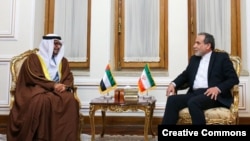
Anwar Gargash, a senior official in the United Arab Emirates, said a resumption of hostilities in the Iran war would be “catastrophic” for the Middle East, which has been embroiled in the US-Israeli conflict with the Islamic republic.
In an interview with RFE/RL on May 22 at the annual Globsec security conference in Prague, the diplomatic adviser to the UAE president said only a “political resolution” could end an 11-week war that has disrupted international oil and gas supplies and upended the global economy.
Read full story here.
Pakistan Army Chief Arrives In Tehran For Latest Peace Push
(This item is updated to reflect Munir's arrival in Iran)
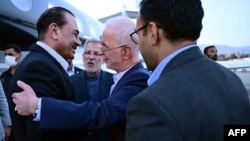
Pakistan’s powerful army chief, Asim Munir, has arrived in Tehran amid renewed peace efforts, the Pakistani military and Iranian state media reported late on May 22.
Munir’s visit comes as US officials voiced hope of progress on ending the 11-week war with Iran, with Washington looking to Pakistani mediators to help advance efforts to strike a deal.
The Iranian state-run IRNA news agency and Pakistan's Dawn newspaper both reported that Munir was expected to hold talks with senior Iranian officials as part of Islamabad's mediation efforts.
The trip is Munir’s second to Tehran since a cease-fire between the United States and Iran went into effect on April 8.
Pakistan’s Interior Minister Mohsin Naqvi has been in Tehran since May 20.
Munir’s trip has raised hopes that the United States and Iran are close to agreeing a draft peace agreement.
EU Says Hormuz Strait Closure Against International Law
Calling Iran’s actions against vessels transiting through the Strait of Hormuz a violation of international law, the Council of the European Union has decided to impose restrictions on individuals and entities involved in these “actions and policies” by the Iranian authorities.
“Such actions infringe upon established rights of both transit and innocent passage through international straits,” the council said in a press release on May 22.
In an X post on the same day, the EU Council said that from now on the bloc "will be able to sanction individuals and entities threatening freedom of navigation in the Middle East.”
Individuals and entities in violation of the freshly adopted measures will face travel restrictions as well as asset freezes in EU territory, according to the press release.
Since the start of the US-Israeli war against Iran on February 28, Tehran has practically closed the Strait of Hormuz, a key maritime chokepoint, causing a surge in oil prices across the world.
Senior UAE Official Warns Control Over Hormuz Would Set Dangerous Precedent, Sees '50-50' Chance Of US-Iran Deal
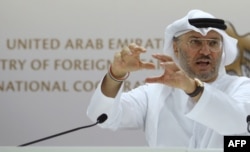
Anwar Gargash, diplomatic adviser to the president of the United Arab Emirates, said any change in the status of the Strait of Hormuz would have serious consequences for the region and even Europe, warning that any form of control over the strategic waterway would create a dangerous precedent.
Speaking on May 22 at the annual GLOBSEC security conference in Prague, Gargash also urged Europeans on behalf of Abu Dhabi to view the issue not as a distant problem but as one directly tied to their own energy supplies and trade.
He said the chances of the United States and Iran reaching an agreement that would lead to the reopening of the Strait of Hormuz were “50-50,” adding that Iranian authorities "had missed a lot of chances over the years because there's a tendency to overestimate their cards."
"I hope they don't do that this time," he added.
Gargash also stressed that any control over the Strait of Hormuz would set a perilous precedent and claimed the issue would become politicized in Iran’s hands.
Asked about the possibility of another round of war between the United States and Iran, the UAE adviser said it would make the situation even more complicated.
At the same time, he stressed that any political solution must address the root causes of the crisis and be designed in a way that avoids creating new complications in the future.
"Negotiations just to reach a cease-fire and sow the seeds for further conflict in the future is not what we're seeking," he said. "And I think that the Strait of Hormuz clearly has to go back to the status quo and this should be an international waterway."
Speaking about Tehran’s nuclear program, Gargash said the Islamic republic’s nuclear activities had previously been the UAE’s "second or third worry," but that now "it's our first worry. "
"We see that Iran is capable of using any weapon that it has in its hands, which is what we learned," he added.
The remarks came a day after a newly established Iranian government body published a map asserting control over the Strait of Hormuz that also included what the UAE described as its territorial waters, prompting a sharp reaction from Abu Dhabi.
Gargash wrote on X late on May 21 that Tehran was “trying to impose a new reality born from a clear military defeat. But attempts to control the Strait of Hormuz or violate the UAE’s maritime sovereignty are nothing more than pipe dreams."