



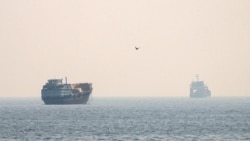

Starmer Hails Deal, Says Hormuz Must Open
British Prime Minister Keir Starmer was among Western leaders to welcome the agreement reached between Washington and Tehran to end the war.
"We are clear that toll-free freedom of navigation must now be restored in the Strait of Hormuz," he said, adding that "Iran must never have a nuclear weapon."
Starmer congratulated US President Donald Trump and mediators on the "breakthrough" after Trump said an agreement "is now complete" and that Strait of Hormuz shipping route would be reopened without tolls.
"This is a hugely important step forward in ending the war, ensuring regional stability, and re-opening the Strait of Hormuz," Starmer said in a statement.
UN Chief Welcomes US-Iran Deal As 'Critical Step' Toward Peace
UN chief Antonio Guterres on Sunday welcomed the US-Iran peace agreement -- which includes a permanent cease-fire and the reopening of the Strait of Hormuz -- as a "critical step" toward resolving the war in the Middle East.
"The Secretary-General hopes that the parties will build on this new momentum and redouble their efforts toward a final resolution of the conflict," Guterres said in a statement attributed to his spokesman Stephane Dujarric.
US President Donald Trump and Pakistani mediators said the peace accord is scheduled to be signed on June 19 in Switzerland. Although some issues reportedly have been decided, others matters will be subject to negotiations over the next 60 days, officials said.
Macron Says G7 Will Discuss US-Iran Deal, Eyes Hormuz Reopening
French President Emmanuel Macron said the leaders of the Group of 7 (G7) nations will on June 15 discuss the long-term reopening of the Strait of Hormuz under the newly announced US-Iran agreement to end the fighting in the Middle East.
At the G7 summit -- to be held in Evian, France -- "the aim will be to see the consequences of this agreement, support for Lebanon, the lasting reopening of Hormuz and of course the concluding of an accord on nuclear and ballistic activities in Iran," Macron said in a video on Instagram.

In a statement on X, Macron said: "I welcome the agreement reached between the United States and Iran, the result of a diplomatic effort to which several partners contributed. I call for its rapid and complete implementation by all belligerents."
He said the deal "should allow the urgent and unconditional reopening of the Strait of Hormuz, which the international mission set up with the United Kingdom is ready to support."
"The means are in place and ready to be committed. The resumption of maritime traffic, without restrictions or tolls, is an essential condition for regional stability and the global economy," he added.
Trump Says Iran Deal 'Now Complete' -- Blockade To End, Hormuz To Open
US President Donald Trump said a peace deal with Iran is "now complete" and that he has ordered an end to the naval blockade of Iran's ports in exchange for the free flow of traffic through the crucial Strait of Hormuz.
"The Deal with the Islamic Republic of Iran is now complete," he wrote on Truth Social on June 14.
"Congratulations to all! I hereby fully authorize the toll free opening of the Strait of Hormuz, and, simultaneously herewith, authorize the immediate removal of the United States Naval blockade. Ships of the World, start your engines."
Iran appeared to confirm that a deal had been reached, with its deputy foreign minister saying the "immediate and permanent end to the war and military operations on various fronts, including Lebanon, will be announced starting tonight," according to state-run Tasnim news agency.
However, the Fars news agency -- which is close to the hard-line Islamic Revolutionary Guards Corps (IRGC), said that "it has been decided that marine traffic through the Gulf will be regulated by Iran in coordination with Oman," remarks that would be counter to Trump's earlier comments.

Separately, Pakistani Prime Minister Shehbaz Sharif confirmed that a peace agreement had been reached, saying: "Following intensive talks, we are pleased to announce that the peace deal between the United States of America and Islamic Republic of Iran has been reached."
"Both sides have declared the immediate and permanent termination of military operations on all fronts, including in Lebanon," Sharif said on X.
Sharif, whose country has been working as a mediator in the talks between Washington and Tehran, said a signing ceremony would be held on June 19 in Switzerland.
Trump earlier told the Wall Street Journal that the deal would either be signed electronically by himself or by Vice President JD Vance.
Throughout the day, Iran had suggested that while it believes a deal was close, it would still take more days to finalize.
Iran has insisted that an end to fighting in Lebanon be included in any deal.
Israel has maintained its offensive against the Hezbollah militant group in southern Lebanon.
Iran-backed Hezbollah, a militant group and political party that controls much of southern Lebanon, is considered a terrorist organization by the US, while the European Union has blacklisted its armed wing but not its political branch.
No Nuclear Weapon, Opening Of Hormuz
Trump told the WSJ that the deal would include an agreement by Tehran not to obtain a nuclear weapon and to immediately open the Strait of Hormuz, through which some 20 percent of the world's oil and gas supplies flowed prewar.
The WSJ report added that Trump expressed "no urgency" to extract nuclear material Iran, saying that would come later.
With reporting from Reuters and The Wall Street Journal
Read more here.
Iran Soccer Team Arrives In Los Angeles Ahead Of First World Cup Match
Iran's World Cup soccer squad arrived at Los Angeles International Airport on June 14 following a 15-minute flight from their training base in Tijuana, Mexico.
The team will face New Zealand in its opening group play match on June 15 at 6 p.m. Pacific time in Los Angeles.
The team was expected to head to their hotel, where a police security presence was already in place.

A news conference was scheduled at Los Angeles Stadium later on June 14, with coach Amir Ghalenoei and striker Mehdi Taremi expected to participate.
The Iran team's presence in California comes amid the backdrop of the US war with Iran and as peace negotiations between Washington and Tehran continue.
With reporting by Reuters
Former Trump Official Says US Pressure Forced Iran To Recalibrate As Talks Advance
WASHINGTON -- Cale Brown, a former State Department deputy spokesperson during President Donald Trump’s first term, said that the growing momentum in US-Iran negotiations reflects what he described as Washington’s successful use of pressure to force Tehran back toward compromise.
“If we are close to a deal today, it is because America demonstrated this week that it would not respond to Iranian aggression with a mere tit-for-tat,” Brown, now the chairman of Polaris National Security, told RFE/RL on June 14.
“By establishing escalatory dominance, the president forced Tehran to recalibrate its position,” he added, stressing that diplomacy must be accompanied by strict conditions. “We are all hopeful for a peaceful resolution to this conflict, but not at any cost.”
“Any agreement with Iran must include strict safeguards and robust verification mechanisms to ensure full compliance with its obligations,” Brown said.
He added that he saw Washington as remaining in a strong position during the ongoing talks, saying that potential sanctions relief for Iran should be tied not only to ending Iran’s nuclear program but also to curbing its support for armed proxy groups across the region.
“If economic relief is tied to commitments to both end Iran’s nuclear program and its support for terror proxies, then the president will have addressed the breadth of Iran’s threats to the region and the world,” Brown said.

Brown’s comments came as a senior US administration official told RFE/RL that dialogue between Washington and Tehran remained ongoing and was “inching closer,” without elaborating.
The official also said the White House did not believe the latest air strikes exchanged between Israel and Lebanon's Hezbollah -- considered a terrorist organization by the United States -- would disrupt diplomacy. Earlier in the day, Trump urged "all sides" to de-escalate, saying the United States and Iran were “very close” to an agreement.
At the same time, Iranian President Masoud Pezeshkian said the country’s Supreme National Security Council had determined that “the path of dialogue should be pursued,” signaling continued backing for negotiations from Tehran’s top decision-making body.
Trump Says Latest Strikes On Beirut 'Should Not Have Happened'
US President Donald Trump said the Israeli attack on Beirut "should not have happened," adding that the timing of the strikes coincided with a "special day" when Washington and Tehran could reach a deal to end the war in the Middle East.
"Israel has the right to defend itself against threats, but the attack it was responding to was very small and meaningless, nobody was hurt, injured, or killed, and should not disrupt this important process," Trump wrote in a Truth Social post on June 14.
The president added that the United States was "very close to a Deal that will bring peace to the region, including to Lebanon," urging both Israel and Lebanon to cease all attacks.
Trump's comment comes hours after Tehran has played down the chances of an agreement being signed on June 14 and Iran's chief negotiator and speaker of Parliament Mohammad Baqer Qalibaf lashed out against the United States in a post on X following Israeli attacks on Hezbollah targets in Dahiyeh, a southern suburb of Beirut.
To read the full report, click here.
Qalibaf Criticizes US Over Israel's Latest Attack On Lebanon
Iran’s chief negotiator and speaker of Parliament Mohammad Baqer Qalibaf lashed out against the United States in a post on X after Israel launched new attacks on Hezbollah targets in Dahiyeh a southern suburb of Lebanon’s capital Beirut earlier on June 14.
Hezbollah is both a militant group and political party that controls much of southern Lebanon. It is considered a terrorist organization by the United States, although the European Union has only blacklisted its armed wing.
Israel's "incursion into Dahiyeh has once again shown that America either lacks the will to fulfill its commitments or the ability to do so. By giving the green light to the regime, you cannot gain concessions," Qalibaf wrote. "The game of bad cop and good cop is outdated. If you lack the will and ability to fulfill your commitments, speaking of continuing the path is not possible."
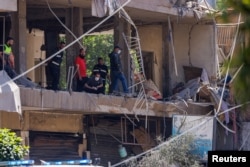
Israel said it had attacked the southern parts of Lebanon after Hezbollah launched three projectiles toward communities in northern Israel.
"Israel will not tolerate firing at its territory," Israeli Prime Minister Benjamin Netanyahu and Defense Minister Israel Katz said in a statement issued on June 14.
There are fears that renewed fighting between Israel and Hezbollah once again may postpone an agreement between United States and Iran that might be signed later on June 14.
Potential Deal To Include Iran Opening Strait Of Hormuz, US Lifting Naval Blockade
Details about the content of a memorandum of understanding between the United States and Iran that may be signed later on June 14 are emerging, according to Reuters, which quoted a "senior Iranian official."
The text reportedly stipulates that Iran would immediately open the Strait of Hormuz while the United States in parallel would lift its naval blockade of Iranian ports.
Washington would also release $25 billion of Iran's frozen assets, including via direct cash transfers, impose no new sanctions until a final deal is reached, and waive oil sanctions that it has imposed on Tehran.
Iran, on the other hand, should agree to neither produce nor purchase nuclear weapons, enrich no new uranium until a final deal is concluded, and dilute its highly enriched uranium stockpile inside the country -- although an exact mechanism for that still needs to be worked out.
A final deal would then be discussed within the 60 days of agreement by the two sides.
Qatari Negotiators Travel To Tehran
Qatari negotiators flew to Tehran early on June 14 in a bid to finalize an agreement between the United States and Iran to end the monthslong conflict, according to Reuters.
Iran’s ISNA news agency further reported that Qatari Foreign Ministry officials had been dispatched to the Iranian capital.
The development comes a day after US President Donald Trump posted on social media that a deal with Iran would be signed on June 14 -- his 80th birthday -- and Pakistani Prime Minister Shehbaz Sharifi adding that Islamabad was ready to prepare for an "electronic signing" to be followed by technical-level talks in the coming week.
Both Qatar and Pakistan have been mediating between the two sides in a bid to end the war that began with US-Israeli strikes on Iran on February 28.
Iran's Foreign Ministry has, however, played down the chances of a deal being signed on June 14 but added it could happen "in the coming days."