


Trump's Iran Accord And The 2015 Nuclear Deal: What's Different This Time?
- By Ray Furlong
The US-Iranian deal to end their war and reopen the Strait of Hormuz is inevitably being compared with the 2015 Joint Comprehensive Plan of Action (JCPOA) agreed with Tehran by then US President Barrack Obama.
That deal was fiercely criticized by his successor, Donald Trump, who pulled the United States out of it in 2018 during his first term of office. Trump has repeatedly said his deal would be better, although the text he signed in Versailles is not the final one -- it leaves many issues to be negotiated over the next 60 (or more) days.
“If it were easy we would have resolved it, you know, two wars ago,” Naysan Rafati, Iran Senior Analyst at the International Crisis Group, told RFE/RL, referring both to the 12-Day War in June last year and to this year’s hostilities, that reignited with US and Israeli air strikes on February 28.
“The fundamentals of the Iranian nuclear program since last June have been different to what they were like under the JCPOA,” he added.
Read more here
International Energy Agency Says Hormuz Closure Has Altered Perceptions Of Energy Security

International Energy Agency (IEA) Executive Director Fatih Birol has welcomed the interim agreement ending the Iran war and called for the Strait of Hormuz to be reopened "without conditions" to restore confidence in global energy markets.
Speaking at an event in Istanbul on June 18, Birol said several countries were reassessing their energy policies after Iran's closure of the strategic waterway during the conflict highlighted its vulnerability to future disruptions.
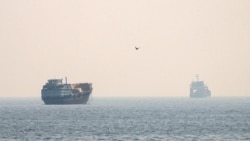
The US-Iran agreement provides for the reopening of the strait, which usually accounts for around one-fifth of global oil and gas supplies, and the lifting of the US naval blockade of Iran, potentially ending a disruption that the IEA estimates blocked more than 14 million barrels per day of Middle East oil output.
Birol said the agency would discuss new energy-security strategies with governments, warning that the crisis had fundamentally altered perceptions of global supply routes.
"The vase is broken," he said. "Now all actors know that the Strait of Hormuz was closed once and it can be shut down again."
With reporting by Reuters
UN Nuclear Watchdog Says It's Ready To Work With US, Iran On Deal Implementation
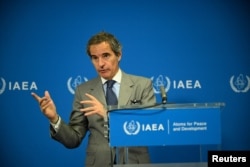
The International Atomic Energy Agency (IAEA) has said that it is ready to begin work on implementing the US-Iran agreement signed on June 17, under which Tehran has agreed to dilute its enriched uranium stockpile in exchange for economic relief.
IAEA Director General Rafael Grossi said on June 18 that the agency would now work with US and Iranian officials to define the "concrete steps" needed to carry out the deal.
Under the agreement, Iran's enriched uranium could be reduced through "down-blending on site under the supervision of the IAEA," placing the UN nuclear watchdog at the center of the verification process.
Grossi described the operation as highly complex and said the IAEA's role in the memorandum of understanding between Tehran and Washington underscored its credibility and expertise. He welcomed the agreement, saying: "I think it's good that the memorandum is there."
"Now the technical work starts," he added.
The deal is intended as a temporary arrangement while broader negotiations continue over the future of Iran's nuclear program.
Israel Seeking To Keep Troops in Southern Lebanon Despite US-Iran Deal, Say Officials
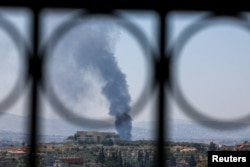
Israel is holding talks with the United States as it looks to maintain its military presence in southern Lebanon despite a new US-Iran agreement that calls for respect for Lebanon's sovereignty, Reuters reported on June 18, citing two Israeli officials.
One senior official close to Prime Minister Benjamin Netanyahu said Israel was "conducting stubborn negotiations" with Washington and would not retreat from its position of keeping troops deployed south of Lebanon's Litani River.
The discussions come a day after the United States and Iran signed an interim pact that commits parties to ensuring "the territorial integrity and sovereignty of Lebanon."
The negotiations are taking place as violence in Lebanon has declined sharply following the announcement of the agreement.
However, an Israeli drone strike in southern Lebanon on June 18 killed one person and seriously wounded another, according to Lebanon's state-run National News Agency.
Israel's military also announced the death of a soldier during an incident in southern Lebanon the previous night that left seven other troops wounded.
Israel expanded its military operations in southern Lebanon after Hezbollah opened fire on March 2 in support of Iran. Israeli officials describe territory seized in Lebanon, Gaza and Syria as buffer zones intended to enhance security.
Since the US and Iran announced they had reached an agreement on June 16, Hezbollah has not claimed responsibility for any new attacks against Israel, although limited exchanges of fire have continued.
With reporting by Reuters
Oil Prices Fall, Dollar Steady As US-Iran Deal Eases Supply Concerns
Oil prices fell on June 18 as investors weighed the interim peace agreement between the United States and Iran which could reduce risks to global energy supplies, while the dollar was little changed against major currencies.
US crude dropped 1.25 percent to $75.83 a barrel and Brent crude fell 1.4 percent to $78.41, continuing declines after US President Donald Trump and Iranian President Masud Pezeshkian signed a deal aimed at ending months of conflict in the Middle East.
Recent falls in oil prices have eased concerns about a global economic slowdown, particularly in energy-importing economies.
The International Energy Agency said the oil market could move into a significant supply surplus by 2027 following the reopening of the Strait of Hormuz.
Currency markets were steadier.
The dollar index, which measures the US currency against a basket of major peers, slipped 0.03 percent to 100.32. The euro rose 0.1 percent to $1.1511, while the dollar edged up against the Japanese yen to 160.65, near its highest level since July 2024.
With reporting by Reuters
US, Iran Sign Initial Deal To End Conflict
The US and Iranian presidents have signed a memorandum of understanding, marking an initial peace agreement intended to end the conflict in the Middle East and taking effect immediately.
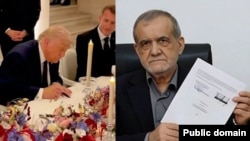
US President Donald Trump signed the memorandum of understanding on June 17 during a candlelit dinner at the Palace of Versailles following a Group of Seven (G7) summit.
A video shared by the White House and French President Emmanuel Macron on X shows Trump signing the document.
"This was not easy," Trump said as he signed the agreement, while host French President Emmanuel Macron and other guests applauded.
"This agreement paves the way for lasting peace and allows the reopening of the Strait of Hormuz," Macron said on X.
Iran's state news agency, IRNA, released photos showing Iranian President Masud Pezeshkian signing the agreement between Iran and the United States.
In the photos, the Iranian president holds the pages of the agreement up to the cameras, with both his signature and that of the US president visible.
Pakistani Prime Minister Shehbaz Sharif, whose government helped mediate the agreement, announced on X that the deal would take effect immediately.
With reporting by AFP and Reuters
We are now closing the live blog for the day. We'll be back at 7:30 a.m. Central European time to cover the latest events across the Middle East.
US Officials Disclose Details Of Framework Deal With Iran
WASHINGTON -- Senior US officials have disclosed details of the framework deal with Iran that is set to be officially signed during a ceremony in Switzerland on June 19.
The memorandum of understanding envisages ending the fighting on all fronts, including in Lebanon, reopening the Strait of Hormuz to commercial traffic, and ending the US naval blockade on Iran, according to the text read out on a background call with reporters on June 17.
Upon officially signing the deal, the two sides commit to agreeing to a final settlement in 60 days that includes limits to Iran’s nuclear program and the removal of US sanctions on the Islamic republic, the US officials said.
“This is fundamentally an agreement that allows us to open the Strait of Hormuz immediately, commits the Iranians to destroying the nuclear stockpile, and then gives us a dial,” one senior US official said.
The accord, which has already been signed electronically, marks the most sweeping US-Iran diplomatic breakthrough in years and comes after months of war, maritime disruption, and back-channel negotiations involving regional mediators.
Read more here
Iran Says Trump And Pezeshkian May Sign Peace Deal
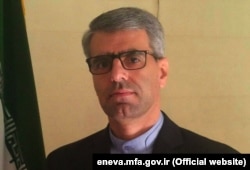
Iran's Foreign Ministry said US President Donald Trump and his Iranian counterpart, Masud Pezeshkian have signed the memorandum of understanding virtually as "a better option."
Earlier,the Iranian ministry said it was considering a plan for US President Donald Trump and his Iranian counterpart, Masud Pezeshkian, to sign the framework deal in Switzerland.
“So far, our plans for the Geneva meeting have not changed,” said ministry spokesman Esmaeil Baqaei on June 17. “Regarding the signing of the memorandum of understanding, one idea is that it be done by the presidents of the two countries, which is currently under review.”
Earlier, Trump told reporters at a G7 press conference in France that he “might” stick around for the signing ceremony.
The ceremony is set to take place in Switzerland on June 19, although Trump said it could happen on June 18.
US and Iranian officials had previously said US Vice President JD Vance and Iran’s parliament speaker and top negotiator, Mohammad Baqer Qalibaf, would sign the agreement.
US Achieved 'Regime Change' In Iran, Says Trump
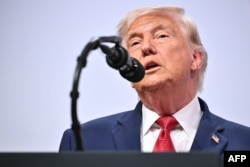
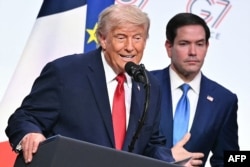
US President Donald Trump told reporters at the G7 meeting in France on June 17 that the United States had achieved regime change in Iran.
“You talk about regime change, nobody will say that, but I guess it is,” he said. “One set of leaders is all gone, the second set of leaders is all gone. Their third set of leaders is a little bit gone... I think that's regime change.”
Trump added that Iran now has a new group of leaders who are “smarter” and “far less radicalized,” saying he has achieved regime change.
Trump also said the framework deal with Iran will be signed “shortly.” “Tomorrow, maybe the next day,” he said at the G7 news conference, fueling uncertainty over the date.
Earlier, Trump said the agreement would be formally signed during a ceremony in Switzerland on June 19.
He added that a copy of the deal was shared with Israel, which he said was a “good partner,” despite expressing frustration with Israeli Prime Minister Benjamin Netanyahu in recent days.
Trump called him a “good man” but said he gets “a little excited sometimes.” Netanyahu could have “a little softer touch,” Trump said, adding: “You don’t have to knock down a building every time someone walks into it that’s from Hezbollah.”
During the news conference, Trump rejected US media reports that Iran could be given access to a reconstruction fund worth $300 billion as part of the deal to end the war.
“We don’t give them money,” he said. “We don’t give them any of that.”
He said negotiations over a final settlement will cover not just Iran’s nuclear program but “non-nuclear issues,” including Tehran’s “conventional ballistic missiles.”
Trump said he was advised to prevent Iran from having any missiles, but he said, “it doesn’t work that way.”
“They have to have some because other people have some, you’ve got to have some,” Trump added.
The US president also told reporters that he was prepared to “bomb the hell” out of Iran if Tehran violated the agreement.
“If they are not behaving, they will be hit again,” he said. But he added: “They don't want to get bombed, they don't want to get hit.”