




US Government Requests Additional $88 Billion In Funding, Mostly Related To Iran War
The US government has asked Congress for nearly $88 billion in additional funding. According to a statement on the White House website, the bulk of the request is for "urgent needs" related to the Iran war and the Ebola outbreak in Africa.
More than $67 billion of the requested budget is for the military; $21 billion of that is requested for the Pentagon, which the US Department of Defense will use to replace spent ammunition, bolster the military industry, and help with critical capabilities.
We are now closing the live blog for the day. We'll be back at 7:30 a.m. Central European time to cover the latest events across the Middle East.
Trump: Iran Is Making Big Concessions; They Agree To All My Demands
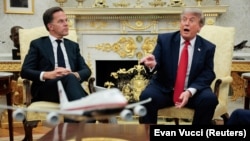
US President Donald Trump claimed major progress in talks with Tehran while reviving grievances against European allies over the recent US war against Iran.
Hosting NATO Secretary-General Mark Rutte at the White House on June 24, Trump told reporters that negotiations with Iran are advancing rapidly, asserting, that "Iran is making a lot of concessions and we are winning by a large margin."
Trump also reiterated that any attempts by Iran to introduce fees or tolls for ships passing through the Strait of Hormuz would be unacceptable.
With Iranian officials denying US immediate access to their damaged nuclear sites, Trump insisted Tehran has capitulated to oversight, including joint US and International Nuclear Energy Agency (IAEA) inspections. "They are agreeing to everything I want, and they have to; otherwise we will come back and do whatever is necessary," Trump warned speaking to journalists on a separate occasion on June 24 in Washington, D.C.
Trump used the meeting with Rutte to express resentment toward NATO members who opposed or distanced themselves from the conflict, telling the secretary-general that many allies "disappointed me" regarding Iran. Although Rutte defended European cooperation by highlighting vital logistical support and airspace access, Trump added that he wouldn't have gone to a NATO in Ankara on July 7-8, if it wasn't for Turkish President Recep Tayyip Erdogan who hosts it.
Rubio Says US 'Completely Aligned' With Gulf Allies In Iran Talks
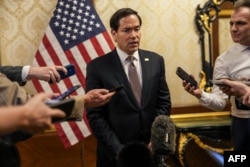
US Secretary of State Marco Rubio has sought to reassure Persian Gulf allies that Washington would remain “completely aligned” with regional partners as technical talks continue on a US-Iran memorandum of understanding signed last week and aimed at ending the conflict in the Middle East.
Speaking in Kuwait on June 24 during a tour of Gulf states, Rubio stressed that the United States was “not going to do anything that undermines the security of our allies” as negotiations move forward.
His trip to the United Arab Emirates, Kuwait, and Bahrain comes amid concerns among some Gulf governments that the proposed deal is too accommodating toward Tehran.
The memorandum, the first such accord signed by US and Iranian presidents since the 1979 Islamic Revolution, includes a proposed $300 billion fund for Iran's postwar reconstruction and the easing of some sanctions.
Rubio said technical negotiators would resume talks later this month, likely in Switzerland, to work out implementation details.
“If Iran wants to make a good and real deal, the United States is open to that,” he said, while warning that President Donald Trump still has “options” if diplomacy fails.
Iran Pushes Back Against Trump's Claims About Frozen Assets Amid Anger From Hard-Liners
- By Kian Sharifi
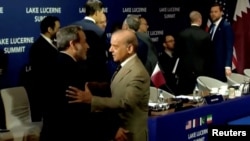
Iran has pushed back against US claims that any frozen Iranian assets released under a framework deal would be used to buy American agricultural products but stopped short of ruling it out, as the proposal sparked a sharp backlash from the country’s hard-liners.
The release of billions in Iranian funds held abroad is part of the memorandum of understanding (MOU) signed by Tehran and Washington on June 17 that aims to end months of war between the foes.
US President Donald Trump said on June 23 that any unlocked Iranian funds would be used to purchase American corn, soybeans, and wheat. The money, he said, would be held "in escrow, controlled by" Washington and spent "exclusively" on American food and medical supplies.
But Iranian Central Bank Governor Abdolnasser Hemmati swiftly denied there was such an obligation. "Based on the signed memorandum, we have no requirement to purchase agricultural inputs from America," he said.
Read more here
Shipping Increases In Strait Of Hormuz
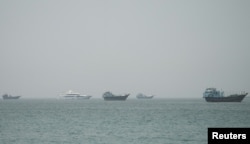
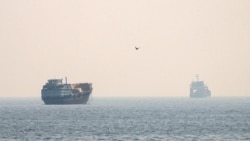
Shipping appears to be rapidly increasing in the Strait of Hormuz, with one maritime monitor tracking a 48 percent increase day-on-day on June 24 while the International Maritime Organization (IMO) said an operation to evacuate stranded seafarers was underway.
Shipping monitor Windward said in a daily brief that shipping had surged in the strait, which carried 20 percent of global oil supplies prior to the war, in “the clearest sign yet” that it was “moving toward functional commercial normalcy.”
The brief said traffic was boosted by the IMO corridor, announced on June 23, which is aimed at evacuating 11,000 seafarers on hundreds of vessels.
"Ships have already begun to pass under the plan," an IMO spokesperson said on June 24, declining to provide any details of the vessels that had crossed.
"The (IMO) framework was developed due to the continued degradation of navigational safety within the strait and concerns over elevated collision risks," British maritime risk management group Vanguard said in a note on June 24.
US Reopens Kuwait Embassy
KUWAIT CITY -- The US Embassy has reopened with a flag-raising ceremony attended by Secretary of State Marco Rubio, in a sign of normalcy returning to the Persian Gulf after the conclusion of a memorandum of understanding (MOU) between Washington and Tehran.
Operations at the embassy were suspended due to Iranian missile and drone strikes, as Tehran lashed out at US Gulf allies following the US and Israeli air strikes that began on February 28.
The State Department said emergency services for US citizens would be resumed immediately while full services would be phased in.
Rubio will shortly be meeting Sheikh Mishal Al-Ahmad Al-Jaber Al-Sabah, the Emir of Kuwait, before heading on to Bahrain.
Earlier on June 24, he held talks in the United Arab Emirates with President Sheikh Mohammed bin Zayed Al Nahyan and other senior figures. Talks focused on the MOU and shipping in the Strait of Hormuz, the State Department said.
Asked on arrival if he planned to address allies' disquiet with the accord, Rubio told reporters: "That most certainly will come up in these discussions."
Israeli Defense Minister Says Country's Forces Won't Withdraw From Lebanon
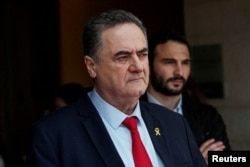
Israel will not withdraw its forces from Lebanon, Israeli Defense Minister Israel Katz said, as Tel Aviv and Beirut continued talks mediated by Washington.
“We have made it clear that under no circumstances will we withdraw,” Katz said at the MUNI EXPO conference in Tel Aviv on June 24, adding that he had outlined this stance to his US counterpart.
“As of this moment -- and this is a diplomatic achievement -- there is no American demand for Israel to withdraw from Lebanon,” he added.
Katz’s statement came as Israel and Lebanon discussed a US-backed proposal during negotiations in Washington that would see Israeli forces leave parts of the territory they have invaded and transfer control to Lebanese forces.
Speaking to reporters after the second day of talks had begun, a US State Department official said Israel and Lebanon were "negotiating as two sovereign states with the goal of finding long lasting peace and security."
"Our shared goal is to end the cycle of violence for good. The talks continue to advance a comprehensive peace and security between the two countries," the official added.
Israel began launching strikes targeting Hezbollah militants in Lebanon since the start of the US-Israeli war with Iran, when Hezbollah forces opened fire in support of Tehran. The MOU declares "the immediate and permanent termination of military operations on all fronts, including in Lebanon."
Hezbollah is a militant group and political party that controls much of southern Lebanon. It is considered a terrorist organization by the United States, while the European Union has blacklisted its armed wing.
With reporting by Reuters.
Iran Official Says 'No Plan' For IAEA To Inspect Nuclear Sites

Iranian Deputy Foreign Minister Kazem Gharibabadi said there is currently "no plan" for the International Atomic Energy Agency (IAEA) to inspect Iran's nuclear sites, and Tehran would only negotiate issues related to the country's nuclear sites and enriched nuclear material within the framework of a final agreement with the United States.
"These discussions will be reviewed and determined solely within the framework of the final agreement," Gharibabadi wrote in a post on X on June 24, adding it will also depend on Washington showing "practical steps" to lift its sanctions on Tehran.
Gharibabadi's comment came after IAEA Director-General Rafael Grossi announced on June 25 that the UN agency's inspectors will visit Iran's nuclear enrichment sites damaged during the Israeli-Iranian war last year and after US President Donald Trump said the agency would go to Iran "at the appropriate time."
"There is no plan to access the attacked facilities or nuclear materials," Gharibabadi said. He also claimed Grossi had requested a meeting with Iranian officials in Switzerland but that the request was denied.
Pakistan Announces Fresh US-Iran Technical Talks Amid Diplomatic Tensions
Pakistan, which has been mediating peace talks between the United States and Iran, announced on June 24 that a new round of technical talks between the two countries was set to take place next week.
"Talks will resume next week," Pakistani Foreign Ministry spokesman Tahir Andrabi told journalists in Islamabad, providing no details about the potential venue.
Andrabi's announcement came amid intensified regional diplomacy as US Secretary of State Marco Rubio began a Gulf tour aimed at reassuring Washington's closest Arab allies, while Iranian Parliament Speaker Mohammad Baqer Qalibaf traveled to Oman and Azerbaijan.
At the same time, tensions between Washington and Tehran over a final peace deal remained elevated.
While oil exports and shipping traffic through the Strait of Hormuz have begun to recover after months of its effective closure, more than 1,000 ships were reportedly stuck in the Persian Gulf as of June 24.
The issue of safe passage through the waterway remains key to the final resolution of the conflict. As Iran has been seeking to impose a tolling system on transit through the strait, Rubio insisted the Strait of Hormuz is an international waterway, rejecting the possibility.
"No country is allowed to charge tolls or fees on an international waterway. That's existing international law," he said as he arrived in the United Arab Emirates on June 23.
Meanwhile, speaking at a news conference in Azerbaijan, Qalibaf described the temporary deal between the United States and Iran as a "declaration of America's defeat," adding that security in the Middle East should be managed by regional countries.