


IAEA Chief Grossi Calls For 'Very Strong' Verification System For Iran
International Atomic Energy Agency (IAEA) head Rafael Grossi said that a "very strong" verification system is needed in Iran to ensure the country does not develop nuclear weapons and complies with any US-Iran peace accord.
"I think the objective of this agreement is to ensure that there is no development of nuclear weapons in Iran," Grossi said on June 26, referring to the memorandum of understanding (MOU) between the United States and Iran signed last week.
"The government of Iran has clearly stated that this is not their intention," Grossi told reporters in Japan.
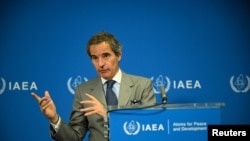
"But of course, intentions are not enough. We need a very strong verification system in place as soon as practicable," he added.
"There is an agreement and to comply with that agreement, the IAEA will have to have access and inspect," Grossi said after Tehran indicated that key sites would remain off-limits until a final deal with Washington is reached and sanctions are lifted.
According to the provisions of the memorandum of understanding signed by the US and Iranian presidents on June 17, Iran reaffirmed that it would not procure or develop nuclear weapons. It also agreed that its stockpiled enriched uranium would be downblended on-site under the supervision of the International Atomic Energy Agency (IAEA).
Iran continues to deny any intention of developing nuclear weapons, while insisting on its right to maintain a full civilian nuclear program.
With reporting from AFP and Reuters
We are now closing the live blog for the day. We'll be back at 7:30 a.m. Central European time to cover the latest events across the Middle East.
Talks Between Israel, Lebanon Extended In US
Talks between Israel and Lebanon, which were scheduled to end on June 25, will be extended for another day, the US State Department said.
The talks will resume early on June 26, US officials said. Washington is hosting and mediating the negotiations.
"Israel and Lebanon talks remain ongoing as we continue to facilitate," the State Department said in a statement.

The talks take place amid a shaky cease-fire between Israel and Iran-allied Hezbollah. The conflict is an offshoot of the US and Israeli war with Iran, which is also under a cease-fire.
Iran-backed Hezbollah, a militant group and political party that controls much of southern Lebanon, is considered a terrorist organization by the US, while the EU has blacklisted its armed wing but not its political branch.
Israel has continued to pound Hezbollah-linked sites in southern Lebanon and in the capital, Beirut, saying the attacks are in defense against the militant group's missile launches into Israel.
With reporting by AFP
FIFA Says Pride Flags To Be Allowed In Stadium For Iran-Egypt Match
FIFA, the world soccer governing body, has reiterated that LGBT rainbow flags will be allowed inside Seattle's Lumen Field for the World Cup match between Iran and Egypt, despite objections from both countries' soccer federations.
The June 26 game, part of city-wide events to celebrate Pride in the northwestern US city, was designated as the "Pride Match" by local officials before it was known which teams would be involved.
Officials from both Iran and Egypt have raised objections to the Seattle Pride celebrations involving their match.
Homosexuality is illegal in Iran under Islamic law and can be punishable by death.
In Egypt, homosexuality is often penalized under vaguely worded laws prohibiting "debauchery."
FIFA said the LGBT rainbow flag would be allowed inside the stadium.
"The FIFA World Cup 2026 is an inclusive event. Fans of all sexual orientations and gender identities are welcome," a spokesperson said.
With reporting by AFP
Trump Again Insists US 'Soon' To Buy Farm Goods With Unfrozen Iranian Funds
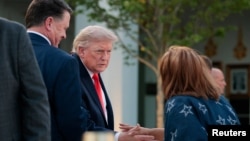
President Donald Trump continued to insist that the US would "soon" buy wheat, soybeans, and corn from American farmers using Iranian assets that have been frozen for years under US sanctions.
Trump said Iran is facing food shortages and that the US would use "some of Iran's money" to buy the farm goods for the country from American farmers.
"We have a new market coming up, and that's called the lovely country of Iran," he said in comments at the White House on June 25.
"It's a beautiful place -- would anybody like to go there? The Islamic republic of Iran."
"They're having a hard time with food, and we're going to be taking some of their money, and we'll spend it, and we're going to be buying wheat, soybeans, and corn, a lot of it, and that process is going to be starting soon. It's going to be pretty big," he added.
Tehran earlier pushed back against similar US claims that any unfrozen assets released under a framework deal would be used to buy US agricultural products, although it stopped short of ruling it out, as the proposal sparked a sharp backlash from the Iran’s hard-liners.
The release of billions in Iranian funds held abroad is part of the memorandum of understanding (MOU) signed by Tehran and Washington on June 17 that aims to end months of war between the foes.
Trump on June 23 said any unlocked Iranian funds would be used to purchase American corn, soybeans, and wheat. The money, he said, would be held "in escrow, controlled by" Washington and spent "exclusively" on American food and medical supplies.
Iranian Central Bank Governor Abdolnasser Hemmati swiftly denied there was such an obligation. "Based on the signed memorandum, we have no requirement to purchase agricultural inputs from America," he said.
Iranian Foreign Ministry spokesman Esmaeil Baqaei said Tehran would decide how to use any released assets "in whatever way is in the country's interest."
"Therefore, there are no restrictions in this regard," he said.
In a news conference in Switzerland last week, US Vice President JD Vance said the administration is looking to use unfrozen Iranian funds to buy US agricultural products.
Bloomberg News quoted StoneX chief commodities economist Arlan Suderman as saying: “I remain skeptical of Iranian purchases of US ag commodities, but the possibility must be respected. That may end up being an area that Iran gives on in order to get what it wants in another area of the talks.”
US sold large volumes of corn, wheat, and rice prior to Iran’s 1979 Islamic Revolution. Since then, however, Iran has established agricultural trade flows with other countries.
With reporting by Bloomberg News and Reuters
Iranians Struggle For Their Daily Bread
Soaring costs and supply shortages exacerbated by the war with the United States and Israel have left much of Iran's infrastructure and industries in tatters, fueling runaway inflation and joblessness.
Bread has historically been among the few staples kept affordable through government subsidies, with the state supplying flour to bakeries at low prices.
But bread prices have doubled from a year ago in places such as Tehran, leaving many struggling to put the staple on their dining tables.
"Things are very bad," one woman in the capital told RFE/RL, "and we're actually better off than a lot of people."
Read the full report here.
UN Maritime Agency Pauses Hormuz Evacuation After Ship Attack
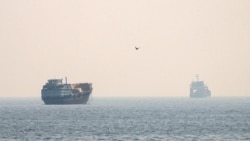
The International Maritime Organization (IMO) has temporarily suspended an operation to evacuate thousands of seafarers from the Strait of Hormuz after a vessel was attacked in the Gulf of Oman, the UN agency said on June 25.
IMO Secretary General Arsenio Dominguez said he had decided to pause the operation "to reconfirm that the necessary safety guarantees continue to be in place for the ships on our evacuation list and all those in the region."
The decision followed an attack earlier on June 25 on a vessel that had transited the Strait of Hormuz. "This vessel did not transit under IMO's evacuation framework," Dominguez said.
The IMO did not identify the vessel or provide details of the attack. The UKMTO shipping security monitor had previously reported a cargo vessel being struck on June 25 by an “unknown projectile” 7.5 nautical miles southeast of Dahit, Oman.
The IMO announced on June 23 that it would evacuate more than 11,000 seafarers stranded in the strait after weeks of disruption caused by attacks on commercial shipping in the region amid the US-Israel conflict with Iran.
Although shipping traffic has begun to recover following a framework US-Iran agreement, uncertainty remains over reported Iranian naval mines in the waterway.
With reporting by dpa
Cargo Vessel Hit By Projectile Off Oman, Says Shipping Monitor
A cargo vessel was struck by an “unknown projectile” 7.5 nautical miles southeast of Dahit, Oman, on June 25, according to the United Kingdom Maritime Trade Operations (UKMTO), which monitors shipping security in the region.
UKMTO said the vessel was hit on its starboard side, causing damage to the bridge. The captain reported no casualties and no environmental impact.
The incident comes as the United States and Iran remain at odds over navigation through the Strait of Hormuz. Under a June 17 framework agreement, Iran pledged to make its "best efforts" to ensure toll-free passage for 60 days, but Iranian officials have since said they intend to charge "service fees" for vessels using the waterway.
UKMTO advised vessels to transit with caution and report any suspicious activity.
US And Gulf States Back Iran Nuclear Talks But Warn Sanctions Relief Is 'Reversible'
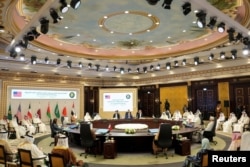
MANAMA -- The United States and Persian Gulf Arab states have backed ongoing diplomacy with Iran but warned that any economic benefits from a recent framework agreement, which paves the way for negotiations on Iran's nuclear program, could be quickly withdrawn if Tehran fails to meet its commitments or continues activities they view as destabilizing.
The warning came in a joint statement issued on June 25 after a ministerial meeting between US Secretary of State Marco Rubio and foreign ministers from the Gulf Cooperation Council (GCC) in Bahrain.
The statement welcomed the June 17 memorandum of understanding between Washington and Tehran as an important step toward reducing regional tensions and praised mediation efforts by Qatar and Pakistan.
But the ministers stressed that any lasting agreement must prevent Iran from developing a nuclear weapon and address what they called the "full spectrum" of Iranian threats, including its ballistic missile and drone programs, as well as support for armed groups across the Middle East.
They said future trade and investment with Iran would be "conditional and reversible," depending on Tehran's compliance with the memorandum and any final agreement reached in ongoing negotiations.
The ministers also called for unrestricted navigation through the Strait of Hormuz, rejecting any attempt to impose tolls or fees on shipping in the waterway.
Beyond Iran, the statement reaffirmed support for reconstruction in Syria, Lebanon's sovereignty and efforts to disarm non-state armed groups, and US-led efforts to end the war in Gaza while opposing the forced displacement of Palestinians.
It also condemned attacks by Iran-aligned groups in Iraq against Gulf states.
Iran Denies Unfrozen Funds Will Be Used To Purchase US Crops
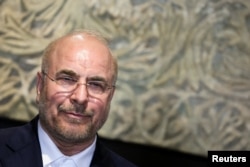
Iran's parliament speaker and top negotiator, Mohammad Baqer Qalibaf, has dismissed claims that Tehran will use its unfrozen assets to buy US agricultural products, calling them false.
"The US only exports GMO soybeans, broken promises and trash talks," Qalibaf said in an X post on June 25, a day after US President Donald Trump said that released Iranian assets will be "totally controlled" by the United States.
"We will be releasing some of their money, that is totally controlled by us, to our Farmers and Ranchers, for the purchase of Corn, Wheat, Soybeans, and more," Trump said in a Truth Social post on June 24.
He added that Iran "desperately needed" food and insisted that "we will be purchasing it for them exclusively from the United States," following a deal with Washington.
The release of billions in Iranian funds held abroad is part of the memorandum of understanding (MOU) signed by Tehran and Washington on June 17 that aims to end months of war between the countries.
The prospect of purchasing US agricultural products using unfrozen funds has not gone down well with hard-liners in Iran, who say Iran is "gifting" billions to that United States and making its food security dependent on US farmers.