




US European allies and Japan express readiness for "appropriate" efforts to secure passage through the key Strait of Hormuz, as the already widespread conflict in the Middle East threatens to spin out of control, although three countries emphasized any effort would only occur after a cease-fire.
"We express our readiness to contribute to appropriate efforts to ensure safe passage through the Strait," said a joint statement from the leaders of the United Kingdom, France, Germany, Italy, the Netherlands, and Japan published on March 19.
"We welcome the commitment of nations who are engaging in preparatory planning," it added, while also criticizing Tehran for its recent attacks on civilian vessels and energy infrastructure in the region.
The statement did not outline specific parameters of the contributions by European nations and Japan, a country that was shipping most of it oil through the Strait of Hormuz.
Later, Italy, Germany, and France stressed that they were considering a potential multilateral initiative after a cease-fire, not an immediate military mission.
"No entry into Hormuz without a truce and a comprehensive multilateral initiative [in which it is right and appropriate for the United Nations to provide the legal framework," Italians Defense Minister Guido Crosetto said.
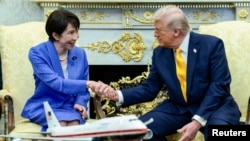
Shortly after the initial statement was released, US President Donald Trump, who recently lashed out at his NATO allies for declining to be directly present in the area to secure shipping, met with Japanese Prime Minister Sanae Takaichi at the White House.
Takaichi condemned Iran's retaliatory attacks and told Trump that only he could achieve peace worldwide, while the US president reiterated it is in the interest of the affected countries to secure passaging in the Strait of Hormuz.
"We don't use the strait... And then, in the case of NATO, they don't want to help us to defend the strait and they're the ones that need it," Trump told reporters at the White Hosue.
"But now they're getting much nicer because they're seeing my attitude," he added.
Effectively closed for civilian shipping, the Strait of Hormuz has become a major driver of disruptions at the global energy market. As of March 19, oil prices continued to rise, with benchmark Brent crude increasing more than 5 percent to $112.84 a barrel.
Attacks On Gulf's Energy Infrastructure
The developments came as Israel and Iran exchanged attacks on energy infrastructure across the Persian Gulf, with the war continuing to spill over with violence to the areas untouched by it before.
Late on March 18, Tel Aviv said its military forces launched air strikes in the north of Iran for the first time since the beginning of the conflict on February 28. According to Israeli media, Israeli warplanes were attacking Iranian naval vessels at the port city of Bandar Anzali on the Caspian Sea coast.
"The Israeli Air Force, acting on navy and [Israel Defense Forces] intelligence, began striking targets in northern Iran for the first time during Operation Roaring Lion," the military said, referring to Israel's name for the campaign.
Separately, Iran said its massive South Pars gas field was also hit on March 18 in the first reported strike on the country's Gulf infrastructure since the US-Israeli bombing campaign began.
Israeli media reported the attack was carried out by Israel with US consent, but Trump later said on Truth Social that Washington did not know about the attack in advance, saying Israel had "violently lashed out" at the key energy site.
In a later comment, Israeli Prime Minister Benjamin Netanyahu confirmed that Tel Aviv acted alone in carrying out the strike on South Pars, adding that the United States had requested holding off on such attacks in the future.
Tehran retaliated by firing at the region's Arab countries' oil and gas facilities.
Iran issued an evacuation warning for several oil facilities across Saudi Arabia, the United Arab Emirates, and Qatar, saying they would be targeted by strikes "in the coming hours."
Soon after, a fire at Qatar's main gas hub, Ras Laffan, was reported. Early on March 19, Iran said it had again attacked the facility, with Qatari officials saying the latest strikes caused fires and "extensive damage" to the site.
QatarEnergy's CEO Saad al-Kaabi said Tehran's attacks knocked out 17 percent of the country's liquefied natural gas (LNG) export capacity and caused around $20 billion in lost annual revenue.
Trump vowed there would be no more Israeli attacks on the "extremely important and valuable" South Pars site.
However, he warned Tehran that US forces would "massively blow up" the entire facility if Iran attacked Qatar again. It wasn't immediately clear if Trump knew about the reported second Iranian strike at the Qatari site.
On March 19, US Director of National Intelligence Tulsi Gabbard said the war objectives "laid out by the president are different from the objectives that have been laid out by the Israeli government."
Hours after, Netanyahu denied he has dragged the United States into the conflict: "Does anyone really think that someone can tell President Trump what to do?"
He also claimed weeks of US-Israeli air strikes was left Iran with no capacity to continue its ballistic missile program or enrich uranium.
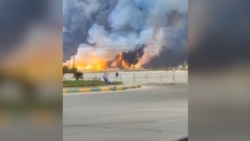


In another apparent assault on the energy sector, Saudi Arabia said it had destroyed four ballistic missiles headed toward Riyadh and reported an attempted drone attack on a gas facility in the east.
In Abu Dhabi, United Arab Emirates, operations were suspended at the Habshan gas facility as authorities responded to two incidents of fallen debris after the interception of a missile.
Israeli media reported that another Iranian attack hit an oil refinery in Haifa, causing damage but no casualties.

