




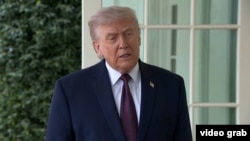
US President Donald Trump said the United States and Iran are "very close" to a deal to end the war and that US and Iranian negotiators could meet for a second round of talks this coming weekend.
"We're going to see what happens. But I think we're very close to making a deal with Iran," Trump told reporters outside the White House on April 16, repeating the word "close" more than once and adding, "There's a very good chance we're going to make a deal."
In an event later in Las Vegas, Trump repeated the sentiment, telling a crowd that the war was going "swimmingly" and that it "should be ending pretty soon."
Trump gave few details about potential elements of an agreement to end the war that began with US and Israeli air strikes on Iran on February 28, but said Iran has agreed to "give us back the nuclear dust," meaning its stocks of enriched uranium, which at a certain level of enrichment is a key ingredient in a nuclear weapon.
He said he wasn’t sure a two-week cease-fire that expires April 22 will need to be extended and that “if there’s no deal…fighting resumes,” though he didn’t specify a timeline.
Trump also reiterated an announcement he made on social media hours earlier, saying Israel and Lebanon have agreed to a 10-day cease-fire starting April 16 at 5 p.m. US Eastern time, and that the cease-fire incudes Hezbollah.
A militant group and political party that controls much of southern Lebanon, Hezbollah is considered a terrorist organization by the United States, while the European Union has blacklisted its only armed wing.
Trump said he expects to host Israeli Prime Minister Benjamin Netanyahu and Lebanese President Joseph Aoun at the White House within a week or two. In a video statement, Netanyahu said he agreed to the 10-day cease-fire and that there was a chance to make an historic deal with Lebanon after decades of conflict.
Seeking 'Lasting Peace'
"The US hopes this cease-fire will help accelerate discussions between Lebanon and Israel to achieve a permanent peace agreement between the two countries," a senior White House official said on condition of anonymity. The US State Department issued a statement that was agreed to by Israel and Lebanon and said the 10-day cease-fire could be extended by mutual agreement.
"Lebanon and Israel have reached an understanding in which both nations will work to create conditions conducive to lasting peace between the two countries, full recognition of each other's sovereignty and territorial integrity, and establishing genuine security along their shared border, while preserving Israel’s inherent right to self-defense," it said.
Israel has been launching strikes targeting Iran-backed Hezbollah militants in neighboring Lebanon since March 2, two days after the start of the US-Israeli war with Iran, when Hezbollah forces opened fire in support of Tehran. An ongoing two-week cease-fire in the Iran war has not applied to Lebanon.
The current Israeli campaign against Hezbollah in Lebanon comes 15 months after another major outbreak of hostilities.
Iranian authorities have repeatedly said that an end to Israeli attacks on targets in Lebanon was a requirement for its own peace negotiations with the United States. Pakistan, for its part, has said that peace in Lebanon is crucial for its efforts to mediate between the United States and Iran.
Following the announcement, the Iranian government hailed the cease-fire and said it was part of the earlier two-week cease-fire reached between Iran and the US, according to Iranian state media.
'Good Relationship With Iran'
Trump asserted that Tehran wants to make a deal.
"We have a very good relationship with Iran right now, as hard as it is to believe. And I think it's a combination of about four weeks of bombing and a very powerful blockade," he said, referring to a US blockade in place since April 13 and aimed at preventing ships from entering or leaving Iranian ports.
The question of Hezbollah's adherence to a truce is crucial. Reuters cited senior Hezbollah lawmaker Hassan Fadlallah as saying earlier in the day that the group had been informed by Iran's ambassador to Lebanon that a one-week cease-fire could begin on April 16.
"Asked if Hezbollah would commit to the truce, Fadlallah said everything was tied to Israel's commitment to halt all forms of hostilities, and credited Iran's diplomatic efforts for the possible cease-fire," Reuters reported.
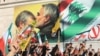
Trump's cease-fire announcement came two days after the Israeli and Lebanese ambassadors to Washington met, the first major high-level engagement between the two governments in more than three decades. The meeting ended with the sides agreeing to launch direct negotiations at a mutually agreed time and venue.
The gap between Israel and Lebanon had remained wide ahead of the announcement: Lebanon made a full cease-fire its precondition for further talks while Israel refused, with a spokesman for Netanyahu saying there would be no cease-fire with Hezbollah. Netanyahu has said the Israeli campaign's goal is the disarmament of Hezbollah.

More than 2,100 people have been killed in Lebanon since the renewed fighting began and over 1 million displaced, according to Lebanese health officials. Hezbollah attacks have killed two Israeli civilians, while 13 Israeli soldiers have died in Lebanon since March 2, Israel says.
Possible Second Round Of Peace Talks
An initial round of Iran-US peace talks took place in Islamabad on April 11-12 and ended without an agreement. The White House said on April 15 that a potential second round would likely again be held in Pakistan.
A Pakistani military delegation led by army chief Asim Munir landed in Tehran on April 15 carrying a new message from Washington, in the latest effort to revive negotiations.
Hegseth: Iran Will Never Have A Nuclear Weapon
US Defense Secretary Pete Hegseth told reporters on April 16 that Washington "will ensure that Iran will never have a nuclear weapon" and called on Tehran to "choose a deal which is within your grasp."
Dan Caine, chairman of the Joint Chiefs of Staff, said US forces remain “postured and ready” to resume military operations “at a moment’s notice.”
On April 17, attention will also turn to a separate but linked crisis as French President Emmanuel Macron and British Prime Minister Keir Starmer co-chair a video conference aimed at restoring freedom of navigation in the Strait of Hormuz, a vital waterway that has been largely choked off since the start of the Iran war.

Discussions are expected to cover possible financial sanctions on Iran if it continues blocking the waterway, alongside steps to work with the shipping industry to resume transit.
Iran's Islamic Revolutionary Guards Corps (IRGC) has carried out several confirmed attacks on merchant ships and reportedly laid sea mines in the strait in retaliation for the US-Israeli aerial campaign. Begore the war, the Strait of Hormuz carried roughly a quarter of the world's seaborne oil and a fifth of its liquefied natural gas.
A European official familiar with the summit told RFE/RL that Europe would take action only after there is a peace agreement between Iran and the United States. The official said the EU's "substantial" reluctance to join a military effort to reopen the strait stems from the lack of anti-drone defenses in the bloc's naval capabilities.
"Even our brand-new minehunter that will be operational in September doesn't have anti-drone tech onboard," the source said.
The conference, the official said, is meant to serve as "a gesture of goodwill to Trump...with the goal not to torpedo the NATO Ankara Summit," scheduled for July 7-8. Trump has expressed his disappointment with NATO for not joining the war with Iran.
The United States is not participating in the Paris summit after Trump said securing the waterway was not Washington's responsibility. Trump has instead ordered a separate naval blockade of Iranian ports, which Britain has declined to join.
"For as long as it takes, we will maintain this blockade," Hegseth said.

