


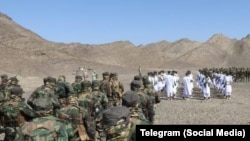
The Sunni militant group Jaish al-Adl says it has joined forces with several smaller Baluch paramilitary groups to form a new coalition targeting Iran’s clerical establishment.
In a video statement released on social media platforms, an unidentified spokesman said the new group would be called the Popular Resistance Front and framed its creation as an effort to “strengthen the effectiveness of the struggle” against the “tyranny” of the Islamic republic.
Notably, there was no explicit mention of Baluch independence, with the spokesman instead appealing to broader Iranian unity against the establishment.
Jaish al-Adl appears to have shifted from its original separatist agenda to presenting itself as part of a wider Iranian opposition movement, marking a significant evolution in its stated objectives.
Abdul-Sattar Doshouki, director of the London-based Center for Balochistan Studies, made a similar observation, telling RFE/RL’s Radio Farda that the new group’s flag bears no symbol associated with Baluch separatist movements.
“This may suggest that Jaish al-Adl has slightly moved away from its traditional stance,” he said.
Doshouki noted that since the Islamic Republic came to power in 1979, Baluch militant groups have been driven by religious or ethnic grievances against Iran’s Shi’ite rulers, adding that only time will tell whether this apparent shift is genuine.
He added that Jaish al-Adl remains the coalition’s largest and most prominent member, while its other partners have been largely dormant in recent years.
There has been no official reaction from Tehran to the new coalition’s formation so far.
Fars news agency, which is affiliated with the Islamic Revolutionary Guards Corps (IRGC), has downplayed the announcement, claiming that Jaish al-Adl is merely “shedding its skin” to attract potential financial backers.
Iran has long accused the United States, Israel, and Saudi Arabia of arming Jaish al-Adl but has not publicly provided evidence.
Analysts told RFE/RL last year that the group’s main funding comes from wealthy Baluchis based in Persian Gulf states and from drug smuggling, rather than foreign governments, while weapons from post-2021 Afghanistan and black market purchases also help supply the group.
Observers have also noted that Jaish al-Adl has begun raising funds through cryptocurrency donations.
Jaish al-Adl, meaning “Army of Justice” in Arabic, emerged in 2012 as the successor to Jundullah, a Baluch militant organization.
Jundullah, which took shape around 2003, staged sporadic bombings and armed assaults against Iranian security forces before being largely dismantled in a fierce government crackdown that culminated in the capture and execution of its leader, Abdolmalek Rigi, in 2010.
Tehran accuses Jaish al-Adl of operating from Pakistan and has repeatedly criticized Islamabad for failing to take action against the group -- an allegation Pakistan denies, saying the organization has no structured presence on its soil.
Jaish al-Adl is designated as a terrorist organization by both Iran and the United States. A US State Department spokesperson told RFE/RL that Jaish al-Adl "under any name remains designated as a Foreign Terrorist Organization and a Specially Designated Global Terrorist."
RFE/RL has contacted the US State Department to clarify whether that designation extends to the newly formed “Popular Resistance Front.”
On the same day it announced its formation, the group claimed responsibility for a deadly attack on an IRGC border patrol in Iran’s southeastern Sistan-Baluchistan province, killing three members of the IRGC Ground Forces.