An Armenian convoy of 19 trucks, which have been blocked by an Azerbaijani checkpoint at the beginning of the Lachin Corridor into Nagorno-Karabakh
A convoy of 19 Armenian trucks carrying emergency food aid to Nagorno-Karabakh remains blocked at an Azerbaijan checkpoint, where it has been waiting for approval to access the Lachin Corridor for three days.
The corridor is the only route linking Armenia with the breakaway region, and has been blocked by Baku for more than seven months. Armenia on July 28 vowed not to turn back the convoy, with Armenian Deputy Foreign Minister Vahan Kostanian saying that although "there are no positive developments at the moment," the vehicles will continue to stay there "as long as necessary."
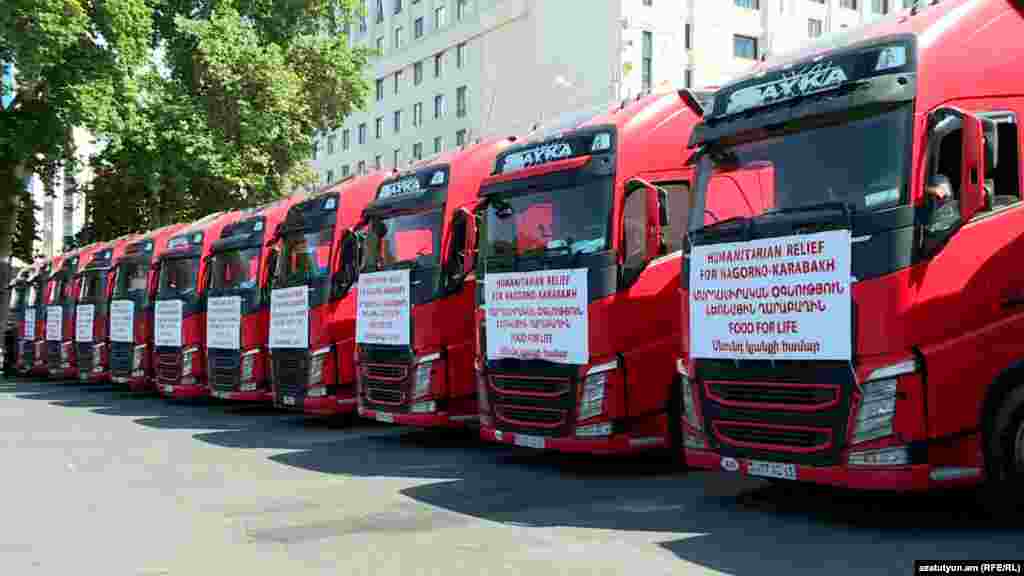
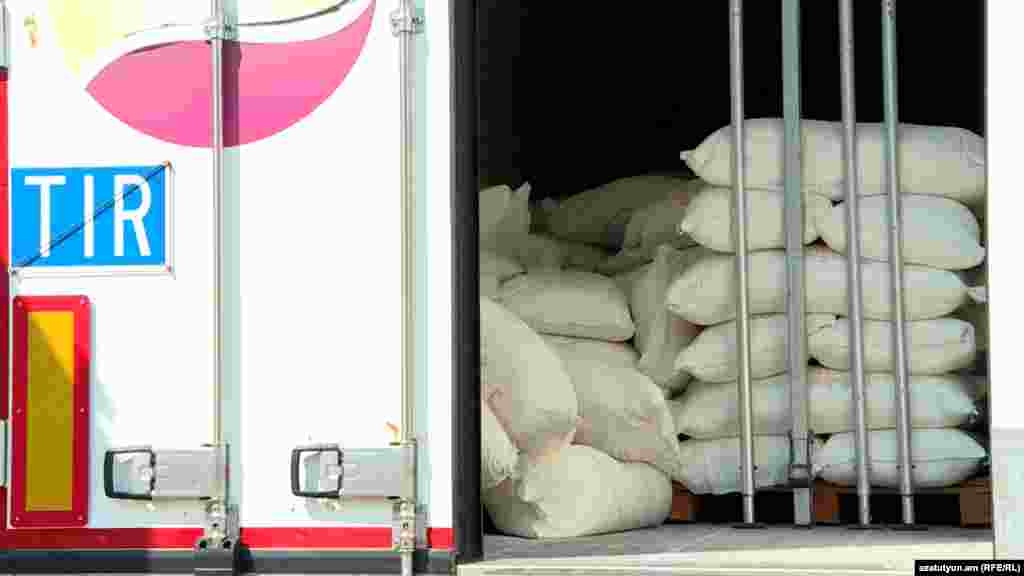
The Armenian government said on July 25 that it would try to send 360 tons of flour, cooking oil, sugar, and other basic foodstuffs to Nagorno-Karabakh to alleviate severe food shortages there caused by the blockade.
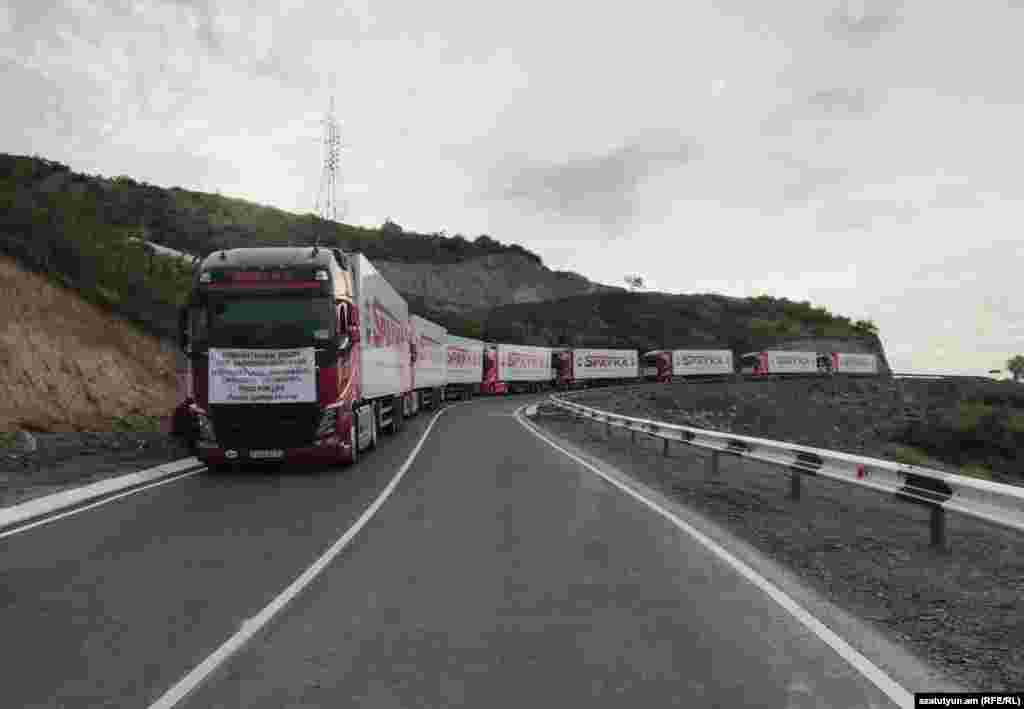
The trucks reached the entrance to the Lachin Corridor late on July 26 but remained stranded there in the following hours, with Baku refusing to let them though an Azerbaijani checkpoint set up there in April.
"We will try to ensure the opening of the Lachin Corridor through all the political means available to us. The trucks will continue to stay here at the moment," Kostanian told the media in front of the convoy.
He was accompanied by representatives of the diplomatic corps and international organizations accredited in Armenia.
Armenian officials had expressed hope that Russian peacekeepers would escort the relief supplies.
But Vardan Sargsian, a representative of the Nagorno-Karabakh separatists, told the media late on July 27 that no progress has been made and that the Russian side has not responded yet to the request.
Nagorno-Karabakh Crisis: Last-Ditch Armenian Aid Effort Blocked By Azerbaijan
1/9Trucks in Yerevan filled with what Armenia says is humanitarian aid. The photo was taken on July 26, shortly before 19 trucks set off on the journey southeast toward Nagorno-Karabakh.
A convoy of trucks, which Yerevan says is carrying aid for ethnic Armenians in the breakaway Azerbaijani region of Nagorno-Karabakh, has been described as a "provocation" by Baku as international humanitarian organizations call for the reopening of the Lachin Corridor, the primary road connecting Nagorno-Karabakh with Armenia.
2/9A view inside one of the trucks, which were reported to be carrying 360 tons of "essential food and goods," intended for Nagorno-Karabakh.
Nagorno-Karabakh is a breakaway region of Azerbaijan that is populated primarily by ethnic Armenians. A monthslong blockade of the road connecting Nagorno-Karabakh to Armenia escalated dramatically in mid-June when Azerbaijan began to stop all supplies entering the territory from Armenia.
A convoy of trucks, which Yerevan says is carrying aid for ethnic Armenians in the breakaway Azerbaijani region of Nagorno-Karabakh, has been described as a "provocation" by Baku as international humanitarian organizations call for the reopening of the Lachin Corridor, the primary road connecting Nagorno-Karabakh with Armenia.
3/9The truck convoy stopped on a road near Nagorno-Karabakh on July 26.
The trucks reached an Azerbaijani checkpoint that was controversially set up in April on the Lachin Corridor, the main road connecting Armenia with Nagorno-Karabakh, but was prevented from driving through. The Azerbaijani Foreign Ministry has condemned the aid convoy as a "provocation."
A convoy of trucks, which Yerevan says is carrying aid for ethnic Armenians in the breakaway Azerbaijani region of Nagorno-Karabakh, has been described as a "provocation" by Baku as international humanitarian organizations call for the reopening of the Lachin Corridor, the primary road connecting Nagorno-Karabakh with Armenia.
4/9A rally in Yerevan held on July 25 calling for the Lachin Corridor to be opened.
The International Committee of the Red Cross (ICRC) on July 25 released a statement saying "despite persistent efforts, the ICRC is not currently able to bring humanitarian assistance to the civilian population through the Lachin corridor or through any other routes..."
A convoy of trucks, which Yerevan says is carrying aid for ethnic Armenians in the breakaway Azerbaijani region of Nagorno-Karabakh, has been described as a "provocation" by Baku as international humanitarian organizations call for the reopening of the Lachin Corridor, the primary road connecting Nagorno-Karabakh with Armenia.
5/9The July 25 protest marches through a motorway tunnel in Yerevan.
The ICRC say the last time they were able to bring medicines and essential food items through Azerbaijan's blockade, "was several weeks ago."
A convoy of trucks, which Yerevan says is carrying aid for ethnic Armenians in the breakaway Azerbaijani region of Nagorno-Karabakh, has been described as a "provocation" by Baku as international humanitarian organizations call for the reopening of the Lachin Corridor, the primary road connecting Nagorno-Karabakh with Armenia.
6/9Crowds inside blockaded Stepanakert, the largest city in Nagorno-Karabakh, watch a livestream of the Yerevan protest on July 25.
Azerbaijan has called for the disbanding of the de facto government of Nagorno-Karabakh and claims Karabakh Armenians will have the same rights as other Azerbaijani citizens. But several brutal murders of ethnic Armenians blamed on Azerbaijani soldiers inside territory retaken during the war over Nagorno-Karabakh that broke out in 2020 has left some observers fearing the worst if control of the region is handed back to Baku.
A convoy of trucks, which Yerevan says is carrying aid for ethnic Armenians in the breakaway Azerbaijani region of Nagorno-Karabakh, has been described as a "provocation" by Baku as international humanitarian organizations call for the reopening of the Lachin Corridor, the primary road connecting Nagorno-Karabakh with Armenia.
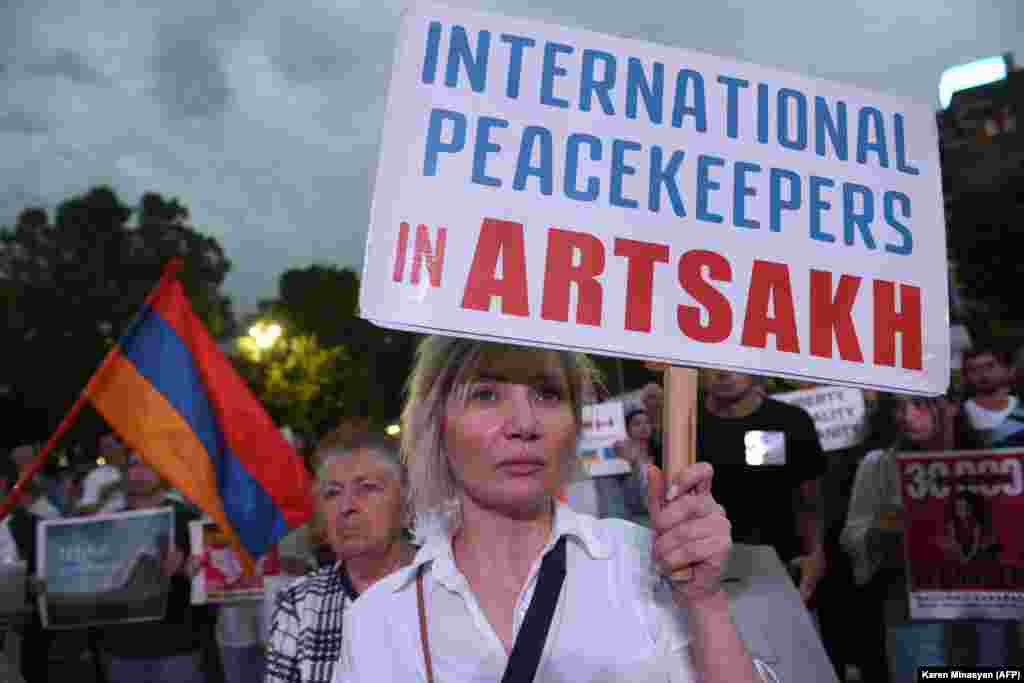
7/9A woman calling for intervention in Nagorno-Karabakh, which Armenians refer to as Artsakh.
A convoy of trucks, which Yerevan says is carrying aid for ethnic Armenians in the breakaway Azerbaijani region of Nagorno-Karabakh, has been described as a "provocation" by Baku as international humanitarian organizations call for the reopening of the Lachin Corridor, the primary road connecting Nagorno-Karabakh with Armenia.
8/9Ararat Mirzoyan (left), Sergei Lavrov and Jeyhun Bayramov, the foreign ministers of Armenia, Russia and Azerbaijan, respectively, meet in Moscow on July 25.
During this July 25 meeting Moscow appeared to call for Armenia to accept Azerbaijani ruleover the Nagorno-Karabakh region.
A convoy of trucks, which Yerevan says is carrying aid for ethnic Armenians in the breakaway Azerbaijani region of Nagorno-Karabakh, has been described as a "provocation" by Baku as international humanitarian organizations call for the reopening of the Lachin Corridor, the primary road connecting Nagorno-Karabakh with Armenia.
9/9Protestors in Yerevan on July 25.
A regional official inside Nagorno-Karabakh told journalists that the situation is becoming increasingly severe, with "no sugar, no cooking oil, no baby food, no candy," and added, "in terms of medication, it’s a matter of days before the reserves are depleted,”
A convoy of trucks, which Yerevan says is carrying aid for ethnic Armenians in the breakaway Azerbaijani region of Nagorno-Karabakh, has been described as a "provocation" by Baku as international humanitarian organizations call for the reopening of the Lachin Corridor, the primary road connecting Nagorno-Karabakh with Armenia.
Previous slide
Next slide
In a statement on July 26, the Azerbaijani Foreign Ministry condemned the aid convoy as a “provocation” and said it was an attack on Azerbaijan’s territorial integrity.
Armenian Prime Minister Nikol Pashinian defended the attempted delivery of the humanitarian aid.
“We cannot turn a blind eye to the situation that Armenians of Nagorno-Karabakh are currently facing,” Pashinian wrote on Twitter.
“The 360 tons of vitally important foodstuff sent to Nagorno-Karabakh is exclusively for humanitarian purposes.”
Tensions have been high over the situation on the Lachin Corridor.
Azerbaijan earlier this month suspended traffic through a checkpoint on the corridor pending an investigation after it said "various types of contraband" had been discovered in the Red Cross vehicles coming from Armenia.
The suspension of traffic heightened concerns over a humanitarian crisis in Nagorno-Karabakh.
Both Armenia and separatist authorities in the enclave have said that Azerbaijan has blockaded the territory since December, resulting in shortages of food, medicines, and energy.
Armenia and Azerbaijan have fought two wars over Nagorno-Karabakh, a predominantly Armenian-populated mountainous enclave that is internationally recognized as part of Azerbaijan. The most recent war lasted six weeks in late 2020 and left 7,000 soldiers dead on both sides.
As a result of the war, Azerbaijan regained control over a part of Nagorno-Karabakh and seven surrounding districts. The war ended with a Russian-brokered cease-fire under which Moscow deployed about 2,000 troops to serve as peacekeepers.