




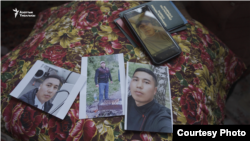
Kyrgyz citizen Ernisbek Mamasydykov did not expect to get caught up in Russia's invasion of Ukraine, but one day in August last year he found himself in a military uniform headed for the front.
The sudden turnaround in his life came after a period of 10 years living on-and-off in Moscow. On August 2, 2025, the 37-year-old called his wife, Nazgul Sagynova, and told her he had been detained and taken to the military commissariat.
"[I'm] not [going] to the war, just to the army. They said I’ll serve for one year. Don’t worry too much. Take good care of the children," he wrote. "They’re taking my phone soon. I’ll contact you when I can."
Mamasydykov, who also holds a Russian passport, made his last call to a relative on August 20. He was in Kupyansk, Ukraine, and said that on the very day they arrived, the teahouse where they were drinking tea was bombed.
Since then, no one has spoken to him directly. Russian military authorities declared him missing in Ukraine since October.
Searching Through Silence
Sagynova has searched tirelessly, traveling to Moscow and filing appeals with the Red Cross, the Russian Defense Ministry and military prosecutor’s office -- all without results or financial support. She constantly monitors social media, hoping for news.
“The only thing I look at are Telegram groups. I just stare at them, look at incoming information, maybe there will be some news. I wait for news on YouTube, hoping the war will end. The only people I talk to are women like me,” she told RFE/RL's Kyrgyz Service.

Mamasydykov is one of about 700 Kyrgyz citizens who have gone missing in the war, according to Tamara Kurushkina of the Ukrainian government-supported “I Want to Live” project -- which tracks soldiers killed, captured, or missing in the war.
"Fewer than 3 percent of the missing are found alive. Approximately 95–97 percent are killed and their bodies are not recovered,” she said.
Kyrgyz authorities warn that citizens joining foreign armed conflicts may face criminal charges. Most families are afraid to make official requests, fearing punishment, and remain silent.
This leaves relatives trapped, unable to seek information or support, and vulnerable to misinformation.
Debt, War, And An Impossible Choice
Minura is also searching for her husband, Erkinbek, who went missing in Luhansk Province, in eastern Ukraine. Their names have been changed for security reasons.
He too is a Kyrgyz citizen with a Russian passport. She said debt forced him to join the Russian Army after their family worked in Moscow for more than a decade. This was his second deployment. The first left him with severe concussion and nightmares, she added.
“At night he would suddenly jump up, scream, even lash out. He would cry, saying he saw the children disappear before his eyes. War changes people,” Minura explained. “My husband went to war in the summer of 2025 for the second time. After one month, there was no news. Since then, we have been searching.”

The bureaucratic obstacles are immense, and the ongoing fighting in Luhansk leaves families waiting, powerless.
“You live as if in a tunnel. You don’t know what to tell your children, your parents. You walk around, but your heart hurts,” said Minura.
Legal Shadows And Financial Silence
Artem Klyga, a lawyer specializing in military law in Russia who has been living in Germany for two years, told RFE/RL’s Kyrgyz Service about the legal and financial challenges faced by families:
"With just a word from the commanders, the court can declare people 'missing' or 'dead.' The main purpose is to avoid paying the soldier or their relatives," he said. "Usually, if the person is alive, they are paid about 200,000 rubles ($2,6000) per month. Kyrgyz citizens outside Russia cannot effectively appeal or demand anything.”
Russia is home to large populations of Central Asian migrants, who account for approximately 3.5 to 3.8 million of the 5.7 million foreign citizens residing in the country at the start of 2026, according to the Russian Interior Ministry.

The Institute for the Study of War, a US-based think tank, reported that the Russian Defense Ministry coerced at least 20,000 Central Asian migrants into military service through threats of citizenship revocation and family deportation.
Many of them have dual citizenship and are a useful source of manpower for a Russian military suffering huge losses every month in Ukraine.
For people like Sagynova, it's a nightmare that they want no part of.
“Women suffer. The children stand in front of me and ask about their father. You do not know what to answer," she said. "Before going [to Russia], people should think about their loved ones -- their parents -- and whether they will return or not.”

