


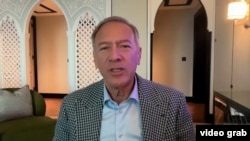
WASHINGTON -- Former US Secretary of State Mike Pompeo says Russian President Vladimir Putin has shown no willingness to end his war against Ukraine, warning that Moscow’s growing cooperation with Beijing, Tehran, and Pyongyang poses a serious challenge to Western security.
In an interview with RFE/RL on October 29, Pompeo, who served in President Donald Trump’s first administration, discussed Ukraine’s prospects for peace, the risks of negotiating with Putin, Iran’s support for Moscow, and the need for stronger Western security guarantees for Kyiv.
This interview has been edited for length and clarity.
RFE/RL: With a fresh round of attacks on the ground, mounting pressure on Kyiv, and high-stakes diplomatic maneuvering, the situation appears to be shifting quickly in Ukraine. What are you observing on the ground, and how do you assess the current calculus?
Mike Pompeo: What I think everyone is seeing is that we are not yet at a point where Vladimir Putin has demonstrated any willingness to back off on his terror campaign, and that's precisely what he's been engaged in. The costs clearly, in his judgment, don't exceed the benefits of him continuing this conflict.
And so you're right; he's trying to make this an incredibly difficult winter for the Ukrainian people, not for the Ukrainian military.
The Ukrainian military is crushing him, -- 42,000 casualties a month -- but [he's targeting] the Ukrainian people...to convince the political leadership -- and frankly, the political leadership in Washington and in Brussels and in European capitals -- that it's not worth continuing the support that they've provided to Ukraine to date.
RFE/RL: Can Washington and its allies afford to trust any diplomatic framework offered by Vladimir Putin right now?
I think Putin is wrong in his judgment that he is winning."
Pompeo: Well, the answer to that is no, but that doesn't mean you don't continue to pursue diplomacy, right? But you don't believe a single thing that he says. You simply observe the actions that he takes. But it's not unheard of to talk to someone that you don't trust.
In the end, you try to develop a framework and agreement, and then you sign it, and then you watch it be executed, and you believe it only when the execution takes place.
And so, you know, the fact that he's been unwilling to even conduct more than just the most minuscule cease-fires. Right now, there's this temporary, short-term ceasefire in one town (Oleshky, in Russian-occupied southern Ukraine). When [Ukrainian President Volodymyr] Zelenskyy has agreed to broad cease-fires on energy, on agriculture at the Black Sea, has agreed to [and] publicly announced that he'd be prepared to take a cease-fire along the military lines as they currently exist, that is radically different from the obstinacy with which Vladimir Putin has treated the discussions.
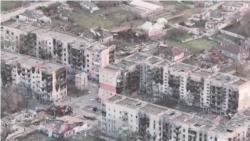

RFE/RL: President Zelenskyy warns that Ukraine is facing severe, compounding political and military pressure. Is the West inadvertently pushing Kyiv into bad-faith concessions?
Pompeo: I can't imagine that Kyiv will ultimately take a bad concession. They've been at this too long. They've been fighting too hard. They've frankly been too successful, with, by the way, enormous support from the United States and Europe.
So, I suspect that President Putin's belief that he can convince the West to drive Kyiv to the table to take a bad deal will prove not to be an outcome that is ultimately achieved. I think Putin is wrong in his judgment that he is winning.
RFE/RL: What does a realistic, secure end-state look like that doesn't simply plant the seeds for another Russian invasion?
Frankly, the Europeans continue to spend enormous amounts of money upholding the Russian war machine.... That's hypocrisy."
Pompeo: That's perhaps the most important question. What is the outcome that defends Western civilization adequately?
I think the answer to that is less dependent on where the lines are. It tends to be that that's the focus of the] conversation. What's more important is that there is a long-term commitment, a security architecture that makes the cost of the next advance by Vladimir Putin simply unacceptable.
That would be whether it's NATO or non-NATO. I don't know that that's as important, but European non-Ukrainian forces on the line would make an attack that happened after the agreement is implemented and in place truly an attack on the West, not simply an attack on Ukraine.
RFE/RL: Russian Foreign Minister Sergei Lavrov is set to visit Atlanta for the G20 ministerial this weekend. What is the single most important line in the sand the United States must draw for him face-to-face?
Pompeo: Oh, goodness, it's a line that, frankly, Americans haven't been prepared to draw to date, right? Nor has Europe, right? I've seen the critiques, including mine, that the diesel agreement -- that President Trump recently said we take some Russian diesel -- I don't think it solves the energy problem for America, nor do I think it draws us any closer to a negotiated solution.
But, frankly, the Europeans continue to spend enormous amounts of money upholding the Russian war machine, right? That's hypocrisy. "Critical" is the nicest thing one can say about that.
And so it's not about what they say to Lavrov in Atlanta this weekend. It's about the actions that the West is prepared to take to support Ukraine's effort to defend its border from this terrorist attack, this aggressive terrorist attack that has so harmed European sovereignty.
RFE/RL: President Zelenskyy has also raised concerns about restrictions on Ukraine's Starlink access affecting defensive drone operations. Given your multiple recent visits to Kyiv and the region, and your firsthand look at Ukrainian command centers, how dangerous is it when technology companies' decisions disrupt frontline military operations?
Pompeo: You know, it's complicated. I mean, the easy answer is it's very dangerous. I've seen multiple explanations for what actually happened: who said what to whom, and when, and how long it actually was. Was the speed limited? I don't know. I don't know what to make of those, other than there seems to be a consensus that there was a limitation for a period of time.

That's very difficult for the Ukrainian forces. Having said that, one of the hallmarks of Ukrainian success is that they have been able to deliver autonomous solutions by themselves, a set of capabilities that they have delivered, not dependent on anyone from any place else.
I think this highlights for every nation the fact that they need their own set of capabilities to do what's necessary. I'm very happy that the United States continues to support Ukraine with intelligence assistance and with an American product developed by an amazing American company, right? Developed by Elon [Musk] and his team. But it does highlight the fact that we need to be good partners in that effort.
RFE/RL: You've warned for years that Moscow isn't acting alone, and that we're witnessing a coordinated effort between Russia, Beijing, and Tehran to systematically undermine Western security. Are we witnessing a formal wartime alliance or simply a coalition of convenience aimed at neutralizing American power?
Pompeo: You know, it's interesting. I don't know that it matters that much which of the two it is. It is clear that there is an alliance. It is clear that they are working together. It would really be Pyongyang, Beijing, Tehran, and Moscow working together. And it would have been the Venezuelans, but we've taken down that risk materially...
The economic pressure that the United States is putting on Iran and Tehran's leadership is very real.... This regime will collapse."
They have many disagreements with each other. They'll find places where they can't cooperate. But on destroying Western civilization, this is something they all agree on. These are a collective set of leaders who don't give a rip about human life, who don't give a rip for basic property rights, who don't care remotely about religious freedom.
They share that common set of understandings. Their principles and their values reflect that understanding of humanity. And so, when they can advance that vision for how the world ought to look, they will work together, even in spite of the fact that they'll have disagreements among themselves.
You see it at the tactical level with weapons systems, with electronic components, with tactical and even strategic-level intelligence sharing. But more importantly, you see it at the senior-leader level, at the nation-state level, where these countries have clearly demonstrated their willingness to work together to undermine that post-World War II architecture that has been so good for the United States, so wonderful for Europe, and frankly amazing for freedom all around the world.
RFE/RL: Given that cooperation, is the current Western defense strategy sufficiently equipped to deter a multitheater conflict involving China in the Indo-Pacific and Russia in Europe simultaneously? Does the West have the military capacity and strategy to handle both theaters at once?
Pompeo: Look, I'll cut to the bottom line. We're going to crush them. That is, to prevail, but it's going to take an enormous amount of determination. It's going to take amazing political leadership. It's going to take European leaders who are prepared to talk to their people about why it is the case that they have this responsibility, why it's in Europeans' best interest.

Every [EU] nation, all two dozen-plus of them, needs to work to deliver good outcomes for their own people. That means spending money, it means training soldiers, it means participating in your military and your strategic efforts. This will take real political leadership, and I hope people across the world can see what happens to nations that aren't prepared to do that.
If you don't defend your borders, you end up with Islamists inside your country. If you don't secure your own freedom by developing a military capable of participating in this civilizational effort, then the bad guys will try to take advantage of it, and every nation has to do this to protect its own sovereignty and to work at it diligently. I'm convinced we will all do that, but there's a lot of work that remains.
RFE/RL: What concrete steps should the United States and its allies take today to dismantle the supply lines connecting Tehran to Moscow?
Pompeo: Yes, so there are many things. There are, I'll call them, tactical and military measures that one can take, right? You can stop ships from sailing. You can interdict goods. The United States has done that with the Europeans, and, frankly, others were more actively engaged in that.
The economic pressure that the United States is putting on Iran and Tehran's leadership is very real. You know, [US Treasury Secretary Scott] Bessent has talked about weeks [for a possible collapse of Iran's economy]. I don't know if it's just weeks, but it will happen. This regime will collapse. As we saw with the Soviet Union, you can't predict the day or the hour or even the year, but the regime cannot possibly withstand the combination of the blockade that sits in place, the economic pressures that have been applied, and, I hope, the continued effort, the continued kinetic efforts that President Trump has indicated he may well be prepared to undertake in the coming weeks as well.
This will give the Iranian people the chance to do what's necessary. We will be able to tip the regime over in a way that delivers an outcome that is remarkable for the Iranian people, incredibly important for the Gulf Arab states and Israel, and enormously valuable to the United States of America as well.

