




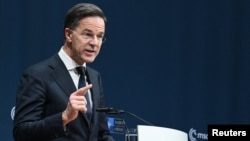
NATO chief Mark Rutte warned that members of the military alliance must treat the threat posed by Moscow more urgently as they may be "Russia's next target."
In one of his starkest statements to date, Rutte said in a keynote address in Berlin on December 11 that NATO's 32 members need to step up defense effort to prevent a war with Russia that could be "on the scale of war our grandparents and great-grandparents endured."
"We are Russia's next target. And we are already in harm's way," Rutte said, noting Russia could be ready to use military force against NATO within five years.

"I fear that too many are quietly complacent. Too many don't feel the urgency. And too many believe the time is on our side. It is not. The time for action is now," Rutte added as he called for allied defense spending and production to "rise rapidly" to ensure the alliance's forces "have what they need to keep us safe."
NATO has been on edge since Russia launched its full-scale invasion of Ukraine almost four years ago, sparking the largest and deadliest conflict in Europe since World War II.
The Kremlin has pointed to the possibility of NATO expansion as one of the reasons it launched the war, which has left more than 1 million casualties according to Rutte and other Western intelligence sources.
Russian President Vladimir Putin warned European powers on December 2 that if they start a "war" with Russia, Moscow is ready to fight.
Russian Foreign Minister Sergei Lavrov told a roundtable of ambassadors in Moscow on December 11 that the Kremlin has no plans to strike out militarily at either the European Union or NATO and is "ready to set out the relevant guarantees in writing and in a legal document" stating as much "on a collective, mutual basis."

Last month German and Romanian fighter jets were scrambled to track drone incursions into Romania's airspace as Russia continued to attack targets just across the Danube River in neighboring Ukraine.
Russian drone incursions over Romania and Poland, along with Russian military jets entering Estonian airspace, led NATO to launch its Eastern Sentry initiative to bolster air defenses.