




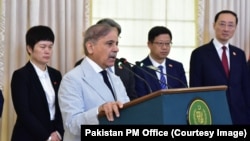
Pakistani Prime Minister Shehbaz Sharif arrived in Beijing on May 23 as his country seeks to reinvigorate its efforts to mediate in the ongoing standoff between the United States and Iran.
On his three-day visit at the invitation of China, a key diplomatic and trade partner with Iran, Sharif is also seeking to deepen bilateral defense cooperation and secure fresh Chinese investment for Pakistan.
“It's unclear what specific asks Pakistan would have of China in this visit, but the country is broadly seeking to inject urgency into the US-Iran negotiation process, which has stalled in recent weeks,” Elizabeth Threlkeld, a senior fellow and director of the South Asia program at the Washington-based Stimson Center, told RFE/RL.
Threlkeld added that, given China's close relationship with Iran, Pakistan has been careful to consult leaders in Beijing regularly.
Pakistan and China will review bilateral ties "and cooperation in political, economic and strategic domains,” Pakistani Foreign Office spokesman Tahir Andrabi said on May 22.
He did not say Pakistan’s mediation in the Iran war would be discussed, but Foreign Minister Ishaq Dar had earlier told Pakistani lawmakers that Islamabad has been in close touch with China throughout the US-Israeli war with Iran, which began on February 28.
Michael Kugelman, a senior fellow at the Washington-based Atlantic Council, said Pakistan acknowledges the leverage that China has over Iran.
“So, in that sense, I think, Sharif will be looking for assurances from the Chinese government that it remains supportive of the efforts that Pakistan is making,” Kugelman told RFE/RL.
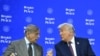
Sharif's trip comes shortly after visits by US President Donald Trump and Russian President Vladimir Putin to Beijing, where the war in Iran and its global energy and economic fallout took center stage at their meetings with Chinese President Xi Jinping.
Trump's visit, in particular, drew attention to what role China could play in pushing Iran to make concessions that would bring about a deal. Trump said in an interview recorded in Beijing with Fox News that Xi offered to help broker a deal with Tehran.
“Pakistan has consistently kept China informed about its role as a mediator and sought Chinese support in convincing the Iranian regime to agree to dialogue with the United States,” said Hussain Haqqani, a scholar at Hudson Institute in Washington and the Anwar Gargash Diplomatic Academy in Abu Dhabi.
Nearly 40 days into the war, Trump announced a cease-fire after Pakistan requested a halt to Operation Epic Fury -- the US-led bombing campaign against Iranian military targets -- to make way for peace talks. High-level US and Iranian teams held negotiations in Islamabad on April 11-12, but they ended without an agreement.
Haqqani, who has also served as Pakistan’s ambassador to the United States, told RFE/RL that since Pakistan is facing economic challenges due to the Iran war, it is likely that it will seek Chinese support to help get it through the crisis.
These issues may force their way onto the Sharif-Xi agenda, and key Pakistani officials will be able to relay details of their recent contacts in Tehran.
Talks In Tehran
On May 22, Pakistani Interior Minister Mohsin Naqvi met with Iranian Foreign Minister Abbas Araqchi for the second time since he arrived in Tehran two days earlier on his second trip to the Iranian capital in 30 hours -- an indication at least of intense diplomacy speeding up, even though no details of the talks emerged.
As Pakistan's powerful army chief, Field Marshal Asim Munir, arrived in Iran late on May 22, Baqir Sajjad, diplomatic correspondent for the Pakistani daily Dawn, wrote that Munir would only travel there "to finalize" a deal. Naqvi is believed to be Munir’s closest confidant among Pakistan’s civilian authorities.
Both Pakistan and China have been profoundly impacted by the almost complete closure of the Strait of Hormuz.
As the world's largest exporting nation, China has a clear interest in seeing the crucial waterway reopened. Its closure has caused huge disruption to the global economy and would severely reduce demand for Chinese products if it continues long-term.
Haqqani said China is better placed to withstand the effects of the Hormuz blockage because of its large strategic reserves and domestic capacity, but that it would like to see the strait reopened.
Roughly 40 percent of China's oil and 30 percent of its liquefied natural gas (LNG) imports also flow through the strait, including from Persian Gulf countries that Iran has attacked.
Pakistan has been hit by energy shortages and could face a wide range of risks if armed conflict resumes.
Threlkeld said these included economic issues such as disruption of fertilizer supplies but also security concerns: "domestic sectarian frictions, cross-border insecurity from refugee flows and militant groups taking advantage of the unrest, and potential pressure to enter the conflict directly on behalf of defense partner Saudi Arabia.”
Meanwhile, Haqqani said that, at the strategic level, "China is seeking to position itself as the net security provider in different parts of the world, especially those from where the United States is either retreating or is damaging its own reputation.
"The Middle East is one such region and here a close relationship with Pakistan can help China play that role,” he added.

