





Victory for Armenian Prime Minister Nikol Pashinian in parliamentary elections marks a firm slap down for Russian efforts to derail his signature pro-Western policy moves, although failure to win a two-thirds majority in parliament will complicate the ongoing US-brokered peace process with Azerbaijan.
Official preliminary results gave Pashinian's Civil Contract party 64 seats in the 105-seat legislature, enough to remain in office for a fresh term of office. Two Russian-leaning opposition parties took the remaining seats, while a third appeared to have fallen narrowly short of the 5 percent barrier for entry into parliament pending a recount.
"With the re-election of the Armenian government, this election provides a fresh mandate on sustaining the positive momentum of diplomatic engagement, normalization of relations with neighbors, and the continued diversification of Armenia’s security partners," Richard Giragosian, head of the Regional Studies Center think tank in Yerevan, told RFE/RL on June 8.
Pro-Western Course Confirmed
Pashinian can now be expected to seek to push ahead with moves to strengthen ties with the European Union and the United States.
Last year, the country passed a law initiating the process of EU accession, and EU leaders have welcomed the outcome of the election.
French President Emmannuel Macron, who performed a song with Pashinian onstage during a state visit to Yerevan last month, congratulated him in a statement pledging "to further strengthen cooperation serving the interests of our peoples, to support Armenia's peace and sovereignty, as well as to back the process of rapprochement with Europe."

Pashinian's re-election will also please US President Donald Trump, who personally endorsed him in the weeks before the June 7 vote. "Nikol completely shares my vision for peace and prosperity for Armenia and the entire South Caucasus region," Trump wrote on social media.
Trump hosted Pashinian and Azerbaijani President Ilham Aliyev at the White House last year to symbolically bring an end to decades of conflict, both hot and cold. It was a moment that underlined the decline of Russian influence in the region since the 2023 conflict in which Azerbaijan regained control of the Nagorno-Karabakh region, driving 100,000 ethnic Armenians from their homes.
The pre-election period was also marked by Russian threats and actions aimed at dampening support for Pashinian's pro-Western path. These included restrictions targeting Armenian exports that highlighted how dependent the country is on access to Russian markets, as well as a threat by Russian President Vladimir Putin to take further measures that “could result in a loss of at least 14 percent of Armenia's GDP." Putin even hinted darkly at a possible "Ukrainian scenario" for Armenia.

But analysts in Yerevan said the Russian efforts to influence the outcome of the election had not succeeded.
"This vote confirms the belief that Armenia is heading in the right direction," Giragosian said, describing it as a "pivotal parliamentary election."
Areg Kochinian, head of the Yerevan-based Armenian Council Research Center, told Current Time that the Russian efforts had completely backfired.
"If Russia's intention was to try to support its proxies in Armenia using various instruments -- disinformation campaigns, trade wars, in other words the full arsenal of hybrid tools -- then all of this produced the opposite result," he said.
"The Armenian population was, in general, quite mobilized, I would even say 'electrified,' so to speak -- and Pashinian achieved an impressive victory," he added.
A Bumpy Road To Peace
This was the first election since Armenia's military defeat in 2023 and a key part of Pashinian's pitch was what he called "real Armenia," meaning accepting the country's current borders and improving relations with neighbors that have traditionally been hostile -- namely Azerbaijan, but also its patron, Turkey.
Recent moves have seen the border with Turkey opening and Brussels touting it as a new route for Armenian exports to the European Union.
But while peace with Azerbaijan was celebrated at the White House, with Trump hosting Pashinian and Aliyev for the signature of a joint declaration last August, it was actually a deal to sign a future deal -- and the election results could leave some bumps in the road.
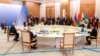
Azerbaijan has demanded Armenia approve a new constitution removing references to Nagorno-Karabakh that it finds irritating. That would require a two-thirds majority that Pashinian has not secured.
"The most important new issue in Armenia after the elections is, or will become, the topic of adopting a new constitution," said Kochinian.
"First, it is a continuation of democratic reforms and changes in our country. And second, it is linked to the continuation of the peace process with Azerbaijan. Since neither of these outcomes is in Russia's interests…without opposition support it will not be possible to initiate the process of adopting a new constitution -- because at least two-thirds of parliament are required to start it, which would then lead to a referendum on adopting a new constitution," he explained.
In Moscow, Foreign Ministry spokeswoman Maria Zakharova said on June 8 the election had taken place amid "unprecedented pressure on the opposition and interference from the West." She added that the elections showed that Armenia was deeply polarized.

Her position echoed a statement overnight by Samvel Karapetian, head of the Strong Armenia party that came second with 29 seats, claiming "persecution" and hinting without evidence that the vote count was being manipulated.
Karapetian was arrested last year on charges of calling for the unlawful seizure of power and is currently under house arrest.
An international observer mission by the Organization for Security and Cooperation in Europe (OSCE) noted on June 8 that there had been "numerous criminal proceedings of opposition candidates and activists, resulting in many opposition supporters refraining from actively engaging in the campaign."
OSCE special coordinator Farah Karimi told a news conference in Yerevan that "this, along with pressure on public sector employees to attend ruling party events and recently introduced social and economic measures, raised concerns about the equality of opportunity to campaign."
However, the OSCE also called out Russian interference.
"Direct pressure from abroad in the form of escalating trade restrictions and security threats during the campaign aimed at unduly influencing voters in favor of opposition forces was observed," Karimi said.





