




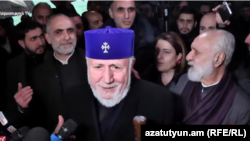
Armenia is facing its gravest church-state clash since gaining independence, as tensions continue to grow between Prime Minister Nikol Pashinian and Catholicos Garegin II, the supreme head of the Armenian Apostolic Church.
The dispute has led to arrests, public accusations, and competing narratives about Armenia's identity, governance, geopolitical orientation -- and whether or not the prime minister respects the country's constitution.
The standoff could reshape Armenia’s political landscape and relations with its diaspora ahead of parliamentary elections in June next year.
What Is The Dispute About?
The government claims it’s targeting corruption and entrenched business interests within the church, an Oriental Orthodox institution.
For example, the church, which is exempt from property tax by law, has been accused of using this exemption for enrichment. However, no official legal judgement or independent verification has so far confirmed these claims.
Pashinian has accused Garegin II of violating celibacy vows by allegedly fathering a child and being “a threat to Armenia’s national security." The prime minister has also implied that Garegin II and figures close to him -- including his brother, who serves as a diocese primate in Russia -- have links to foreign intelligence services.
In a recent speech to parliament, Pashinian said, "I do not need a Catholicos who obeys me; I need a Catholicos who does not obey a senior lieutenant of a foreign intelligence service and does not report to lieutenants of a foreign intelligence service on a daily basis.”
The church has insisted the government is overstepping its constitutional limits.
RFE/RL’s Armenian Service contacted the Investigative Committee, which handles preliminary probes into serious crimes, as well as the Prosecutor-General's Office and National Security Service, and learned that no criminal case has ever been opened against Garegin II.
How Did Things Escalate?
Tensions between church and state deepened after Armenia's second war with Azerbaijan over its breakaway region of Nagorno-Karabakh in 2020. The war lasted six weeks before a Russia-brokered cease-fire came into force and resulted in Armenia losing control over parts of the region. In September 2023, Baku completely retook Karabakh from Armenian separatists following a lightning offensive.
Between April and June of 2024, church cleric Bagrat Galstanian led protests -- the largest of Pashinian's tenure -- over what he sees as Armenia's territorial concessions to Azerbaijan. At the time, he was serving as bishop of the Diocese of Tavush, where four villages were returned to Azerbaijan after having been under Armenian control since the first war over Nagorno-Karabakh, which ended in 1994.
Galstanian was later arrested on charges of plotting a coup and attempting to seize power. And since April 2024, four archbishops have been arrested on different charges.
Accusations Of Russian Ties
When Galstanian was arrested, Russia responded angrily, with Foreign Minister Sergei Lavrov calling for an end to what he called “unjustified attacks” against the church, which he described as “one of the key pillars of Armenian society.”
Armenian Foreign Minister Ararat Mirzoyan fired back, accusing Moscow of meddling in Armenia’s internal affairs.
Some analysts claim church leaders, including Garegin II, maintain close ties to Russia. “There’s a Russian connection to the leader of the church,” Richard Giragosian, head of the Yerevan-based Regional Studies Center, told RFE/RL.
In 2023, Russian President Vladimir Putin awarded Garegin II the Order of Honor for his "great contribution to the development of cultural-humanitarian links between Russia and Armenia."
Giragosian adds that while the allegations of corruption and ties to Russia may be valid, the government’s response has been punitive: “I think the government is [getting] carried away. This is a vendetta. It’s too personal.”
Accusations that the church has ties with Russia have emerged at a time when the Armenian government is experiencing strained relations with Moscow. Pashinian has argued that Russia abandoned Armenia during the 2020 war, prompting a strategic shift toward the EU and other Western partners.
'Real Armenia'
The backdrop to the church-state confrontation has been Pashinian's Real Armenia doctrine. According to the prime minister, Armenia should refocus national identity on the Republic of Armenia rather than territory outside its borders. Pashinian has said that focusing on a historical homeland for Armenians, which includes parts of Turkey and Azerbaijan, has only caused geopolitical vulnerability and leaves room for Russian meddling.
Elections Ahead
The standoff between church and state comes at a sensitive time for Armenia, with the country heading toward parliamentary elections in June.
Analyst Giragosian cautions that the government is “going too far, too fast,” undermining legal norms and public confidence. “If this conflict continues next year, the government will suffer in terms of worse relations with the diaspora and will be seen as unnecessarily vindictive,” he adds.
Critics of the government's actions say that the arrests of clergy and investigations into the church violate the constitutional separation of church and state.
Another sensitivity is Armenia's peace agreement with Azerbaijan. While the presidents of both countries initialed the draft peace deal in August, the full treaty has not yet been formally signed or ratified.
The prime minister, however, has not let off the pressure, recently confirming that he ordered the National Security Service to censor church services by instructing priests not to mention Garegin II’s name during liturgies.
Pashinian has defended his actions, saying that he is criticizing the catholicos as an ordinary believer calling for church reform rather than prime minister.