



- By Mike Eckel
It wasn't clear if Putin would address the bombshell investigation from earlier this week by Bellingcat, along with The Insider, Der Spiegel, and CNN. (Among other things, the investigation found that prior to Navalny's Novichok poisoning in August, during a trip to Siberia, he had been trailed by FSB agents, some of whom had backgrounds in chemicals and toxins.)
He did end up addressing the issue.
Not surprisingly, he dismissed it all -- and blamed it on the United States.
"We know what this is. It's the legalization of materials from U.S. intelligence agencies... He is supported by U.S. intelligence."
("Legalization" basically means "laundering.")
He also asserted the Bellingcat investigation was a "trick" or a "ruse" aimed at denigrating Russia's government.
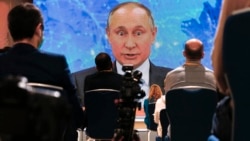
Putin, without evidence, claims that investigative report pointing to the FSB in Navalny's poisoning is a fabrication and the "legalization" -- or laundering -- of U.S. intelligence assertions.
Next question is about the conflict in eastern Ukraine and the future of relations with Ukraine. Putin says the future of relations depends primarily on the government of Ukraine. Says the Zelenskiy government promised to resolve the conflict, but after it came to power it came under the influence of "extreme nationalist forces."
Putin praises the current cease-fire in the Donbas, but says nothing has been done regarding political and economic settlements. Blames Kyiv for not implementing the Minsk agreements.
Putin says a settlement is inevitable, but when it will happen depends on Kyiv. Says Russia has been "helping" the Donbas and intends to increase its support.
As before, Putin does not refer to Aleksei Navalny by name; calls him 'the patient.'
Now answers Navalny question, calling him "the patient at a Berlin clinic." Says he has answered this question many times. "We perfectly well understand that this report is the legalization of information from American spy agencies," he says. Says "the patient" is supported by U.S. secret services. Claims that he personally gave the order for Navalny to be released to Germany "the very moment" that he was asked. Says that we should judge Navalny by who his "partner" is. Putin says people should show their worth through "concrete deeds" and he calls all government opponents to think not about their personal ambitions, but about the good of the country.
- By Mike Eckel
Putin riffs off a question about Russian hackers and cyberintrusions in the United States to offer some lukewarm praise for President-elect Joe Biden:
"He's an experienced man. I hope that problems that arose under the current administration will be solved."
Putin waited six weeks after the November 3 election to congratulate Biden on his victory, waiting only (like many Republican lawmakers) until the Electoral College confirmed the win on December 14.
In 2016, Putin was among the first leaders to congratulate President Trump, just hours after Trump's opponent, Hillary Clinton, conceded the election (and WELL before the Electoral College met).
Next question is about recent journalistic investigations, including one about Putin's alleged former son-in-law and one about the poisoning of Aleksei Navalny. Question is, who killed Navalny?
Putin says such false reports are very common these days. Putin says that "reading such material is impossible," regarding his former son-in-law. Putin picks out a few alleged details that he claims are wrong. Does not deny that Shamalov was his son-in-law. Says the "main thing" is that the information in the report came from anonymous hackers.
Says this reminds him of the hack of the Democratic Party in 2016 and says both hacks were carried out by U.S. secret services. Says the "goal is clear" -- "revenge" and "an attempt to influence Russia's internal politics."