



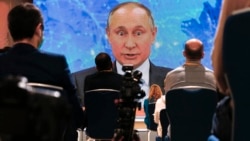
Putin suggests that if the Russian state had wanted to kill Kremlin foe Aleksei Navalny, it would have "finished the job" -- he would not have survived the poisoning. But many observers say that numerous past events in Russia indicate that the FSB and other authorities and agents of the state often fail to achieve their desired aim.
Next question is from Rossiiskaya Gazeta. Asks why the constitution was amended earlier this year. "Why exactly now?" she asked.
Putin notes that the constitution was adopted in the early 1990s when the country was falling apart and it "played a stabilizing role." It served as the basis for Russia's political development.
"Now we have a different situation," he said. For example, he says it wasn't possible in 1993 to promise to index social benefits to inflation, but now that can be done. He says in 1993 it wasn't possible even to guarantee the country's territorial integrity, but now it is possible. So that's why the constitution had to be changed.
"All of this we can now establish in the basic law," he said.
Then he thanks the public for sending in their suggested amendments and for participating in the nonbinding poll (which Putin calls a "de facto referendum") on the amendments.
After a journalist complains of being criticized for his stance on an electrical energy station, Putin brings up poisoning and assassinations in what might be a tongue-in-cheek reference to accusations surrounding Navalny's poisoning.
Next question is from Channel One state television in Moscow. Asks whether the delays in the National Projects were brought on by the pandemic or by some other problems. Putin says the country's strategic goals have not changed, although the pandemic has extended the timeline. Putin says that because of the pandemic, some of the resources intended for the National Projects have been diverted to "direct support to citizens." Repeats that he thinks government worked very effectively during the pandemic "day and night."
Commenter points out that one of Putin's remarks about Navalny echoes a remark he made five years ago about Boris Nemtsov, an opposition leader and vocal critic who was shot dead near the Kremlin in February 2015.
Next question is from St. Petersburg. Asks when will the borders be reopened for foreign tourists. Putin says that he loves St. Petersburg as much as anyone and all Russians love it as well. Says the city is "a magnet" for tourists. Praises the architecture, both traditional and modern.
But opening borders depends on the pandemic and the infection rate in St. Petersburg is still "very high." Putin says hospitalization rate there is higher than the national average. Putin says as soon as doctors say it is possible, borders will be reopened. Says government is helping the tourism industry, including by promoting domestic tourism.
- By Mike Eckel
As is usual, reporters hold up signs during the news conference, trying to get the attention of the Kremlin spokesman, so that they can be called on, to ask their question (on live national television, no less).
As in past years, some of the signs this year have been, shall we say, unusual:
- By Mike Eckel
Ukraine.
Putin gets a question about the Donbas, the region of eastern Ukraine where a conflict between Ukrainian government forces and Russian-backed militias has been going on since April 2014. More than 13,000 people have been killed, more than 1 million have been forced from their homes.
Though relatively quiet at this present time, the conflict there is very much a hot one, and there's been virtually no progress toward resolving it in recent months.
Asked about the prospects for a settlement, Putin puts (somewhat disingenuously) the burden on Ukrainian authorities.
He asserts all Ukrainian leaders, including President Volodymyr Zelenskiy, came to power under pledges for settlement and reconstruction. But nothing comes of them... There is not enough political will. Nothing has been done in terms of a political settlement.
Resolution is inevitable, the question is when, he says. And Russia has supported the Donbas and will continue to support it. And will even increase support, he says.
(This isn't exactly a hopeful sign that resolution is imminent...)
Here is RFE/RL's story on the report regarding Putin's former son-in-law and how he allegedly used his connections to amass a vast fortune. Putin claimed the report is just disinformation from the U.S. secret services aimed at interfering in Russia's internal affairs.