



That Russia’s economy was grinding its gears was no secret to anyone paying close attention.
That it was outright screeching to a halt, if not shifting into reverse, was more of a surprise -- apparently even to President Vladimir Putin, who chided his top economic advisers last week in a Kremlin meeting that was televised for maximum effect.
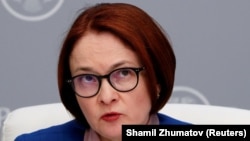
Among those on the receiving end of Putin’s ire: Elvira Nabiullina, the respected Central Bank chief who has played a singular role in keeping the economy humming despite being knocked off balance by the war on Ukraine.
Now, the question is whether Nabiullina, who has held the position for almost 13 years, may have finally fallen out of favor with the Kremlin’s leadership. And if so, what do they plan to do about it.
“Replacing her now would not just signal weakness,” said Aleksandra Prokopenko, a former Central Bank adviser who is now a fellow at the Berlin-based Carnegie Russia Eurasia Center. “It would unsettle the one institutional anchor that has maintained credibility with markets and kept the inflation stabilization on track.”
“If they fire her, the entire business ecosystem will panic,” said Nicholas Birman-Trickett, a political risk and commodities analyst and former fellow with the US-based Foreign Policy Research Institute. The Kremlin “may want lower rates but they also know that a ‘yes’ man would be terrible.”
Nabiullina “is one of the few positive aspects of Russian economic leadership and the economy,” said Richard Portes, a professor of economics at London Business School, who spoke on a St. Petersburg panel discussion with Nabiullina in 2019. “There is nobody better qualified than she to run the Russian Central Bank, and any replacement will not be as good.”
Putin “can do all the scolding he likes. It won’t improve the shape of the Russian economy, which is fairly disastrous,” Portes said. “I think he's got a lot to worry about there.”
The Central Bank did not respond to e-mail queries seeking comment.
'Everyone's Realizing Now Just How Bad Things Are'
What’s powered Russia's gross domestic product (GDP) since the full-scale invasion of Ukraine in 2022 is largely war spending.
The Kremlin has retooled the country into a war economy, spending record amounts on recruiting and paying soldiers, as well as building factories and transport networks to manufacture guns, tanks, planes, and drones, and ship them to the fight.

As it had for the two decades preceding the full-scale war, the Kremlin funded its economic retooling with oil and gas exports, despite Western efforts to choke off those revenues.
Labor shortages -- resulting from men being drawn by high salaries to fight in Ukraine -- drove up wages, which in turn drove up inflation, forcing the Central Bank to hike interest rates.
It worked, but it’s squeezed both businesses, which are increasingly defaulting on debt, and consumers, who are struggling to keep up with rising consumer goods prices.

Last year, GDP growth slowed sharply, government figures show: from 4.9 percent in 2024, to just 1 percent in 2025.
In the first two months of 2026, however, the economy contracted by 1.8 percent, which Putin noted during the Kremlin meeting. Officials have also signaled that 2026 forecasts -- currently 1.3 percent growth -- might have to be downgraded soon.
“The economic slowdown -- and the prospect of Russia tipping into negative growth territory -- is not a surprise to anyone who has been paying attention,” Prokopenko said. “The only people for whom this should come as news are those who took the 4.9 percent growth in 2024 at face value without asking what was driving it.”
“Everyone's realizing now just how bad things are; it just took years of war to get there,” Birman-Trickett said. “The system can’t really self-correct anymore.”
The reversal is showing up in fiscal figures, with the federal budget deficit skyrocketing to 4.5 trillion rubles ($60 billion) -- double the same period last year -- as oil export revenues dropped.
Due to a strong ruble, high interest rates, labor shortages, and budget constraints, the reserves in the Russian economy “have been largely exhausted,” the daily Nezavisimaya Gazeta quoted Economics Minister Maksim Reshetnikov as telling a Vladivostok business forum this past weekend.
'Whoever Spoke To Him Last'
Along with Reshetnikov, Prime Minister Mikhail Mishustin, and other ministers, Nabiullina was shown prominently in the March 15 meeting with Putin, who seemed to suggest that he had been misled as to the dire state of the economy.
“I hope to hear detailed reports why macroeconomic indicators are falling short of expectations, not only that of experts and analysts but also the actual forecasts of the government and the Central Bank,” he said.
Outside of Russia, Sweden’s military intelligence agency, and Germany’s main intelligence agency both believe that the government is manipulating data, understating the scope of the country’s economic problems, according to the Financial Times.

Don’t read too much into the televised meeting, Prokopenko cautioned, saying it was a calculated performance.
“One of Putin's persistent governing patterns is that whoever last spoke to him shapes his framing of an issue,” she said. “That pressure is landing on the economic bloc in a public setting is not unusual -- it's how the Kremlin manages internal tensions. It doesn't necessarily signal a policy reversal or a change in who holds power over monetary policy.”
Last summer, prominent business and banking officials began warning publicly about the danger of “stagflation” -- where an economy is hampered by low growth, high inflation, and high unemployment.
Business leaders trained their ire on Nabiullina, whose rate hikes were aimed at tamping down soaring inflation -- but saddled business with loans that were too expensive to refinance.
The director of a foundry in northern Russia sounded the alarm last week, saying the economy faced a “catastrophic event” and the government was badly out of touch.
In December, a think tank linked to Defense Minister Andrei Belousov warned of a possible banking crisis by October if “bad” loans continue to increase sharply.
A day after Putin’s scolding, Nabiullina gave a frank assessment of the sand grinding the economy’s gears: there aren’t enough workers, something she said was unprecedented in modern Russian history.
In spite of the criticism, Nabiullina, who reportedly attempted to resign in the immediate wake of the Ukraine invasion in 2022 but was rebuffed by Putin, has stayed the course in spite of the criticism -- an indication experts said partly reflected Putin’s backing.
By law, her mandate as head of the Central Bank runs out within a year. Prokopenko said it was unlikely Putin would replace her before then.
“The more interesting question is what happens at mandate renewal: whether the political conditions in a year make an independent [Central Bank] governor more or less convenient for the Kremlin,” she said.
“As I say, she's one of the few protectors of stability in the Russian economy,” Portes said.