



News
- By RFE/RL
Rights Watchdog Condemns 'Baseless' Treason Charges Against Kremlin Critic Kara-Murza
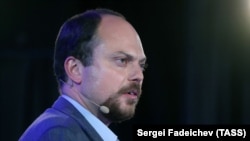
Human Rights Watch (HRW) has blasted Russian accusations of high treason against prominent opposition leader Vladimir Kara-Murza as "the third baseless charge" since his detention six months ago.
The group described it as "a blatant attempt to quash any criticism of the Kremlin and deter contact with the international community."
“It is painfully obvious that the Kremlin sees Kara-Murza as a direct and imminent threat," HRW quoted its Europe and Central Asia director, Hugh Williamson, as saying. "These charges against him and his prolonged detention are a travesty of justice. Russian authorities should immediately and unconditionally free Kara-Murza and drop all charges against him.”
Russian media last week quoted unnamed law enforcement officials and sources as saying that the high treason charge against Kara-Murza stems from his alleged cooperation with organizations in a NATO member for many years. If convicted on the charge, the staunch opponent of the Kremlin faces up to 20 years in prison.
The 41-year-old politician was detained in April and sentenced to 15 days in jail on a charge of disobedience to police. He was later charged with spreading false information about the Russian Army while speaking to lawmakers in the U.S. state of Arizona.
Kara-Murza has rejected the charge, calling it politically motivated.
His lawyer, Vadim Prokhorov, reportedly said the treason charge stems from "open criticism" in speeches Kara-Murza gave at events in Lisbon, Helsinki, and Washington.
HRW noted Kara-Murza's friendship with slain opposition leader Boris Nemtsov and two near-fatal poisonings in the past seven years that open-source sleuths Bellingcat have blamed on Russian security services.
Kara-Murza's arrest in April came amid a mounting crackdown by Russian authorities on opposition figures and any disagreement with the ongoing war in Ukraine that Moscow launched against its neighbor on February 24.
In August, Kara-Murza was additionally charged with carrying out activities of an undesirable organization for taking part in organizing a conference in Moscow last year to support political prisoners in Russia that was sponsored by the foreign-based Free Russia Foundation. That group has been recognized as "undesirable" in Russia.
The "undesirable organization" law, adopted in 2015, was part of a series of regulations pushed by the Kremlin that squeezed many nonprofit and nongovernmental organizations that received funding from foreign sources -- mainly from Europe and the United States.

More News
Bosnia Formally Granted EU Candidate Status As Part Of Wider Push For Enlargement
EU leaders have confirmed candidate status for Bosnia-Herzegovina, putting the Balkan country at the start of what is expected to be a long and complex process toward membership.
The decision comes two days after the European Council said it supported the conclusions of the European Commission, which recommended candidate status for Bosnia but attached a list of eight conditions designed to bolster democracy in the country.
The European Commission made its recommendation in October, but the commission only advises which countries should become EU candidates. The final decision on granting candidacy lies with the 27 member states, and according to EU rules, they must agree unanimously.
European Council President Charles Michel on Twitter called the EU leaders' decision a "strong signal to the people, but also a clear expectation for the new authorities to deliver on reforms."
EU foreign policy chief Josep Borrell echoed Michel, saying on Twitter that the decision confirmed that the future of Bosnia lies in the EU and its political leaders "can now turn this ambition into reality through decisive reforms."
The EU leaders approved the move despite concerns over the political situation in Bosnia, a country of 3 million people that fought a civil war three decades ago and that has struggled to overcome ethnic divisions since then.
Bosnia remains partitioned between a Serbian entity, Republika Srpska, and the Bosniak-Croat federation connected by a weak central government.
The administrative system, created by the 1995 Dayton agreement, succeeded in ending the conflict but has not been conducive to advance the country's political development.
Among the eight conditions are implementing steps to fight corruption and organized crime, making judicial and immigration reforms, strengthening of laws against torture, and providing guarantees of freedom of expression and the protection of journalists.
Formal accession negotiations -- the next step on the path to membership -- are to begin only after the fulfillment of the conditions. The opening of accession talks will again require the unanimous approval of all EU member states.
Bosnia becomes the third country after Ukraine and Moldova to be granted candidate status in the past six months.
The moves toward expansion come amid concern that powers such as Russia and China might spread their influence in the Balkans if countries hoping to join the bloc are turned away.
Bosnia in 2016 applied for full membership in the EU. The European Commission in 2019 issued an opinion but did not recommend candidate status, citing the necessity for the country to fulfill the conditions. Before the war in Ukraine, there were 14 criteria required for Bosnia before the next stage, formal accession negotiations.
Montenegro and Serbia are two other Balkan states that wish to join the EU. They started accession talks in 2012 and 2014, respectively. Turkey was named a candidate in 1999, but its membership talks are effectively frozen.
Kosovo Prime Minister Albin Kurti on December 15 handed over his country's application to join the EU to Czech European Affairs Minister Mikulas Bek in Prague.
The submission of Kosovo's application to Bek, representing the country that currently holds the rotating EU presidency,
is expected to be a lengthy process, given that five EU members have yet to even recognize it as independent.
With reporting by AFP and dpa
More Than 200 Iranian Activists Call For Campaign To Halt Executions
More than 200 Iranian civil activists, writers, and family members of victims of the Islamic republic have signed a statement inviting activists and unions in Iran to launch a campaign to stop executions there amid threats from lawmakers that harsher punishments are needed for protesters during the current wave of unrest.
The 235 signatories of the letter said they were prompted by the recent executions of two protestors as the authorities ratchet up their brutal crackdown on dissent, which was set off in mid-September by the death of 22-year-old Mahsa Amini while in police custody.
The letter says the execution of Mohsen Shekari and Majidreza Rahnavard is one of the tactics being used by the government to silence people who are fed up with the repressive government of the Islamic republic, "people who come to the streets every day with empty hands and become more united against the oppression of the regime."
"These executions, which are often carried out following unfair trials and in violation of the most basic human rights, are examples of clear discrimination against the most helpless, deprived, and vulnerable people, including immigrants, religious minorities, people with a low socioeconomic base, women, and gender minorities," the letter says.
Rahnavard was hanged in a public execution on December 12 -- just 23 days after he was arrested -- following his conviction for killing two members of the security forces. The group Iran Human Rights said Rahnavard's sentencing was based on "coerced confessions, after a grossly unfair process and a sham trial."
Shekari was executed publicly on December 8 after an appeal of his sentence was rejected by the Supreme Court. He was accused of injuring a security officer.
Farhad and Farzad Tahazadeh, two brothers from the northwestern city of Oshnavieh, are among several protesters who rights groups say are in imminent danger of execution.
Reports also indicate that soccer player Amir Nasr-Azadani faces accusations of "waging war against God" and "corruption on Earth," which are punishable by death and often leveled in cases allegedly involving espionage or attempts to overthrow the government.
Since Amini's death, Iranians have flooded streets across the country in protest, with women and even schoolgirls making unprecedented shows of support in the biggest threat to the Islamic government since the 1979 revolution.
The Oslo-based Iran Human Rights Organization says the number of executions in Iran exceeds 500 this year.
Written by Ardeshir Tayebi based on an original story in Persian by RFE/RL's Radio Farda
- By RFE/RL
U.S. Adds Russian Oligarch Potanin, Rosbank To Sanctions Blacklist
The United States has imposed financial sanctions on one of Russia's richest men, Vladimir Potanin, and Russian commercial bank Rosbank in another expansion of efforts to curb Moscow's ability to fund its war in Ukraine.
The designation of Rosbank, which was purchased earlier this year by an investment holding company Potanin controls, and other entities related to Russia's financial sector, are taken together with the State Department's designation of Potanin, said the Treasury Department in a statement on December 15.
The Central Bank of Russia considers Rosbank to be a systemically important credit institution to the Russian government. Britain and Canada designated Rosbank earlier this year.
In addition to Rosbank, the Treasury Department's Office of Foreign Assets Control is blacklisting 17 entities related to Russia's financial-services sector. These are all subsidiaries of VTB Bank, Russia's second-largest bank, which was designated for sanctions in February.
The designations "are part of the U.S. government's efforts to further limit the [Russian government's] ability to fund its unconscionable war of choice against Ukraine," the Treasury said.
"Since the start of Russia's brutal full-scale invasion in February, Treasury has taken unprecedented action to isolate Russia from the global financial system, with severe short- and long-term effects on its economy," the statement said.
Russia's economy is expected to contract this year and continue contracting in 2023, the department said.
"Beyond that, lost investment, export controls, and constraints on Russia's real economy will inhibit Russia's growth prospects for years to come," the statement added.
Treasury Undersecretary for Terrorism and Financial Intelligence Brian Nelson said the designations "continue to deepen Russia's isolation from global markets," and taken together with actions by international partners "will further inhibit the [Russian President Vladimir] Putin regime's ability to fund its horrific war against Ukraine."
The State Department also designated Potanin, his network, and more than 40 additional persons linked to the Russian government. Potanin formerly served as a deputy prime minister and has direct ties to Putin, according to the State Department.
The State Department's new sanctions includes members of the government, certain family members, and an entity. The department noted that governors "oversee and enforce the conscription of citizens in response to Russia’s recent mobilization order."
The sanctions freeze any assets the individuals or companies have under U.S. jurisdiction, inhibit their access to global financial markets, and bars people based in the U.S. from dealing with them.
Iran Releases Teen After Mother's Interview Goes Viral On Social Media
A 15-year-old Iranian teenager imprisoned in the central Iranian city of Karaj has been released after an interview with his mother went viral on social media.
Amirhossein Rahimi's mother told the Tehran-based Etemad newspaper that her son had been in prison for two months, even though he still had pellets in his head and chest from wounds inflicted by security forces shooting at crowds during a protest.
"My son was arrested in Karaj on October 13 and I did not know his whereabouts for a week. Finally, I found him in a juvenile detention center," she told Etemad, adding that no matter how much she begged, the judge would not reduce bail to an amount she could afford because he was facing serious charges.
The interview went viral on social media and Etemad announced on December 15 that Amirhossein Rahimi had been released from detention on a reduced bail.
"The people's reactions caused the judge to back down and immediately issue the release order. This shows the power of the people. I hope the rest of the prisoners will be released," an Etemad political editor wrote on Twitter.
Rahimi's mother said in the interview that the public defender did not respond to her requests for a meeting and only once was she able to talk to him on the phone, which ended with him behaving in an aggressive manner.
By threatening and intimidating lawyers, authorities in the Islamic republic often prevent or discourage them from accessing files of the accused, forcing detainees to appear in court with a public defender. In many cases, these public defenders not only fail to support the defendant, some often speak against them in court.
The unrest sparked by the death of Mahsa Amini has swept across the country over the past three months.
Amini died while in police custody in mid-September after being detained for allegedly wearing a hijab improperly. Eyewitness reports said the 22-year-old was beaten while being arrested by police, while the authorities said she died of "underlying diseases."
Security forces have waged a violent crackdown on protesters around the country, killing scores, injuring hundreds, and detaining several thousand people.
As the scattered anti-government protests rage across Iran for a 12th week, universities and schools have turned into a major battleground between the protesters and the authorities.
The activist HRANA news agency said that, as of November 29, at least 459 protesters have been killed during the unrest, including 64 minors, as security forces try to stifle widespread dissent.
Written by Ardeshir Tayebi based on an original story in Persian by RFE/RL's Radio Farda
- By Reuters
Murray Receives Arthur Ashe Humanitarian Award For Ukraine Relief Effort
Andy Murray has been named as the 2022 Arthur Ashe Humanitarian Award recipient in recognition of his support for humanitarian efforts in Ukraine following Russia's invasion of its neighbor. Murray, a three-time Grand Slam champion, said in March he would donate all his prize money won from tournaments in the year toward aid efforts for children affected by the war. The Scot said in a statement he decided earlier this year that he would donate his prize money for the rest of the season to UNICEF's humanitarian response. The final total was just over $630,000. To read the original story by Reuters, click here.
Siberian Mother Charged With 'Discrediting' Russian Troops After Son Fined For Sharing Dream
CHITA, Russia -- The mother of a man in the Siberian city of Chita has been charged with discrediting Russia's armed forces and insulting President Vladimir Putin after her son was fined for sharing on Instagram a dream he had where Ukrainian President Volodymyr Zelenskiy made an appearance.
Igor Losev told RFE/RL on December 15 that police charged his mother, Nelli Loseva, for "likes" she put under two of his posts on social media saying that Russian-occupied Crimea is Ukraine and Putin is "a mother...er."
According to Losev, his mother was informed that she will be summoned to the police again next week.
On December 8, a court in Chita ordered Losev to pay a 30,000-ruble ($470) fine after finding him guilty of discrediting Russia's armed forces involved in Moscow's unprovoked invasion of Ukraine.
The charge against Losev stemmed from a post on Instagram on September 23, two days after Putin announced a partial military mobilization for the war in Ukraine. Hundreds of thousands of Russians, mostly men, fled the country in response.
In his Instagram post, Losev described a dream in which he saw himself mobilized for the war, only to be captured along with other Russian soldiers by Ukrainian forces led by Zelenskiy.
"[Ukrainian solders] rush inside and tie everyone up and are going to shoot everyone. And at that moment, Zelenskiy passes me and says: 'Oh, I saw your stories on Instagram. Glory to Ukraine!' and I answer him, 'Glory to the heroes!' and he says, 'Well, let this one go and shoot all the rest.' And then we stay together, watching all that, and I say to him, 'Can I take a selfie picture with you?' and he says, 'You can,'" Losev's post on Instagram said.
Losev told RFE/RL that the regional Anti-Extremism Center said it found at least six reasons to launch an administrative probe into his post.
- By Reuters
Iranian Oil Minister Stable After Heart Attack, Ministry Says
The Iranian oil minister is in a stable condition after a heart attack on December 15, the Oil Ministry said in a statement reported by the official IRNA news agency. "Javad Owji, the minister of oil, was admitted to a public hospital in Tehran following a heart attack, which occurred on the sidelines of a government meeting and was caused by heavy work pressures," the statement said. "After necessary measures were taken by the medical staff, the minister's condition is currently stable." To read the original story by Reuters, click here.
- By RFE/RL
RFE/RL Files Suit In Bishkek Court Appealing Blockage Of Its Websites
RFE/RL's Kyrgyz Service, known locally as Radio Azattyk, says it has filed an administrative suit appealing the blocking of its websites in the Central Asian country.
The court has yet to confirm that the suit, filed on December 15, has been officially registered for consideration.
The Kyrgyz government blocked Radio Azattyk's websites in Kyrgyz and Russian on October 26 after the broadcaster refused to take down a video about clashes along a disputed segment of the Kyrgyz-Tajik border.
Officials claimed the video, produced by Current Time, a Russian-language network run by RFE/RL in cooperation with Voice of America, "predominantly" took the position of the Tajik side.
The government decision was based on the Law on Protection from False Information, legislation that drew widespread criticism when it was adopted in August 2021. Analysts said it would stifle free speech and independent reporting by the media.
Radio Azattyk's bank account in Bishkek was frozen at the time, and in November, Kyrgyz authorities suspended the accreditations of 11 RFE/RL correspondents at parliament.
"RFE/RL is continuing to exercise all legal remedies available under Kyrgyz law," RFE/RL President and Chief Executive Officer Jamie Fly said in a statement on December 15.
"As over 100 prominent Kyrgyz figures recently attested, Azattyk has a rich 70-year history and should continue its operations free from government pressure and harassment," he added.
RFE/RL's move comes two days after almost 120 Kyrgyz public figures, writers, actors, politicians, and activists urged President Sadyr Japarov and other top officials to unblock Radio Azattyk's websites.
"It is impossible to overestimate the significant contribution Radio Azattyk has made during its 70-year history to the formation of the sovereign, independent Kyrgyzstan, to the achievement of the liberty Kyrgyz people dreamed about and for which our ancestors fought during the Soviet period," the letter said, urging the country's leaders to immediately and fully restore Radio Azattyk's operations.
Earlier this week, RFE/RL's lawyers filed a complaint in a district court in Bishkek challenging the suspension of Radio Azattyk's bank account.
In solidarity with RFE/RL, independent Kyrgyz media outlets on October 28 posted a black screen on their webpages from 9 a.m. to 12 p.m. local time with the caption: "No news today. Media under pressure in Kyrgyzstan," and also refused to cover news stories about the government for the whole day.
Earlier in October, threats were made against RFE/RL journalists during a demonstration in Bishkek at the office of the Kyrgyz Service. Most of the participants of the action covered their faces, avoided the camera, and refused to answer questions about their demands.
Ilimbek Israilov, the organizer of the demonstration, threatened to spray gasoline on RFE/RL reporters and use force against them. Israilov is known for organizing of numerous rallies to support the former deputy chief of the Customs Service, Raimbek Matraimov.
In 2019, an investigation by RFE/RL, the Organized Crime and Corruption Reporting Project, and Kloop implicated former deputy chief of the Customs Service Raimbek Matraimov in a corruption scheme involving the transfer of hundreds of millions of dollars out of Kyrgyzstan.
- By Current Time
Ukraine Jails 15 Moscow-Backed Separatists
A court in Ukraine has sentenced 15 separatist fighters from the eastern regions of Donetsk and Luhansk to 15 years in prison on charges of high treason and collaboration. The Ukrainian Security Service (SBU) said on December 15 that the men voluntarily joined the Russian armed forces on February 24 after Moscow launched its unprovoked invasion of Ukraine. They all were captured in battle by Ukrainian troops in the last few months. To read the original story by Current Time, click here.
Iranian Director Sadeghi Says Impossible To Resume Productions Amid Unrest
Prominent Iranian theater director and playwright Ghotbeddin Sadeghi has said the social unrest gripping the country makes it impossible to resume productions, rebuffing a request from the minister of Islamic guidance for artists to return to the stage.
Most artists have canceled performances in support of protests sparked by the death of 22-year-old Mahsa Amini in police custody. Security forces have met the demonstrators with brutal, and sometimes deadly force.
Sadeghi said in response to the request by Minister of Islamic Guidance Mohammad Mahdi Esmaili that "the violence on the streets these days does not allow people to think about intellectual activities like watching theater."
Referring to the "big social gap in Iran," Sadeghi added that "the ruling minority denies the will of the majority of the people and takes their lives and does not retreat. They think can solve the problem with more violence."
Sadeghi's comments come amid one of the deepest challenges to the Islamic regime since the revolution in 1979, which erupted following the September 16 death of Amini after being detained for allegedly wearing her hijab improperly.
Since the start of daily protests, several Iranian cinematographers and prominent public figures have been summoned by the police or arrested, including actress Soheila Golestani and director Hamid Pourazari.
Several celebrities, including actor Hamid Farrokhnejad, have been interrogated and had their passports confiscated after showing support for the protests.
Hossein Mohammadi, a 26-year-old theater actor, also faces a death sentence after he was reportedly tortured into making a confession to security forces who were looking to pin the blame on him and 15 others for the death of a member of the Basij paramilitary force during a demonstration.
Since Amini's death, more than 400 people have been killed in the police crackdown, according to rights groups. Several thousand more have been arrested, including many protesters, as well as journalists, lawyers, activists, digital rights defenders, and others.
Written by Ardeshir Tayebi based on an original story in Persian by RFE/RL's Radio Farda
Jump In Illness Rate Forces Kyrgyz Schools To Go Online
All schools in Kyrgyzstan have switched to online learning due to a sharp increase in flu and acute-respiratory-viral-infection cases in the Central Asian country. Deputy Education Minister Nadira Jusupbekova said the online system of education at all schools below the university level will start on December 15 and last until December 24. The Health Ministry said earlier that the most dramatic flu situation was at schools in Bishkek and regions of Talas and Chui. To read the original story by RFE/RL's Kyrgyz Service, click here.
Kazakh Activist Detained After 15 Days In Jail For Organizing Rally
Kazakh activist Marat Abiev has been placed in pretrial detention for two months after serving a 15-day jail term for organizing an unsanctioned protest rally on November 26, the day of President Qasym-Zhomart Toqaev's inauguration. The Astana City Court on December 14 did not specify what charges Abiev faced. Toqaev was reelected in an election held on November 20. A monitoring mission by the OSCE's Office for Democratic Institutions and Human Rights said after the election that the election lacked "competitiveness." To read the original story by RFE/RL's Kazakh Service, click here.
European Parliament Recognizes Holodomor Famine In Ukraine As Genocide
The European Parliament (EP) has recognized the "artificial" famine in Ukraine caused by the policies of the Soviet government led by Josef Stalin in the early 1930s as genocide.
The legislature on December 15 approved a resolution recognizing the Holodomor, "the artificial famine" in Ukraine caused by "a deliberate policy of the Soviet regime, as a genocide against the Ukrainian people."
In all, 507 EP lawmakers were in favor of the resolution, while 12 voted against it and 17 abstained.
The EP called on Russia, as the legal successor of the Soviet Union, to "officially recognize the Holodomor and apologize for these crimes."
It also called on "all countries and international organizations that have not yet recognized the Holodomor as genocide to do so."
WATCH: In a solemn ceremony on November 26, Ukrainian President Volodymyr Zelenskiy, his wife Olena, and a few top officials came to pay their respects in central Kyiv at a statue known as The Bitter Memory Of Childhood, symbolizing the Holodomor.
The famine, known as the Holodomor, took place in 1932-33 as Stalin's police forced peasants in Ukraine to join collective farms by requisitioning their grain and other foodstuffs.
Historians say the failure to properly harvest crops in Ukraine in 1932 under Soviet mismanagement was the main cause of the famine.
It is estimated that up to 9 million people died as a result of executions, deportation, and starvation during the Stalin-era campaign.
Many Ukrainians consider the famine an act of genocide aimed at wiping out Ukrainian farmers.
Along with Ukraine, at least 16 other countries have officially recognized the Holodomor as genocide.
In October 2018, the U.S. Senate adopted a nonbinding resolution recognizing that Stalin and those around him committed genocide against the Ukrainians.
Moscow has long denied any systematic effort to target Ukrainians, arguing a poor harvest at the time wiped out many in other parts of the Soviet Union.
The EP's resolution comes as Russia continues its unprovoked invasion of Ukraine launched in late February.
Moscow has targeted Ukraine's grain storage facilities and blockaded Ukraine's Black Sea exports have sparked accusations that Russia is weaponizing food as part of its strategy in the war.
Tiny Meteorite May Have Caused Coolant Leak From Soyuz Capsule
Russian and NASA engineers are assessing a coolant leak from a Soyuz crew capsule docked with the International Space Station (ISS) that may have been caused by a micrometeorite strike. The coolant leak forced the last-minute cancellation of a spacewalk by two Russian cosmonauts on December 14 and could potentially impact a return flight to Earth by three crew members. Russian space agency Roskosmos and the U.S. space agency said the leak on the Soyuz MS-22 spacecraft did not pose any danger to the astronauts and cosmonauts aboard the ISS. On November 25, a space walk by Prokopyev and Petelin was also canceled due to technical problems related to the cooling system in a space suit. To read the original story by RFE/RL's Russian Service, click here. With reporting by AFP
Kosovo Submits EU Membership Application; Process Likely To Take Years
Kosovo on December 15 officially submitted its application to join the European Union, setting the country on a path to the bloc that is expected to be a lengthy process given that five EU members have yet to even recognize it. Kosovo Prime Minister Albin Kurti handed Pristina's application to the Czech minister for European affairs, Mikulas Bek, at a ceremony in Prague. The Czech Republic currently holds the bloc's rotating presidency. To read the original story from RFE/RL's Balkan Service, click here.
Explosion At Siberian Oil Refinery Kills Two People, Injures Five
A fire caused by an explosion at an oil refinery in Russia's Siberian city of Angarsk has killed two people and injured five others, local authorities said on December 15. The governor of the Irkutsk region, Igor Kobzev, said the fire did not affect operations at the facility. A probe was launched into the fire. In recent months, several fires have hit shopping malls and industrial facilities across Russia. To read the original story from RFE/RL's North.Realities, click here.
Saakashvili's Lawyer Calls Release Of Hospital Video By Authorities A 'Crime'
TBILISI -- The lawyer of jailed former Georgian President Mikheil Saakashvili has accused prison officials of committing a criminal offense by releasing without consent security camera footage of his client while he was in a medical facility in Tbilisi.
Georgia's Penitentiary Service on December 14 released video segments taken on August 9, October 4, and December 12, showing Saakashvili in the clinic as "proof that his life is not in danger."
Last week, Saakashvili's legal team distributed a medical report that said he had been "poisoned" with heavy metals while in custody and risked dying without proper treatment.
Saakashvili’s lawyer, Shalva Khachapuridze, told journalists late on December 14 that "the distribution of this video is a criminal offense."
"This video material belongs to the category of personal data and cannot be made public without the inmate's consent," Khachapuridze told journalists late on December 14.
Khachapuridze added that although the video segments had been doctored to give an impression that Saakashvili's health state is normal, "it is clear to any reasonable person that the man in the video feels ill."
Khachapuridze's statements came after Saakashvili announced that he had started a hunger strike to protest against his incarceration. He ended the protest hours later.
Saakashvili, who served as Georgia's president from 2004 until 2013, was arrested on his return to Georgia from self-imposed exile in October 2021, after an eight-year absence.
He is now serving a six-year sentence after being convicted in absentia of abuse of office, a charge he calls politically motivated.
Saakashvili is currently on trial on separate charges of violently dispersing an anti-government rally in November 2007 and illegal border crossing. He has rejected those charges as well, calling them trumped up.
Saakashvili was transferred in May to a regular hospital in Tbilisi as his health markedly worsened.
Russian Man Gets Lengthy Prison Term On High Treason Charge
A court in Russia's Far East has sentenced a local man to 12 1/2 years in prison on a high treason charge, the Federal Security Service (FSB) said on December 15. According to the FSB, Vyacheslav Mamukov, a resident of the city of Khabarovsk, was handed the prison term after a local court found him guilty of planning to pass "classified data linked to transport infrastructure" to Ukraine for financial award. To read the original story by RFE/RL's North.Realities, click here.
- By Reuters
Pakistan Signs $475 Million Flood Loan Deal With Asian Development Bank
Pakistan has signed a $475 million loan agreement for flood relief with the Asian Development Bank (ADB), the country's economic affairs minister said on December 15, taking the total for the year to $2.7 billion with the agency. Floods caused by abnormal monsoon rains and a melting glacier submerged huge swathes of the country earlier this year and killed nearly 1,700 people, the majority of them children and women. To read the original story from Reuters, click here.
Attack Kills Two, Wounds 15 In Restive Border Area Of Pakistan
A soldier and a passerby were killed and at least 15 other people were wounded in a suicide attack in Pakistan's northwest border area, the military and police said on December 15. Regional police chief Farhan Khan told RFE/RL that on December 14 a suicide bomber drove his motorcycle into a military convoy passing the town of Miran Shah in Khyber Pakhtunkhwa Province near the Afghan border. No group immediately claimed responsibility for the attack. The area is a former stronghold of Tehrik-e Taliban (TTP), also known as the Pakistani Taliban. To read the original story from RFE/RL's Radio Mashaal, click here.
- By Reuters
Russia Concerned By Blocking Of Route From Armenia To Nagorno-Karabakh
Russia expressed concern on December 15 over the blocking of the Lachin Corridor that links Armenia to the enclave of Nagorno-Karabakh. The route is the only land connection across Azerbaijani territory between Armenia and the disputed Nagorno-Karabakh region. Armenia has accused Azerbaijan of blocking it, which Baku denies. At a briefing in Moscow, Russian Foreign Ministry spokeswoman Maria Zakharova said Russia hopes the corridor will be unblocked soon. To read the original story from Reuters, click here.
- By RFE/RL
EU Agrees Fresh Sanctions On Russia Over Ukraine War, Diplomats Say
The European Union has agreed on a fresh round of sanctions on Russia over the war in Ukraine after complaints from hawkish Eastern European leaders that some countries were trying to water them down.
Diplomats said a compromise deal -- thought to include targeting some 200 individuals -- was reached on the sidelines of a leaders' summit in Brussels and that the sanctions would be formally confirmed on December 16.
Countries had moved closer to a deal in negotiations on December 14, but Poland and some other countries still had objections.
Fresh sanctions on Moscow had been held up over whether the EU should make it easier for Russian fertilizer exports to pass through European ports, even if the fertilizer companies are owned by blacklisted oligarchs.
With reporting by AFP and Reuters
- By RFE/RL
EU Leaders To Discuss Ukraine Aid, Bosnian Candidacy At Summit
European Union leaders are gathering in Brussels on December 15 for their last summit of the year, where they are expected to discuss further political, military, humanitarian, and financial aid for Ukraine and how to restore the war-wracked country's critical infrastructure. Ukrainian President Volodymyr Zelenskiy will join via video link at the start of the meeting. EU leaders could also grant Bosnia-Herzegovina official candidate status to join the bloc, following a similar approval for Ukraine and Moldova in June. To read the highlights of the summit agenda, click here.
Russia Strikes Ukrainian Infrastructure Again As UN Warns Of Serious Humanitarian Crisis
Russian forces keep pounding critical power infrastructure in Ukrainian cities, killing more civilians and leaving tens of thousands of more people without electricity, as its troops step up the pace of their relentless attacks along the entire front line in the east.
UN High Commissioner for Human Rights Volker Turk warned on December 15 that further strikes on Ukraine's infrastructure could lead to a serious deterioration of the humanitarian situation and spark further displacement.
Live Briefing: Russia's Invasion Of Ukraine
RFE/RL's Live Briefing gives you all of the latest developments on Russia's ongoing invasion, Kyiv's counteroffensive, Western military aid, global reaction, and the plight of civilians. For all of RFE/RL's coverage of the war, click here.
The General Staff of the Ukrainian military said on December 15 that Russian artillery fire was concentrated on Bakhmut and Avdiyivka in Ukraine's eastern Donetsk region, as Moscow is seeking to stabilize its tactical positions around Kupyansk in the eastern Kharkiv region and Zaporizhzhya in the southeast.
The recently liberated southern city of Kherson was left completely without power following Russian shelling that also killed at least two people on December 15, according to the head of the Kherson regional military administration, Yaroslav Yanushevych.
The shelling of Kherson region injured nine people, Yanushevych said. Russian troops attacked the center of Kherson city for the second day in a row, he said, adding that among the victims is a volunteer from an international organization who helped people during the shelling.
Russian forces also targeted critical infrastructure in the eastern city of Kharkiv on December 15, causing several explosions, the mayor said.
"Explosions in Kharkiv. The enemy is targeting infrastructure facilities. I am asking everyone to exercise utmost caution and stay in shelters if possible," Mayor Ihor Terekhov wrote on the Telegram messaging app.
In a speech to the Human Rights Council in Geneva following a trip to Ukraine last week, Turk said on December 15 that Russian strikes were exposing millions of people to "extreme hardship."
"Additional strikes could lead to a further serious deterioration in the humanitarian situation and spark more displacement," Turk said. He called the war an "unmitigated tragedy and disaster."
Turk's remarks came as he formally presented a report which found that Russian forces killed at least 441 civilians in the early days of the invasion. Moscow has denied targeting civilians.
Turk said accountability for such incidents was "sorely lacking," adding that not a single member of Russia's armed forces was known to have been held accountable by Moscow for carrying out, or failing to prevent, these killings.
As Moscow kept up the unabated pressure on the whole front line and continued to target civilian areas, Ukrainian Foreign Minister Dmytro Kuleba warned on December 14 that Russia's capability to launch a "major offensive may be restored" by the end of January or February.
"They definitely still hope that they will be able to break through our lines and advance deeper into Ukraine," Kuleba told foreign journalists in a bomb shelter in Kyiv, according to CNN.
Kuleba said there are signs that Russia still has its sights set on larger portions of Ukraine and its huge missile attacks have turned the "entire country into a front line."
The latest wave of attacks came as Ukrainian President Volodymyr Zelenskiy said Kyiv was doing everything it could to obtain more modern and powerful antiaircraft systems and had made important progress on the issue this week.
WATCH: In the woods of eastern Ukraine, a team of volunteers are scraping the dirt from a corpse and searching for anything that might identify who it was.
Zelenskiy was speaking after several media outlets quoted senior U.S. officials as saying an announcement on Washington's plans to provide the Patriot missile-defense system to Ukraine could be made as soon as December 15.
The Russian Foreign Ministry warned that if Washington confirmed these reports, it would be "another provocative move by the U.S." that could prompt a response from Moscow.
Ministry spokeswoman Maria Zakharova said in a weekly briefing that the United States had "effectively become a party" to the war in Ukraine. U.S. military assistance to Ukraine, including the transfer of such sophisticated weapons as the Patriot missile system, "would mean even broader involvement of military personnel in the hostilities and could entail possible consequences," Zakharova said.
She did not specify what those consequences might be.
Asked about the Russian warning, Pentagon spokesman Air Force General Pat Ryder responded that the U.S. was "not going to allow comments from Russia to dictate the security assistance that we provide to Ukraine.”
Ryder added that he found it “ironic and very telling" that Russian officials who launched a "campaign that is deliberately targeting and killing innocent civilians" would choose a word like "provocative" to describe defensive systems that are meant to save lives and protect civilians.
Meanwhile, the U.S. military plans to expand its training of Ukrainian military personnel in Germany, the Pentagon said on December 15, including training in combined arms.
Ryder said the new training will involve approximately 500 Ukrainians per month and will not require an increase in U.S. troop deployments to Europe.
The onset of winter has also led to an abrupt worsening of living conditions in the southern Ukrainian port city of Mariupol, which fell to the Russians earlier this year following a months-long resistance put up by Ukrainian fighters.
WATCH: A Ukrainian military medic who was pregnant when she was captured by Russian troops in Mariupol has spoken of her nearly six-month ordeal in captivity.
The city was almost completely destroyed by heavy Russian bombardments, and thousands of civilians were reportedly killed.
Petro Andryushchenko, an adviser to the mayor of Mariupol, said the death rate in the Russian-occupied city has skyrocketed amid a lack of heating, food, and medical supplies.
"The incidence rate is insane. A flu epidemic is spreading in Mariupol. Hospitals are overcrowded. The ambulance does not even leave for those with a high temperature because there is no place to hospitalize people for treatment," Andryushchenko told RFE/RL.
"At the beginning of November, the weekly death rate was about 150 people. Last week it exceeded 250 deaths per week.... That is 7-7.5 times higher than it was before the beginning of this phase of the war," he added.
Andryushchenko's claims could not be independently verified.
With reporting by Reuters, AP, and CNN
- By Reuters
Canada To Bring Back Sanctions On Nord Stream 1 Turbines
Canada says it will revoke a time-limited sanctions waiver that allowed turbines for Nord Stream 1, Russia's biggest gas pipeline to Europe, to be repaired in Montreal and returned to Germany. Nord Stream 1 was shut down for repairs on August 31 but never restarted and was subsequently damaged by explosions in September. "Canada is making this decision recognizing that the circumstances around granting the waiver have changed. It no longer serves its intended purpose," Foreign Minister Melanie Joly and Natural Resources Minister Jonathan Wilkinson said in a joint statement on December 14. To read the original story from Reuters, click here.
Editors' Picks
Top Trending
In Satellite Images Of Russian-Occupied Crimea, Experts Point To Potential Targets For Ukraine
2'The Bakhmut Meat Grinder': Russian Troops Are Pummeling This Donbas City. It's Unclear Why.
3'For Russia's Victory': Moscow Places Ukraine's Occupied Crimea Region On All-Out War Footing
4In Photos: Outbreak Of Mystery Fires Hits Russia
5China Bans Exports Of Loongson Military Grade Processors To Russia
6Iranian Father Learns Of Son's Death Sentence During Phone Call
7With Russians On The Edge Of Town, A Scramble To Evacuate Civilians From Bakhmut
8Far-Right Protesters Rally In Belgrade In Support Of Kosovar Serbs As EU Urges De-Escalation
9Russia Strikes Ukrainian Infrastructure Again As UN Warns Of Serious Humanitarian Crisis
10Unborn Baby Saved By Prisoners' Scraps, Says Ukrainian Medic Held By Russians
Subscribe


