




When Rahmat leaves for Russia in August, he will take more than his luggage with him.
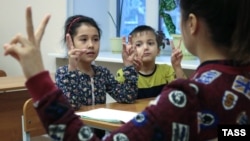
The worker from Tajikistan will also bring his two children -- aged 7 and 9 -- who have spent the past few months preparing for the new school year in Russia.
"My wife hired a teacher from our village to tutor our children, and the kids have also been watching Russian TV to improve their language skills before the move," said Rahmat, who did not provide his full name.
To enroll in a Russian school, Rahmat's children must pass a rigorous language test.
"I have permanent residency in Russia and want to bring my family to live with me. But I'm worried that if my kids fail the exam, I will have to take them back home [to Tajikistan] to live with their grandparents," Rahmat told RFE/RL.
Rahmat's concerns reflect a wider challenge facing some of the millions of Central Asians who work in Russia.
As the new academic year begins on September 1, parents in the region's five former Soviet republics are weighing whether to bring their children to Russia or leave them behind, fearing they may not be able to enroll under the country's stricter language requirements.

In April 2025, Russia imposed new tougher rules on admitting the children of migrants to Russian schools, including passing a mandatory language test and proving their legal status.
The impact was immediate. In the 2025-2026 academic year, the number of foreign children studying in Russian schools fell by about 44,000, according to data from Russia's Education Ministry.
Children from Central Asia make up the largest share of foreign students in Russian schools. In the past academic year, about 48,000 students hailed from Tajikistan, 22,000 from Uzbekistan, and 19,000 from Kyrgyzstan.
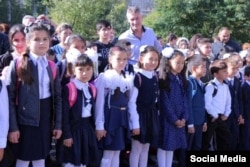
Overall, the number of schoolchildren from Kyrgyzstan, Tajikistan, and Uzbekistan fell by 27 percent in one year from 122,000 to 89,000, according to Russian government data.
Millions of citizens from those countries live and work in Russia -- the main destination for Central Asian migrants for decades -- due to a lack of jobs and opportunities at home.
Russian officials have said the stricter rules for children of migrants are intended to ensure the students can follow lessons and integrate into schools. But human rights groups and education experts say language testing and documentation requirements ultimately mean many children are unable to access education.
The move has also separated thousands of children from parents who have traveled to Russia for work, leaving their children to live with relatives in their homeland.

The tougher rules came as Russia has waged an intensifying crackdown on Central Asian migrants, who face growing harassment, legal pressure, and violence.
Attacks and discrimination against migrants intensified after the Islamic State-Khorasan extremist group attacked a concert hall outside Moscow in March 2024, killing nearly 150 people. Several Tajik citizens were arrested over their alleged involvement in the attack.
Repercussions At Home
Earlier this year, Tajik Education Minister Rahim Saidzoda said around 9,000 children had returned from Russia after failing to enroll in school. He added that some children went months without a formal education upon their return.
The returning children have also put pressure on the school system in Tajikistan.
Anvar, a parent in the southern city of Bokhtar, said his daughter noticed overcrowding at her school during this last academic year. Instead of sharing a desk with one classmate, she was seated with two other children.
"When I asked the teacher what happened, she said several children had returned from Russia and there was suddenly not enough space for everyone," Anvar said. "She told me they were working on solving the problem."
A teacher in Tajikistan's Sughd Province told RFE/RL on July 27 that the return of children marked a reversal.
"Until 2025, we had the opposite problem. Too many children were leaving for Russia, and we had to close or merge some classes," said the teacher, who spoke on condition of anonymity because she was not authorized to speak to the media. "But this year, for the first time, we saw a significant number of children returning."
She said local schools have enough classrooms and teachers to accommodate the returning children, but the biggest problem is the disruption to their education.
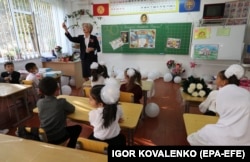
Kyrgyz families are facing similar uncertainty.
The Education Ministry did not reveal the number of Kyrgyz children who returned from Russia over the past year after failing to register in school. But the ministry told RFE/RL on July 28 that more than 140,000 children currently attend school in Kyrgyzstan while their parents work abroad.
The government recently approved a five-year program to attract Kyrgyz citizens working abroad back to their homeland, including employment support, training, and social assistance.
Kyrgyzstan is also developing alternatives for children who cannot attend school in person. The state-run online school Tunguch was launched as a pilot project in 2025 and is open to the children of Kyrgyz citizens living abroad. Around 2,540 students enrolled during the 2025-2026 academic year.
For families like Rahmat's, however, Russia remains the preferred destination despite the uncertainty.
"Yes, there are many challenges in Russia, but we don't have better alternatives at home," he said.