



- By Mike Eckel
The presidency isn’t the only thing on Russian ballots on March 18. Some municipalities across Russia are also expected to hold nonbinding referendums on local issues, like infrastructure spending.
One of the tussles reflects the strong showing by liberal politicians in September’s local elections in and around the capital. The Moscow district of Akademichesky wants to ask local voters for a ban on buildings higher than nine stories in an effort to keep high-rises from transforming the well-heeled region. But prosecutors are so far blocking the push to include the question on the ballot, and a court is expected to rule this week on the question.
- By Mike Eckel
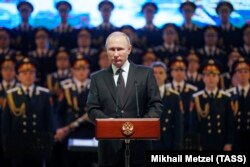
Vladimir Putin has officially qualified to appear on the ballot of the March 18 election.
Not that there was any doubt to begin with, but Putin’s election campaign spokesman told RIA-Novosti on February 5 that his registration papers have been officially accepted by the Central Election Commission. Including Putin, six candidates are confirmed as having submitted the required 100,000 signatures by the January 31 deadline. The commission has until February 10 to approve or reject candidate registrations papers.
- By Mike Eckel
Sobchak Goes To Washington
Ksenia Sobchak has raised plenty of eyebrows with her campaign. Her visit to Washington this week is raising yet more.
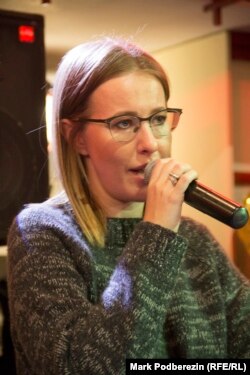
Sobchak told Russian media that, among other things, she would be seeking to meet policymakers to discuss the U.S. Treasury Department’s recent “oligarchs list,” a sort of blacklist of government officials and Kremlin-connected wealthy businessman. And she’ll be speaking at at least one public venue: a talk scheduled for February 6 at the Center for Strategic and International Studies (CSIS), an influential Washington think tank.
Her supporters argue she’s a viable alternate to Putin. But visiting the U.S. capital just six weeks before the vote, at a time when U.S.-Russian relations are at their worst since the Cold War, is giving plenty of ammunition to her detractors, who already suspect her candidacy was engineered by the Kremlin to boost voter turnout. Critics have also wondered why it makes sense for a Russian presidential candidate to travel out of the country -- to the United States, moreover -- just six weeks before the vote.
- By Carl Schreck
Communist Candidate Getting Personal With Putin?

Reporting on Putin's family has long been a no-no in much of the Russian media landscape. But Communist Party candidate Pavel Grudinin appeared to make a veiled reference to Putin's elder daughter when asked about foreign real estate allegedly held by his own family.
"Every presidential candidate has children. Some get married in Holland, some get married in other [countries]. Everyone has some kind of property. You think I'm going to tell the kids what to do?" the state-run RIA Novosti news agency quoted him as saying.
Russian and Western media outlets have reported that Putin's elder daughter, Maria, married a Dutch citizen named Jorrit Joost Faassen. Reuters reported in 2015 that she was going by the last name Faassen.
Navalny shares a photo of milk cartons urging shoppers to turn out for the vote.
There is a lot of murmuring about a 70-percent goal the Kremlin has for turnout to lend credibility to the process.
A follower's tweet shows plastic grocery bags urging shoppers to "Choose the future of your country."
- By Carl Schreck
Navalny Summoned For Questioning, Accused Of Attacking Police
By RFE/RL
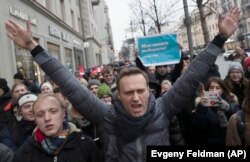
Investigators in Moscow have summoned opposition politician Aleksei Navalny for questioning over what they claim was an assault on the police officers who detained him at a rally late last month.
Navalny wrote on Twitter that police came to his home at 7:30 a.m. local time on February 5 and handed him two subpoenas.
He said he was accused of "hitting the police" who detained him at the protests, one of dozens that Navalny organized nationwide on January 28 to rally in support of his call for a boycott of Russia's upcoming presidential election.
Navalny also wrote on Instagram that the case against him was linked to a video showing the moment he was detained.
MORE
- By Carl Schreck
Bad news for any brave souls who bet money that Putin wouldn’t make the ballot.
The Russian president, a shoe-in for reelection, submitted a “record” number of valid signatures as part of a formal bureaucratic step to register as a candidate, a Central Election Commission (CEC) official has said.
Because he’s formally running as an independent, Putin had to submit 300,000 signatures of eligible voters backing his candidacy. The CEC verifies a sampling of those signatures to ensure that no more than 5 percent are invalid. Commission member Nikolai Bulayev said while verifying signatures submitted by Putin, just 0.39 percent were flagged as invalid.
"That's a record-low amount," Bulayev was quoted by the state-run TASS news agency as saying.
Fawning TV coverage of the signature-collection drive for Putin drew criticism from the respected Russian election-monitor Golos, which said it constituted illegal campaigning for a particular candidate.
With pollster Levada Center sidelined by the Justice Ministry's "foreign agent" designation (it's still said to be conducting surveys but can't publish or otherwise "participate"), independent polling data will be next-to-impossible to come by.
Last week, state pollster VTsIOM ranked the candidates' public support before filings were confirmed at: Putin 69.9%, Grudinin 7.2%, Zhirinovsky 5.9%, Sobchak 1.2%, Yavlinsky 0.9%, and Titov 0.3%. Baburin and Suraikin weren't accounted for.
- By Carl Schreck
'Yeah, I Said It': Communist Lawmaker Blasts Election
Regional television in the Tambov region produced a vox-pop segment interviewing passersby about the election.
The journalists ran into a sitting federal lawmaker, Tamara Pletnyova of the Communist Party, who had some harsh words about Russia's elections: "They won't change anything, and there are no elections. You know all this -- it's nothing but vote rigging. One district head -- not from our region, from another -- said: 'If they tell me to vote for an ape, I'll do it!'"
Pletnyova chairs the committee on families, women, and children in the State Duma.
The news portal Znak.com reached her by telephone to confirm her thoughts on the country's elections. Her response: "Yeah, I said it."
"I can repeat it if you like," Pletnyova added. "You found the video? Then just watch it."
Europe's foremost election observer announcing its mission for the March vote will be led by Norwegian Ambassador Jan Petersen:
Here's the key bit of the ODIHR summary of Russia's last presidential election, in 2012:
"Although all contestants were able to campaign unhindered, the conditions for the campaign were found to be skewed in favour of one candidate. While all candidates had access to media, one candidate, the then Prime Minister, was given clear advantage in the coverage. State resources were also mobilized in his support. On election day, observers assessed voting positively, overall; however, the process deteriorated during the count due to procedural irregularities.
"Despite the challenge of organizing elections for nearly 110 million voters residing in a territory comprising nine time zones, the administrative preparations for the presidential election proceeded efficiently. There was, however, a general lack of confidence among many interlocutors in the independence of election officials at all levels, mostly due to their perceived affiliation with local administration and the governing party."
And this is the heart of the ODIHR assessment of the Russian Duma elections in 2016:
"The legal framework can serve as an adequate basis for the conduct of elections, but democratic commitments continue to be challenged and the electoral environment was negatively affected by restrictions to fundamental freedoms and political rights, firmly controlled media and a tightening grip on civil society. The liberalized party registration process has yet to result in distinct political alternatives, and the campaign was low-key. Local authorities did not always treat the contestants equally, and instances of misuse of administrative resources were noted. The election day generally proceeded in an orderly manner, but numerous procedural irregularities were noted during counting."