



School Officials Berate, Threaten Student Over Navalny Tag
A student at High School No. 8 in Krasnodar on February 22 posted on social media an audio recording of school officials berating another student for allegedly writing the slogan "Navalny 2018" over a portrait of President Putin and on a restroom door. The audio is also available here.
The accused vandal, who was not identified, denied writing the slogans, according to a transcript of the recording.
The unidentified school officials threaten to "murder" the student no fewer than seven times during the 10-minute recording. They also call the student a "cow" and a "pig." Barred opposition politician Navalny is referred to as "a moral defect."
"Now you explain the political subtext," one school official demands. "Why did you write this, you animal? You live in Russia -- you aren't starving, obviously. Do you know who Navalny is and what [infection] he carries? You are an idiot! It will be like in Syria! Do you at least understand what you are writing? You don't understand anything about politics!
"On the eve of the election in this school!" another says. "Who paid you?"
The suspected vandal said the entire tongue-lashing lasted more than three hours.
The school's director, Natalya Ustyugova, told the Prospkt Mira website that the student in question "is not exactly outstanding in terms of behavior." She said she is investigating the actions of the school staff. Those involved, she said, have apologized to the student and his parents.
"The parents say they have no claims against the school," she added. "We will work and, I hope, such things won't happen again."
Election Selfies In Kuban
Russia's southern Kuban region -- including such cities as Sochi, Krasnodar, Anapa, and Novorossiisk -- is joining a national trend and organizing an Election Day selfie contest. Similar contests are being organized across Russia as part of a sweeping campaign to boost turnout for the heavily managed presidential election.
To participate in the Kuban contest, people need only show up at a polling place on March 18 and take a selfie next to a special sign that they will find there. They must then post the selfie on social media using a variety of tags. Contest rules are quick to point out that manipulated photos or those carrying any slogans or symbols of any kind are ineligible.
The public can then vote on the selfies at a special website that has been created for the project.
The top 25 photos will win either an iPhone or an iPad. No made-in-Russia prizes.
- By Carl Schreck
Pro-Putin demonstrators recruited with promises of cash
An effort appears to be under way to boost numbers at an upcoming rally for President Putin by paying people to attend.
An ad on a Russian website frequently used to find demonstrators-for-hire says it has now wrapped up its recruitment for the planned March 3 rally at Moscow's Luzhniki Stadium. The announcement promises 500 rubles ($8.85) to men and women between the ages of 20 and 55 years old.
The tactic of paying demonstrators to attend rallies, known in Russian as "massovka," is not new to Russia's political scene. The last time Putin was on the ballot -- in 2012 -- there were also numerous claims that many participants in a pro-Putin rally ahead of the vote were paid.
Kremlin spokesman Dmitry Peskov said this week that Putin himself might show up to the rally, which he said was organized by the incumbent's campaign.
Russian journalist Vladimir Varfolomeyev, a Kremlin critic, quipped on Twitter that he'd like to look at the campaign-spending reports.
"I'd like to see the line in there that says: 'payment for massovka,'" Varfolomeyev wrote.
- By Andy Heil
Sexual Harassment Becomes A Campaign Issue
The allegations appear to be escalating against senior Duma deputy Leonid Slutsky, with a journalist from RTVI, a privately owned New York-based Russian-language broadcaster, saying on air that the lawmaker groped her and tried to kiss her in his office.
Here's our story from yesterday, highlighting candidate Sobchak's call for a sexual-harassment probe into the actions of Slutsky, chairman of the State Duma’s International Relations Committee.
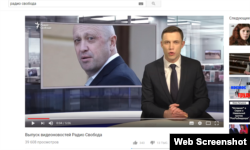
Suspicions Of 'Bots' Grow Over Spikes In 'Dislikes' Of Russian Stories Ahead Of Election
By Alan Crosby
When Zmitser Yahorau saw the number of "dislikes" for a Belsat TV story on YouTube about life in a Russian village, something looked wrong. Once the independent online news station's deputy editor in chief saw the data behind the numbers, he knew the problem -- "bots."
After the story was posted on January 30, it took only two days for the video to receive some 24,000 dislikes, compared with fewer than 2,000 likes.
A week later, as the station dug deeper into the numbers, they said all of the evidence pointed toward a "bot" attack against the story, most likely by pro-Russian sources unhappy with the content put out by the Warsaw-based channel for its Belarusian-language broadcast and online programs.
"The proportion between dislikes and views looks very suspicious. As a rule, people rarely click 'like' or 'dislike' on YouTube. The disproportion was evident, and we decided to find out from which countries people who actively disliked the post are. And we got curious statistical data," Yahorau says.
READ MORE
Navalny Team's Dark March
In a piece headlined Alexey Navalny Heads Back To Court Next Monday, And He'll Probably Spend Election Day In Jail, Meduza notes the convenience for Putin of a March 5 arraignment day for the president's most vocal critic. Here's Meduza:
As expected, Alexey Navalny will likely spend Russia’s Election Day behind bars. Moscow’s Tver Court has announced that he will be arraigned on Monday, March 5, for repeatedly violating statutes on public assemblies.
On January 28, Navalny helped organize nationwide rallies to promote a voters’ boycott of the presidential election. If given the maximum jail sentence, he wouldn’t go free until April 4 — seventeen days after Vladimir Putin’s almost certain re-election. Jailing Navalny roughly two weeks before the vote and for more than two weeks afterwards is presumably the authorities’ strategy for suppressing potential anti-Kremlin protests.
On February 22, Navalny’s campaign manager and right-hand man Leonid Volkov was jailed for 30 days on the same charges. He won’t go free until March 24, six days after the vote.
- By Carl Schreck
United Russia Steps Up Effort To Get Out The Vote
The push to boost turnout in the March 18 presidential election rolls on in Russia. The Kommersant daily today reports that President Putin's ruling United Russia party is requiring its members to bring a certain number of people out to the polls. The higher one's rank in the party, the more voters he or she is required to mobilize. Party officials told the newspaper that no one is being pressured to vote for Putin, who is running as an independent and expected to win in a landslide.
Running Away From His Record
Police in the Urals town of Verkhny Ufalei have been confiscating small signs that appeared recently on the walls of six shops owned by local entrepreneur Nikolai Korshunov.
The signs feature a portrait of President Putin and note that he has run the country since 2000. It then plays on one of Putin's favorite slogans, the idea that he "raised Russia off its knees" during his long rule by providing local "examples." It then lists local enterprises and social institutions that purportedly have been shut down since 2000 -- a list that amounted to 40 points, a notable achievement for a town of just 31,000 people.
Local media posted photographs of the damaged walls that police left behind in their zeal to maintain public order.
Korshunov was quoted as saying he now awaits a summons to the police for further explanation.
- By Mike Eckel
Russia's 'Tsar-Sultan War-Chief' Seen Facing Major Challenges
Russian academic Nikolai Petrov argues in a recent paper for George Washington University’s Ponars Eurasia program that Putin -- whom he calls "Tsar-Sultan War-Chief" -- faces deep problems assuming he triumphs in next month’s election (as nearly all experts predict).
“The Russian political system is beset by a certain stasis and the president is in a legitimacy trap,” Petrov, a professor of comparative politics at Moscow’s Higher School of Economics, writes in Russia On The Eve Of Its Presidential Election: How Long Can Change and Stasis Coexist? Any major postelection moves that Putin makes to push Russia out of its deepening structural problems, he says, risks putting the country’s governing system out of balance.
Ekho Moskvy quotes Central Election Commission head Ella Pamfilova saying the free airtime on state broadcasters translates into 60 hours of TV and 36 hours of radio time for each of the eight candidates.