

Amnesty Warns Russia Is Escalating Opposition Crackdown As Election Nears

Amnesty International has accused Russia of mounting a "fierce crackdown" on political activists ahead of this week's presidential election, systematically violating their rights through "arbitrary" arrests and detentions.
The London-based rights group said on March 15 that Russian authorities are using a draconian law on public assemblies to "deliberately" target activists calling for an election boycott. In addition, many prominent opposition voices have been arbitrarily detained and charged with politically motivated offenses.
"The Kremlin’s agenda is crystal clear -- the loudest protesters and vote-boycotters must be cleared from the cities' streets during the final stages of the presidential campaign," Denis Krivosheev, deputy director for Eastern Europe and Central Asia at Amnesty International, said in a statement.
"While various methods are used, the authorities usually turn to their favorite one: arbitrarily throwing dissenters behind bars."
CONTINUE READING
Early Voting In Arctic Russia
Voting has begun in the flat, snow-covered expanses of the Siberian Arctic, home to the nomadic Nenets people who herd reindeer. These arresting images are from Reuters.
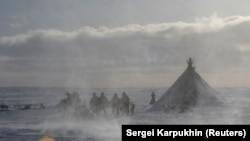
Voting Starts Early For Russia's Nomadic Herders
- By Andy Heil
Putin And The 'Emperor's Moment'
Contributor Ivan Krastev writes in a New York Times op-ed titled Welcome To The Era Of Presidents For Life that "the consensus, forged over centuries," that "rulers should not be encouraged to outstay their welcomes and that their power must always be constrained" is being "called into question."
Krastev cites Chinese President Xi Jingping's example in light of what another writer (Ken Jowitt) has previously dubbed the "Versailles Effect" -- "how power can be best measured by the eagerness of others to imitate one’s institutions and lifestyles."
"After the end of the Cold War, imitating the West signified being on the right side of history," Krastev writes, including by adopting at least a sort of ostensible democracy and constraints on a ruler's power, for instance through term limits.
Krastev writes:
That’s why many undemocratic governments insisted on maintaining democratic trappings, in particular elections and term limits. In 2008, for example, Vladimir Putin of Russia resisted the temptation to change the Constitution to allow him a third consecutive term as president because he did not want his country to look like one of the Central Asian republics where presidents never leave their palaces. Even though the system was rigged, undemocratic governments knew it was important to at least pretend it wasn’t. This — rather than the spread of liberal democracy — is the real evidence of democracy’s hegemony. Even China played along.
Until now.
In this sense, the Chinese Communist Party’s decision to abolish presidential term limits will resound far beyond China. One could imagine Mr. Putin convincing himself that leaving the Kremlin in 2024, when his next term would conclude, is no longer necessary.
Words Fail Me
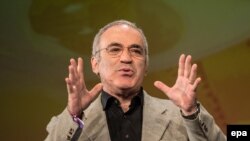
In an essay for The Weekly Standard, Garry Kasparov, world chess legend and staunch opponent of Russian President Vladimir Putin, discusses the difficulties in writing about "elections" in Putin's Russia. Worth a read...
On March 18, the popular leader of Russia, Vladimir Putin, will be reelected to another six-year term as president. This is both a plain statement of fact and a complete falsehood. In American political parlance, this statement can be taken literally, but not seriously.
The conundrum is due to the weakness of language and how we allow even the simplest words to be manipulated and distorted. That simple sentence about Putin and the Russian presidential election on March 18 is wrong in every possible way aside from the date and Putin’s name.
Before we unpack the many fictions in that statement, let us begin with what will happen, literally, on March 18 in Russia. Many people will go to polling stations and cast votes for different candidates. Putin and the other candidates will be shown on television dropping their paper ballots into boxes and smiling as the cameras flash. Vladimir Putin will receive a healthy majority of the vote, likely around the 64 percent he got in 2012.
MORE
- By Carl Schreck
All Eyes On Putin
Russian President Vladimir Putin's campaign spokesman says more than 10 percent of the Russian population has viewed a two-hour online documentary profiling the Russian leader ahead of his all-but-guaranteed reelection on March 18.
The spokesman, well-known television journalist Andrei Kondrashov, said in an interview with the news portal riafan.ru that the film, aptly titled "Putin," has garnered 16 million views since its online release on May 11.
The documentary is based on several interviews between Kondrashov and Putin, as well as associates of the Russian president. It was released online by Russian state-media executive and fiercely anti-American television personality Dmitry Kiselyov.
It is the third in a series of films about Putin distributed ahead of the March 18 ballot. One, called World Order 2018, was released online on March 7 and features a wide-ranging interview with Putin conducted by Kremlin-friendly television host Vladimir Solovyov. In February, state-run Channel One began airing a four-part documentary about Putin produced by American director Oliver Stone whose original broadcast in Russia occurred last year.
Liberal candidates Grigory Yavlinsky and Ksenia Sobchak complained that the Stone filmed violated campaign laws, and Channel One canceled the broadcast of the final part of the documentary at the request of election officials, Meduza reported.
Putin consistently receives fawning media coverage that election watchdogs say has violated campaign laws ahead of the election.
Russia Brands European Vote-Monitoring Groups 'Undesirable'
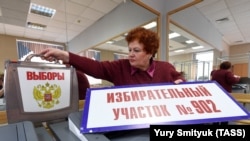
The Russian government has blacklisted two European organizations involved in election monitoring, days ahead of the March 18 presidential vote.
On March 13, the Justice Ministry listed Germany's European Platform for Democratic Elections and Lithuania's International Elections Study Center as "undesirable organizations."
The ministry said the designations were based on legislation on "measures against individuals involved in the violation of basic human rights and freedoms" and on a March 12 decision by a deputy prosecutor-general.
MORE
Monitor The Vote Online
The independent election-monitoring group Golos -- which has been branded a foreign agent by the Kremlin -- has set up a website that will enable the interested to see how each polling station reports its results in the March 18 presidential election.
The site will use official information from the Central Election Commission.
Nizhny Novogorod Also Working To Get Out The Vote
Officials in Nizhny Novogorod are offering a package of incentives to get people to turn out for the March 18 presidential election, including tickets to World Cup warm-up matches.
The enticements also include tickets to an election-night concert and free tickets to the Nizhny Novgorod municipal museum.
The Kremlin worries that low turnout in the election will mar the appearance of legitimacy for the heavily managed process. As a result, officials around the country have come up with dozens of ways of drawing or pushing voters into the voting booths.
Opposition leader Aleksei Navalny has dismissed the election as "the reappointment of Vladimir Putin" and is calling on Russians to boycott.
- By Carl Schreck
Security Stepped Up In Moscow For Vote
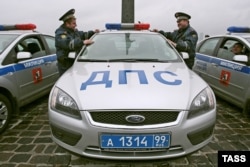
Moscow police say that more than 17,000 security officers, private security contractors, and volunteers will be mobilized to keep order in the Russian capital for the March 18 presidential election.
The press office of the Moscow city police added that in the run-up to the ballot, there security sweeps -- including with police dogs -- will be conducted at all polling stations in the capital, the state-run TASS news agency reported on March 13.
Following the election of President Vladimir Putin in 2012, large-scale opposition protests in Moscow led to mass arrests and convictions of demonstrators whom rights groups have called political prisoners.
Putin is set to coast to reelection in the first round of the March 18 ballot.
Tomsk Police Grab Navalny Material
Police in the Siberian city of Tomsk on March 14 confiscated leaflets issued by opposition politician Aleksei Navalny from the car of his local coordinator, Ksenia Fadeyeva, RFE/RL's Siberia Desk reported.
Fadeyeva told RFE/RL that she was stopped by a traffic police officer and the leaflets, which were about six months old, were seized while her documents were being examined.
On February 10, police carried out a raid of Navalny's office in Tomsk, saying they had received a tip that there were "extremist" materials at the location.