




Criminal prosecutions in Russia over donations to the Anti-Corruption Foundation (FBK), established by the late opposition leader Aleksei Navalny, have surged roughly 60-fold since the start of Moscow's full-scale invasion of Ukraine in February 2022, with courts handling at least 90 cases this year alone, according to an analysis by RFE/RL’s North Realities.
Russian authorities designated the Anti-Corruption Foundation an “extremist organization” in 2021, effectively criminalizing any financial support for the group.
The foundation had investigated corruption among senior Russian officials and business elites close to President Vladimir Putin and continues to operate from abroad despite Navalny’s death in custody last year.

According to the investigative outlet Mediazona, Russian courts handled two donation-related cases in 2022, four in 2023, and 27 in 2024. Data compiled by RFE/RL shows that the number jumped dramatically in 2025, pushing the cumulative total since the war began to at least 123 cases.
Courts most often imposed fines ranging from 120,000 to 500,000 rubles ($1,522-$6,340) or handed down suspended prison sentences of three to four years. The donations cited in the cases were typically modest -- between 100 and 14,000 rubles ($1.20 -$178).
In one case, prosecutors sought a fine of 12 million rubles ($152,000) for 69-year-old retiree Andrey Kuzhelev, who had donated 13,000 rubles ($164) to the foundation. The court rejected that demand but still imposed a fine of 500,000 rubles ($6,340).
One of the harshest sentences was given to postal worker Vladimir Skvortsov, who was jailed for 12 years for donating to the FBK and for allegedly cooperating with the Freedom of Russia Legion, a group of Russian volunteers fighting on Ukraine’s side.
Journalist Karen Shainian and civil activist Konstantin Kotov were both convicted in absentia on charges related to donations to the FBK.
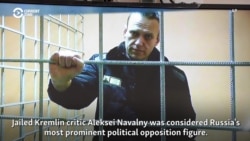
Navalny -- Russia’s most prominent opposition figure -- died in February 2024 in an Arctic penal colony under mysterious circumstances.

The official autopsy report said that hypertension and other diseases caused a heartbeat disorder which led to Navalny's demise.
However, his widow, Yulia Navalnaya, has rejected those findings, saying laboratory tests conducted outside Russia on biological samples smuggled out of the country show her husband was poisoned while in custody.

Earlier this year, the Anti-Corruption Foundation issued a statement condemning the prosecutions, saying the FBK “does not engage in any extremist activity” and calling those targeted by Russian authorities “victims of outright arbitrariness and political repression.”

