





In recent times, the centerpiece of Russia Day -- a holiday that used to be a low-key observance of independence from the Soviet Union -- has been a tub-thumping spectacle with a flag-waving concert on Red Square.
Not this year.
For the first time in 23 years, the Russia Day concert just outside the Kremlin has been canceled, moved to a much less conspicuous indoor location, with far fewer big-name acts.
It’s not the only marquee event that’s been scratched this year.
MAKS, the preeminent showcase for the latest advances and technological offerings from Russia’s once-formidable aviation industry, has been canceled -- for a third year running.
Don’t forget this year’s Victory Day parade; a markedly scaled-back ceremony on Red Square, with no big vehicles, fewer marching soldiers, and a shorter speech by President Vladimir Putin.

Oh, and what used to be the most important event for attracting foreign investors, an annual forum in Putin’s hometown, was literally clouded by plumes of burning oil smoke, ignited by Ukrainian drones.
Looming over all these events: Ukraine’s advancing drone and missile capabilities, threatening refineries and defense plants more than 1,000 kilometers from the border – not to mention a Moscow skyscraper some six kilometers from the Kremlin. Another factor, analysts said, may be a desire to avoid exposing the growing gap between propaganda and reality.
“It's likely that many public events were canceled or scaled back because of the drone threat but in reality, it also done for other reasons, such as minimizing the appearance of ‘pageantry’ in the midst of war,” said Samuel Bendett, an expert on Russian defense and technology at the Center for Naval Analyses, a US-based think tank.
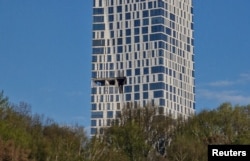
“Minimizing the chance of Ukrainian intelligence activities…and potentially ‘pivoting’ away from showing Russian military might on parades that is diverging from the battlefield reality of the Russian military getting hammered by Ukraine," he said.
This isn’t the first year that Russian authorities -- in Moscow or in regional cities -- have opted to cancel or scale back municipal events.
In 2025, a host of locations, mainly in border regions and other parts of the south and west, canceled various concerts, sports events, festivals, and other public celebrations, citing the threat of Ukrainian attacks.
What’s different this year, experts said, is that Ukraine has sprinted forward in its ability to not only mass produce drones, but also make drones that fly further, are less prone to jamming, and are smarter in their ability to pinpoint targets.
Ukraine has also punched higher in its targets.
A few weeks before the May 9 celebration of the defeat of Nazi Germany in World War II -- the most important secular holiday on the Russia calendar -- Kremlin officials announced a much more modest event: no tanks, no columns of heavy weaponry and armored vehicles grinding across Red Square.
Kremlin spokesman Dmitry Peskov said the threat of Ukrainian drones was the reason.
It’s likely, however, that Moscow also wanted to send a different message, Bendett said.
“The emphasis was on the political and sociocultural message, not just the military message that was prevalent at previous parades when Russian military tech was displayed,” he said.

'Psychological Impact'
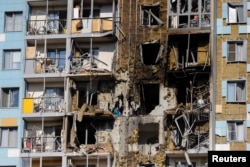
On May 17, Ukraine targeted the Russian capital with scores of drones, what state-run media described as the largest single attack on Moscow this year. Many of the drones made it past substantial Russian air and missile defenses that have been erected to protect the city.
“The psychological impact is enormous, and this is precisely the intended effect,” said Jean-Pierre Maulny, a defense analyst and deputy director of the Paris-based French Institute for International and Strategic Affairs.
“To show Russian citizens that [the Ukraine war] is a failure and that, more than four years after the beginning of this war, fear can change sides,” he wrote in an analysis.
It wasn’t the first time Ukraine targeted Moscow for psychological effect. In May 2023, 15 months after the start of all-out invasion, two Ukrainian drones exploded on the roof of one building within the Kremlin.
Damage was minimal, but the symbolism was not: it was the first time the storied fortress that is the seat of Russian power had been attacked since World War II.
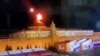
Since that time, Ukraine has rushed to build up an indigenous drone and missile industry to punch back at a bigger, better-armed Russian military -- and it’s shown evidence of success.
A few weeks after the May 17 Moscow attack, the St. Petersburg International Economic Forum opened, with hundreds of foreign visitors gathering for panel discussions, workshops, and a keynote speech by Putin while dozens of Russian companies hawked their wares.
On the event’s first day, Ukrainian drones attacked a major oil terminal on the city’s outskirts -- as well as a naval corvette in dry dock -- and sparked fires that billowed black smoke over the city.
The Ukrainians did the same thing on the last day as well.
Over the past 20 years, the MAKS International Aviation and Aerospace Salon has become the premier event for Russia’s aerospace industry to market its prowess and products, where global airlines and foreign militaries shop for fighter jets or commercial passenger planes.
The event has been “suspended” for the past three years -- due to the Western sanctions imposed in response to Russia’s all-out invasion of Ukraine.
This year, the event has been canceled, according to a government decree dated June 10. The newspaper Vedomosti, which first reported the decree, cited an unnamed official as saying the cancelation was primarily due to security concerns.
Earlier this week, at least one Ukrainian long-range cruise missile flew nearly 1,400 kilometers from the Ukrainian border to hit a defense plant in the central city of Cheboksary, well beyond Moscow.
Compared with drones, cruise missiles fly faster and carry more explosives. They also have powerful targeting systems.
Russia Day
Plans for this year’s Russia Day, meanwhile, called for an outdoor concert, with the Kremlin serving as a backdrop, featuring some of the biggest names in Russian pop music, including Yaroslav Dronov, best known as Shaman -- the author of the song “I Am Russian.”
It’s a theme that contrasts with how the holiday was first envisioned: simply as a day marking Russia’s formal “independence” from the Soviet Union in 1991.
Moscow news portal Msk1, however reported that the Red Square concert had been canceled, moved to an indoor venue a few kilometers northeast of the Kremlin. The list of artists performing was also cut down, though it was unclear if Shaman would be appearing, or the other named performers.
Russian state TV indicated it would be broadcasting some or all of the June 12 event.
Moscow city officials made no comment about the canceled plans.
For his part, Putin attended a ceremony where he thanked veterans of the Ukraine war and clinked champagne flutes with recipients of various state awards.
It was held deep inside the protection of an ornate Kremlin hall.