



News
Ukrainian Navy Says Russia Refused To Allow Movement Of Four Ships In Black Sea Grain Deal
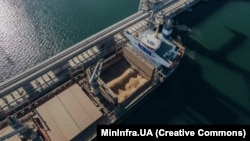
Russia refused to coordinate the movement of four ships in and out of Ukrainian ports under the terms of a grain deal that has been in place since last summer, the Ukrainian Navy said on April 26, in an apparent further complication of efforts to extend the deal.
One of the four ships was chartered by the World Food Program to deliver wheat to Ethiopia, said a Ukrainian Navy statement posted on Facebook.
Russian representatives in the Joint Coordination Center set up in Istanbul under the Black Sea Grain Initiative refused to agree on the movement of vessels to or from the seaports of Ukraine, the statement said.
As a result, three of the vessels, including the one destined for Ethiopia, were unable to leave the ports of Chornomorsk, Odesa, and Pivdenniy and must wait for their passage to be approved, while one vessel was forced to wait for transit to the port of Odesa in the area of Sulina.
The navy said Russia had effectively stalled the ships' movements by refusing to take part in agreeing on the routes they should take, a process that occurs for each export trip.
The Black Sea Grain Initiative was brokered in July by the United Nations and Turkey with Russia and Ukraine to allow the safe passage of grain exports through Ukraine’s ports on the Black Sea.
The pact was renewed for 60 days last month, but Russia has signaled it may well not agree to extend it further unless the West removes obstacles to the exports of Russian grain and fertilizer.
Russian Foreign Minister Sergei Lavrov on April 25 said the situation related to the grain deal had reached a deadlock. Lavrov said UN Secretary-General Antonio Guterres is trying to negotiate with the countries that have announced unilateral sanctions against Russia, but there are no results.
Guterres has written a letter to Russian President Vladimir Putin presenting a "way forward" on extending and improving the grain deal, the secretary-general's office said on April 24 after he met with Lavrov in New York.
During a briefing with UN correspondents on April 26, Gennady Gatilov, Russia's ambassador to the United Nations in Geneva, said Moscow appreciated the UN's efforts and believed the UN was trying its best.
"But what we hear until now is only promises," he added.
Moscow says Western sanctions on its payments, logistics, and insurance industries have created a barrier to the export of its grains and fertilizers. Russia has made the claims even though Russian agricultural exports have not been explicitly targeted by Western restrictions.
"The Ukrainian part of the deal is working well," Gatilov said. "But the Russian part of this deal is not working, and these two parts should be equal. This is not the case."
One of Russia's main demands is the reconnection of the Russian Agricultural Bank (Rosselkhozbank) to the SWIFT payments system. The bank is one of many disconnected from the system more than a year ago as a sanction imposed after Russia invaded Ukraine.
"The UN acknowledges that there are problems that should be resolved," Gatilov said, adding that the world body was in discussions with Washington, Brussels, and others. "I don't know whether they will be able to achieve sufficient progress in the time left."
The UN and many countries expressed alarm when Ukraine's ports were blocked after Russia invaded Ukraine in February last year, saying it could lead to global consequences, including famine in poorer countries. The Black Sea Grain Initiative eased those concerns, but its latest extension runs out on May 18.

With reporting by Reuters and AFP
More News
Family Of Four Feared Dead In Russian Missile Strike On Kramatorsk, Ukrainian Officials Say
Four members of one family -- including two teenagers -- were feared dead in the aftermath of a Russian missile attack in the southeastern city of Kramatorsk, the local adminstration said late on February 17. "The Russians fired three missiles at Kramatorsk, hitting the industrial zone and the private sector," a statement said. "A family of four people, including teenagers aged 14 and 16, were likely buried under the rubble of one of the houses." Shells also hit Slovyansk, authorities said, and at least one person is feared buried in the rubble. To read the original story by RFE/RL’s Ukrainian Service, click here.
Ukraine Warns Of Border Crossing Shutdown Amid Polish Farmers' Protest
Ukraine's customs service warned that a protest by farmers on the Polish side of the Yahodyn-Dorohusk checkpoint will likely block traffic on February 18, as a long line of trucks and other vehicles has already been seen at the crossing. "A complete blockade of traffic for trucks in both directions is expected. Farmers from Germany, Belgium, the Netherlands, and France are [expected] to join in a large-scale protest action," it said. Polish protesters seek limits on the amount of Ukrainian agricultural products coming into the EU, and farmers across the continent are protesting against introduction of various environmental requirements. To read the original story by RFE/RL’s Ukrainian Service, click here.
- By dpa
Germany Says Helped U.S. Shut Down Russian Computer Spy Network
German security authorities have helped to shut down a Russian computer espionage network in a U.S.-led operation that uncovered, in part, spying about Germany's plans for Ukraine, the Interior Ministry said on February 17. The hacker group APT 28 had installed malware on hundreds of small routers in offices and private homes on behalf of the Russian GRU military intelligence service, it said. Hackers used the international infrastructure to attack German targets over the past two years, including about German policy and supplies for Ukraine, a ministry spokesman said, citing Germany's domestic intelligence authorities. Targets in other EU and NATO countries were also attacked.
- By Reuters
Hungary Can Soon Ratify Sweden's NATO Bid, Orban Says
The Hungarian parliament can ratify Sweden's NATO membership when it convenes for its new spring session this month, Prime Minister Viktor Orban told supporters on February 17. "It's good news that our dispute with Sweden will soon be settled," Orban said in a keynote speech. "We are going in the direction that at the start of parliament's spring session we can ratify Sweden's accession to NATO." Parliament reconvenes on February 26. Sweden applied to join NATO nearly two years ago in a historic shift in policy prompted by Russia's full-scale invasion of Ukraine. Membership bids must be unanimously approved by all members.
Dutch PM 'Cautiously Optimistic' Military Aid For Ukraine Coming 'Soon'
Outgoing Dutch Prime Minister Mark Rutte, the front-runner to be the next secretary-general of NATO, has said EU countries are "working with our partners all over the globe" to meet Ukraine's military needs, especially supplying Kyiv with ammunition and air-defense systems.
"I was just speaking with [Ukrainian President] Volodymyr Zelenskiy and I think these are the two main priorities," Rutte said in an interview with RFE/RL on the sidelines of the Munich Security Conference on February 17.
Addressing the global security conference earlier, Zelenskiy urged allies to plug an "artificial" shortage of weapons that is giving Russian forces the upper hand on the battlefield and said stalled U.S. aid was crucial.
Live Briefing: Russia's Invasion Of Ukraine
RFE/RL's Live Briefing gives you all of the latest developments on Russia's full-scale invasion, Kyiv's counteroffensive, Western military aid, global reaction, and the plight of civilians. For all of RFE/RL's coverage of the war in Ukraine, click here.
Ukraine faces acute shortages of ammunition and U.S. military aid has been delayed for months in Congress.
"Unfortunately, keeping Ukraine in an artificial deficit of weapons, particularly in deficit of artillery and long-range capabilities, allows [Russian President Vladimir] Putin to adapt to the current intensity of the war," Zelenskiy said.
Asked about the delayed U.S. aid after a bilateral meeting with Zelenskiy, U.S. Vice President Kamala Harris, a Democrat, denounced "political gamesmanship" in Congress that has no place in such matters.
Republicans have insisted for months that any additional U.S. aid to Ukraine, and Israel, must also address concerns about border security.
Meanwhile, Donald Trump, the front-runner for the Republican presidential nomination, has said he would ask European allies to reimburse the United States for around $200 billion worth of munitions sent to Ukraine.
"We should stop moaning and whining and nagging about Trump," Rutte told the security gathering on February 17. "We do not spend more on defense or ramp up ammunitions production because Trump might come back."
Talk of a potential European nuclear deterrent that would not involve the United States is "not helpful," he told the conference. And it "would only undermine NATO in a time when we really need credible deterrence."
Speaking to RFE/RL, Rutte, who unexpectedly announced his departure from Dutch politics in July, said he was "cautiously optimistic" that U.S. military aid to Ukraine would be delivered soon.
Rutte said any delays by EU countries to deliver weapon supplies to Ukraine was due to the fact that they, along with Ukraine, "are all democracies."
"And sometimes these issues take a bit of time…. And now I know that there are still new discussions on new weapons systems. I think decisions can be made fairly soon," Rutte explained.
Rutte also said Dutch plans to transfer to Ukraine U.S.-made F-16 fighter were "basically on schedule."
"We hope to transfer them as soon as possible. Twenty-four of them, maybe more, but at least 24. We are working together with the Danes and others. So, things are progressing now," Rutte told RFE/RL.
Asked about alleged signals from the Kremlin that Russia could be ready for talks with Ukraine, Rutte said that decision rested solely with Kyiv.
"There's only one person who can ever decide to enter into peace negotiations with Russia. And that man is still the legally elected president of Ukraine," Rutte said, referring to Zelenskiy.
"And what we're doing at this moment is to help him to make sure all your brave men and women in Ukraine, the military and all the citizens, [are able] to free that country from the Russians. And the only one, again, who can decide on peace negotiations is Zelenskiy. Nobody else," Rutte added.
Rutte also commented on the death of Aleksei Navalny, the Russian opposition leader who died at a remote Arctic prison on February 16.
Navalny's spokeswoman confirmed on February 17 that Navalny had died and said he was "murdered," but it was unclear where his body was as his family and friends searched for answers.
"Aleksei Navalny is one person so brave, so enormous, impressive as he was, that this one person was a threat to the Russian state. That means how weak they are and how insecure they are about our own role and position," Rutte said.
Navalny's death at age 47 has deprived the Russian opposition of its most well-known and inspiring politician less than a month before an election that will give Putin another six years in power.
Asked whether Russia and Putin, whom Western leaders have blamed for Navalny's death, could face further Western sanctions, Rutte was not hopeful.
"I don't think it will in itself lead to extra sanctions," Rutte said, noting the EU was already preparing a 13th package of sanctions against Russia that it hopes to pass by February 24.
"New sanctions packages are important, but making sure that we close the loopholes in the existing packages is also important," Rutte said.
Rutte has emerged as a leading candidate to succeed NATO chief Jens Stoltenberg, who plans to step down in October after 10 years at the helm.
Blinken, Scholz Meet Leaders Of Armenia, Azerbaijan, Vow To Support Peace Efforts
German Chancellor Olaf Scholz and U.S. Secretary of State Antony Blinken met separately with the leaders of Armenia and Azerbaijan, with the German leader saying the bitter Caucasus rivals had agreed to resolve their differences "without new violence."
“Germany and Europe stand ready to do everything in their power to support the peace negotiations between Armenia and Azerbaijan,” Scholz said after meeting Armenian Prime Minister Nikol Pashinian and Azerbaijani President Ilham Aliyev on the sidelines of the Munich Security Conference on February 17.
"I reaffirmed this in my talks with both countries. It's a good thing that both sides have pledged to resolve open issues without new violence," he added.
U.S. State Department spokesman Matthew Miller said Blinken met with Aliyev and that the two "discussed efforts to achieve a durable peace agreement" between the Armenia and Azerbaijan.
Azerbaijani state-run Azertag news agency quoted Aliyev as saying that Baku "remains committed to the peace process. The conclusion of a peace treaty in the near future meets the country's national interests."
The State Department said Blinken also met with Pashinian "to discuss strengthening bilateral ties and U.S. support for efforts to reach a durable and dignified peace agreement between Armenia and Azerbaijan."
"Secretary Blinken noted our ongoing efforts to support Armenia’s vision for a prosperous and democratic future for its people, as well as U.S. support for Armenia’s sovereignty, independence, and territorial integrity," a statement added.
Long-standing tensions between the two countries have soared since Azerbaijan retook the Armenian-populated breakaway region of Nagorno-Karabakh following a lightning-fast military strike in September 2023.
The meeting with Scholz comes days after the latest flare-up of violence along the Armenian-Azerbaijani border -- the first major escalation in months.
In that incident, the Armenian Defense Ministry said four Armenian soldiers were shot dead and one wounded by Azerbaijani fire early on February 13 at one of the southern sections of their border.
Azerbaijan's State Border Service said its forces had "completely destroyed" an Armenian border post during a "revenge operation" after Baku accused Armenian troops of opening fire on February 12 in the direction of Azerbaijani positions in the Zangelan district, claiming that one Azerbaijani border guard was wounded.
Following the Scholz meeting, Nazeli Baghdasarian, a spokeswoman for the Armenian prime minister's office, confirmed that a three-party session involving the Armenian, Azerbaijani, and German leaders took place.
"The process of regulating Armenia-Azerbaijan relations and steps to ensure peace and stability in the region were discussed," she said. "An agreement has been made to continue the work on the peace treaty."
Azertag confirmed the meeting took place and that Scholz had reiterated his support for the peace process
The Azerbaijani news agency APA reported that Scholz left the meeting room about an hour after the start of the negotiations and they continued in a bilateral format.
APA said Aliyev and Pashinian instructed their foreign ministers, who also attended the meeting, to "continue negotiations" on the peace treaty and the delimitation of the Armenian-Azerbaijani border.
Azerbaijan had for months refused to hold further Western-mediated talks with Armenia, accusing the European Union and the United States of pro-Armenian bias and seeking direct contacts between the two sides.
"We don’t need mediators to normalize relations with Yerevan," Aliyev said on February 13, adding that the Armenian-Azerbaijani conflict "should be removed from the international agenda."
Yerevan, meanwhile, has insisted on continued Western mediation -- which has also been strongly criticized by Russia. Armenia accused Baku of walking away from understandings reached by Aliyev and Pashinian during their earlier encounters organized by the EU.
On February 14, Pashinian claimed that the Azerbaijani leadership was pursuing a "policy of military coercion" in an effort to extract more Armenian concessions.
He said it could be planning to launch a "full-scale war against Armenia." The Azerbaijani Foreign Ministry dismissed the claim.
Several More Baha'is Jailed In Iran As Crackdown Continues
Iran's judiciary has handed down lengthy sentences to several members of the Baha'i community, the country's largest non-Muslim group, the latest in a series of acts by the government against the faith's followers.
Keyvan Rahimian, a psychologist and Baha'i follower, was sentenced to a total of nine years in prison by Branch 15 of the Islamic Revolutionary Court, according to an Instagram page associated with Rahimian.
It added that the sentence was split between five years for alleged "educational and/or promotional activities contrary to or undermining the sacred Shari'a of Islam," and an additional four years for "assembly and collusion."
Rahimian was arrested in July 2023 and he has been detained in Tehran's notorious Evin prison since then.
Meanwhile, Mina Karami, another Baha'i follower, was arrested on February 14 by security agencies on the streets of the southern Iranian city of Shiraz.
She was subsequently transferred to Adel-Abad prison in Shiraz to commence a five-year sentence previously handed down in September 2022 for similar charges of undermining Islamic Shari'a through educational activities.
Karami had been temporarily released on bail in early 2022 but now faces additional penalties, including a cash fine and a decade-long deprivation of social rights.
Another Baha'i follower, Noushin Misbah, voluntarily presented herself to the local prosecutor's office this week to begin serving a one-year prison term. She was then taken to Vakilabad prison in Mashhad.
Baha'i leaders have accused Iranian authorities of attempting to "systematically marginalize" its followers and deprive its members of their basic rights.
Since the Islamic Republic of Iran was established in 1979, hundreds of Baha'is have been arrested and jailed for their beliefs. At least 200 have been executed or were arrested and never heard from again. Thousands more have been banned from receiving higher education or had their property confiscated, while vandals often desecrate Baha'i cemeteries.
Baha'i officials also point to the arrests and reports of ongoing detentions and the unclear status of other Baha'i followers, such as Iman Rashidi and Yekta Fahandezh, whose situations remain unresolved after more than two months in custody.
The Islamic Republic of Iran does not recognize the Baha'i faith, and authorities have frequently targeted its followers, labeling them as "spies and enemies." This has led to a series of harsh penalties, including death sentences, arrests, and prohibitions on education and employment, highlighting a continuing trend of religious persecution in the country.
International human rights organizations have repeatedly condemned Iran's treatment of Baha'is, calling for an end to the discrimination and for the upholding of religious freedoms as per international standards.
There are some 300,000 Baha'i adherents in Iran and an estimated 5 million worldwide.
In a religious fatwa issued in 2018, Iranian Supreme Leader Ayatollah Ali Khamenei forbade contact, including business dealings, with the followers of the faith.
Written by Ardeshir Tayebi based on an original story in Persian by RFE/RL's Radio Farda
Armenian Ex-Minister Under House Arrest After Corruption Indictment
Former Armenian Economy Minister Vahan Kerobian was put under house arrest on February 16, one day after he was indicted in an ongoing corruption investigation.
Kerobian denied accusations of abuse of power and said he will appeal against the court's decision to put him under house arrest. He told journalists in the courtroom that he was not allowed to comment on details of the high-profile criminal case.
The accusations stem from a procurement tender organized by the Economy Ministry last year. Another Armenian court in June invalidated the ministry's decision to declare a major software company, Synergy International Systems, the winner of the tender. The decision followed a lawsuit filed by another bidder that had set a much lower price for its services.
Armenia's Investigative Committee said late on February 15 that Kerobian and four other ministry officials -- all of whom were charged with abuse of power -- rigged the tender in a bid to grant a $1 million procurement contract to Synergy by illegally disqualifying Harmonia, another tech company, and ensure Synergy's victory in the tender "at any cost."
The statement added that the officials planned on granting the procurement contract to Synergy even after the ministry reluctantly declared Harmonia the winner of the tender in August. It did not accuse them of bribery or give any reasons for the preferential treatment allegedly enjoyed by Synergy.
Kerobian openly defended his subordinates before resigning on February 14. During a cabinet meeting chaired by Prime Minister Nikol Pashinian last week, he complained that the criminal proceedings had "paralyzed the work of the entire state system."
Kerobian was formally relieved of his duties a few hours after announcing his resignation. In a statement, he said that he disagreed with Pashinian and had wanted to step down on numerous occasions during his more-than-three-year tenure. He did not elaborate.
Kerobian on February 16 confirmed media reports that the chief of Pashinian's staff, Arayik Harutiunian, told him to resign shortly before he posted his resignation statement on Facebook. He claimed that Harutiunian gave no reason for the recommendation.
"During these 3-plus years, I have worked with an unrelenting devotion, filled with love for every citizen of Armenia," he said on Facebook. "I have been decisive, honest and dedicated to the homeland."
The ex-minister also said that he did not think the charges brought against him were politically motivated. Some Armenian commentators have suggested that Pashinian ordered this and another corruption probe involving another ministry official in hopes of boosting his falling approval ratings.
Kerobian, 47, was appointed economy minister in November 2020 in the wake of Armenia's disastrous war with Azerbaijan.
He was until then the chief executive of a food-delivery company that he set up with his wife and a friend. He also previously managed an Armenian supermarket chain that went bankrupt before being purchased and rebranded by other investors.
Navalny's Death Confirmed, But Officials Refuse To Release Body Pending 'Investigation'
Aleksei Navalny's family and close associates have confirmed the Russian opposition politician's death in an Arctic prison and have demanded his body be handed over, but officials have refused to release it, telling his lawyers and mother that an "investigation" of the causes would only be completed next week.
"Aleksei's lawyer and his mother have arrived at the morgue in Salekhard," Navalny spokeswoman Kira Yarmysh wrote on X, referring to the capital of the region of Yamalo-Nenets, where Navalny's prison is located.
"It's closed. However, the [prison] has assured them it's working and Navalny's body is there. The lawyer called the phone number which was on the door. He was told he was the seventh caller today. Aleksei's body is not in the morgue," she added.
Yarmysh then said in a new message: "An hour ago, the lawyers were told that the check was completed and no crime had been found. They literally lie every time, drive in circles and cover their tracks."
But in a third message, she said, "Now the Investigative Committee directly says that until the check is completed, Aleksei’s body will not be given to relatives."
Navalny associate Ivan Zhdanov, who currently resides abroad, said that Navalny's mother was told her son had died of a cardiac-arrest illness.
"When the lawyer and Aleksei’s mother arrived at the colony this morning, they were told that the cause of Navalny’s death was sudden death syndrome," Zhdanov said.
Navalny’s mother, Lyudmila, who traveled to the Yamalo-Nenets region some 1,900 kilometers northeast of Moscow, was earlier informed that the Kremlin critic died at the "Arctic Wolf" prison on February 16 at 2:17 p.m. local time, according to Yarmish.
Vadim Prokhorov, a lawyer who has represented Russian human rights activists, told Current Time that "what is happening is not accidental."
"The Russian authorities will do everything not to turn over the body in time or certainly not to conduct a forensic medical examination," Prokhorov told Current Time, the Russian-language network led by RFE/RL in cooperation with VOA.
The penitentiary service said in a statement on February 16 that Navalny felt unwell after a walk and subsequently lost consciousness. An ambulance arrived to try to revive him but he died, the statement added.
Navalny, a longtime anti-corruption fighter and Russia's most-prominent opposition politician for over a decade, was 47.
His death sparked an immediate outpouring of grief among many Russians, while leaders around the world condenmed the death of Vladimir Putin's staunchest critic, blaming the Russian president directly for the death.
Group of Seven (G7) foreign ministers meeting in Munich on the sidelines of a security conference held a minute's silence for Navalny on February 17. The G7 consists of Britain, Canada, France, Germany, Italy, Japan, and the United States.
In a joint statement released by Italy, the ministers expressed their "outrage at the death in detention of Aleksei Navalny, unjustly sentenced for legitimate political activities and his fight against corruption."
Italian Foreign Minister Antonio Tajani said that "for his ideas and his fight for freedom and against corruption in Russia, Navalny was in fact led to his death."
"Russia must shed light on his death and stop the unacceptable repression of political dissent," he added.
Ukrainian President Volodymyr Zelenskiy said the death of Navalny showed that it is impossible to see Putin as a legitimate leader.
"Putin kills whoever he wants, be it an opposition leader or anyone who seems like a target to him," Zelenskiy told the Munich Security Conference on February 17.
Yale history professor Timothy Snyder, an expert on Central and Eastern Europe, told RFE/RL in Munich that Navalny will be remembered as someone who sacrificed his life for his country.
"Putin wants to be remembered as a ruler of Russia. But Navalny will be remembered in a different way because Navalny died for his country rather than for killing other people."
"He tried to show that other things are possible [in Russia] and we'll never know what kind of leader he would have been," he added.
Navalny's vision for change in Russia will be kept alive by his team, his spokeswoman Yarmysh said. "We lost our leader, but we didn't lose our ideas and our beliefs," Yarmysh told Reuters via Zoom, speaking from an undisclosed location.
Navalny's death was a "very sad day" for Russia, and must lead to international action, the wife of a former Russian agent killed by radiation poisoning said on February 17.
Marina Litvinenko, whose husband Aleksandr died of radiation poisoning in 2006, three weeks after drinking tea laced with polonium at a meeting with Russian agents at a London hotel, told AFP she had sympathy for Navalny's wife, Yulia.
The Kremlin, which Navalny said was behind a poison attack that almost killed him in 2020, has angrily denied it played any role in Navalny's death and rejected the "absolutely rabid" reaction of Western leaders.
Inside Russia, people continued to mourn the death of the anti-corruption crusader despite official media paying little attention to his death and efforts to remove any tributes to him.
At least 340 people have been detained in 30 cities and towns in Russia on February 16 and 17 after they came to pay tribute, include laying flowers, to the memory of Navalny, according to OVD-Info, a group that monitors political repression in Russia.
On February 17, police blocked access to a memorial in the Siberian city of Novosibirsk and detained several people there as well as in another Siberian city, Surgut, OVD-Info said.
In Moscow, people came to lay flowers at the "Wall of Sorrow" memorial on the avenue named after Soviet physicist and dissent Andrei Sakharov on February 17. Riot police immediately moved in and more than 15 people were arrested, the Sota news outlet reported.
In St. Petersburg, an Orthodox priest was detained on February 17 after he announced he would hold a memorial service for Navalny.
Grigory Mikhnov-Vaitenko was detained near his home as he was going to the Solovetsky Stone memorial dedicated to Soviet victims of political repression.
He was remanded in custody and was to be presented to a judge on February 19, the site 24liveblog.com reported.
However, a memorial service was performed by a different Orthodox priest at the site, in the presence of several people, some of whom were detained after the service was completed.
Man Kills 12 Relatives In Southeastern Iran
A man shot dead 12 of his relatives on February 17 in a remote rural area in southeast Iran, in one of the deadliest such incidents in the country. Ebrahim Hamidi, the chief judiciary official in the south-central province of Kerman, told Iranian media the man, armed with a Kalashnikov assault rifle, opened fire on his father, brother, and other relatives. Hamidi said the shooting spree appeared to have been caused by family disputes. Reports say several children were among the victims. IRNA news agency said "attempts are under way" to arrest the 30-year-old suspect, who has not been named. To read the original story by RFE/RL's Radio Farda, click here.
Mixed Reaction To Navalny's Death In Moscow While Europeans Gather To Mourn Kremlin Critic
The death of Russian opposition politician Aleksei Navalny in a Russian prison on February 16 led to an outpouring of grief across Europe, but in Moscow the reaction was more mixed, with some people calling him brave and others saying he won't be missed.
As reports spread on February 16 that the opposition politician had died, RFE/RL's Russian Service asked residents of the Russian capital for their reactions.
"I think he was a very brave and honest man. He was the only one to do things we are afraid to do -- [to] do the right things. He paid for this with his life. This is horrible and unfair," one young woman said.
Her positive reflection contrasted with that of and older man who said he was "probably both a good and a bad man," depending on one's point of view.
"I don’t find him interesting, nor his fate. I think that everyone who is against Russia is guilty, even if they are right," the man told RFE/RL.
An older woman with tears rolling down her cheeks said she was very sad.
"He fought for us! My dear boy," the woman said.
Other Russians said they had not followed his case since he was jailed and he won't be missed, while yet another opinion was that he was partly to blame for his death because he returned to Russia after being poisoned in an incident that Navalny himself believed Putin ordered.
"It was his choice to fight until the very end. The people who supported him and his ideas should probably keep fighting," said a bespectacled middle-age man, while a younger man said he'll be remembered for what he did.
Meanwhile, Russians living abroad and citizens of many European Union countries gathered to express their sorrow over Navalny's death and anger at Russian President Vladimir Putin.
In Serbia hundreds of Russians and others lit candles and laid flowers outside the Russian Embassy in Belgrade, capital of the fellow Slavic country that is the home of tens of thousands of Russians who moved to Serbia since Russia launched its full-scale invasion of Ukraine two years ago.
Hundreds gathered in the Georgian capital of Tbilisi, which has also seen a huge influx of Russians since the invasion. Some held banners calling Putin a “killer” and demanding accountability. Up to 300 people attended a similar rally in Georgia’s third-largest city, Batumi.
A crowd of 500 to 600 people gathered in Berlin, according to police estimates. Some chanted "Putin to the Hague," referring to the international criminal court investigating war crimes in Ukraine.
Police used barriers to close off the road between the Russian Embassy and the crowd.
"Aleksei Navalny is the leader of the Russian opposition and we always kept hope in his name," a Russian man who gave his name only as Ilya was quoted by Reuters as saying.
Protesters placed flowers and candles by a portrait of Navalny in Lithuania, which is home to a sizeable community of Russian emigres.
"He was always with us, so it is all surreal," Lyusya Shtein, 26, a Pussy Riot activist who has lived in Vilnius since leaving Russia in 2022, was quoted by Reuters as saying. "None of us yet understand what happened."
Protesters also assembled in the Armenian capital of Yerevan after Russian authorities announced that Navalny fell unconscious and died after a walk at the Arctic prison where he was serving a lengthy sentence.
Crowds of protesters also rallied in London and Paris, as well as the capitals of Latvia, Bulgaria, and Estonia. Groups also gathered in Rome, Amsterdam, Barcelona, Lisbon, Geneva, and The Hague, Reuters reported.
Images of the 47-year-old were left alongside bouquets of flowers outside the Russian Embassy in London. More than 100 protesters stood outside the embassy holding placards that called Putin a war criminal.
Near the Russian Embassy in Paris, where around 100 protesters gathered, Natalia Morozov said Navalny had been a symbol of hope.
"It's hard for me to express my emotions, because I'm really shaken," Morozov told Reuters. "Now we no longer have hope for the beautiful Russia of the future."
Outside Europe, hundreds rallied in Israel at the Russian Embassy in Tel Aviv chanting “Russia without Putin!” and “Russia will be free!" And in New York City a vigil was held outside the Russian consulate.
"I really believe that he's the one and he can lead Russia to a better future," said Violetta Soboleva, a Russian studying for her doctorate who she had volunteered for Navalny's presidential campaign in 2017. "And now we've lost this future forever, and there is nothing we can do about it anymore, for right now."
With reporting by Reuters, AP, and dpa
- By AP
Afghan Women Fear Going Out Alone Due To Taliban Decrees On Clothing, Male Guardians, UN Says
Afghan women feel scared or unsafe leaving their home alone because of Taliban decrees and enforcement campaigns on clothing and male guardians, according to a report from the UN Mission in Afghanistan. The report was issued days before a UN-convened meeting in the Qatari capital Doha, where member states and special envoys to Afghanistan are expected to discuss engagement with the Taliban. The Taliban have barred women from most areas of public life and stopped girls from going to school beyond the sixth grade as part of harsh measures they imposed after taking power in 2021.
- By RFE/RL
Zelenskiy Urges West To Step Up Weapons Deliveries In Face Of Avdiyivka Pullout
Ukrainian President Volodymyr Zelenskiy urged his Western partners to deliver more weapons and ammunition to Kyiv, with the remarks coming on the heels of his decision to pull his outgunned and outmanned forces out of the embattled eastern city of Avdiyivka in the face of the latest Russian onslaught there.
"It’s important for us to save the lives of our people, that’s our main objective. We’re saving the lives of our soldiers," Zelenskiy said at the Munich Security Conference on February 17.
"Russia has not seized anything [following the Ukrainian withdrawal]. They just destroy," Zelenskiy said, adding that Ukrainian defenders were outmanned 7-1 by the Russian invaders in Avdiyivka.
Russia's Defense Ministry late on February 17 claimed that its forces had taken "full control" of Avdiyivka, saying it had been "a powerful defensive hub of the Ukrainian armed forces."
In a news conference with Zelenskiy, U.S. Vice President Kamala Harris reiterated Washington's vow to back Kyiv in its battle against the Russian invasion for "as long as it takes" and said the U.S. government would push for Moscow to pay damages to Ukraine following the end of the war.
"We will continue in our efforts to secure a just and lasting peace," she said. "We will work to make sure Russia pays damages to Ukraine."
Earlier on February 17, Ukraine's commander in chief , Colonel General Oleksandr Syrskiy, announced his forces were withdrawing from Avdiyivka after four months of a brutal battle with Russian soldiers.
"Ukrainians have proven that we can force Russia to retreat," Zelenskiy said, adding that "our actions are limited only by the sufficiency and length of the range of our strength.... The Avdiyivka situation proves this."
Ukraine, which is heavily dependent on economic and military aid from its Western allies and especially from the United States, has been facing an increasingly acute shortage of ammunition and military equipment as U.S. Republican lawmakers squabble over a $61 billion military and economic aid package for Kyiv.
In a phone call with Zelenskiy, President Joe Biden reassured his Ukrainian counterpart of U.S. backing while saying that U.S. congressional “inaction” had contributed to Ukraine's battlefield setback.
"This morning, Ukraine's military was forced to withdraw from Avdiyivka after Ukrainian soldiers had to ration ammunition due to dwindling supplies as a result of congressional inaction, resulting in Russia's first notable gains in months," the White House said in a statement.
"President Biden emphasized the need for Congress to urgently pass the national security supplemental funding bill to resupply Ukrainian forces [and] reaffirmed the strong bipartisan support in the U.S. government and among the American people for Ukraine’s sovereignty and territorial integrity, and to imposing costs on the Russian government to hold it accountable for its actions," it added.
Zelenskiy, who is redoubling efforts to garner more military, political, and economic support for Ukraine to stave off Russia's unprovoked invasion that is nearing the two-year mark, again urged Ukraine's Western allies to speed up heavy weapons and ammunition deliveries.
"Keeping Ukraine in artificial deficits of weapons, particularly in deficits of artillery and long-range capabilities, allows Putin to adapt to the current intensity of the war," he said.
Live Briefing: Russia's Invasion Of Ukraine
RFE/RL's Live Briefing gives you all of the latest developments on Russia's full-scale invasion, Kyiv's counteroffensive, Western military aid, global reaction, and the plight of civilians. For all of RFE/RL's coverage of the war in Ukraine, click here.
In response to a question from the media on whether it would be good for Zelenskiy to invite former U.S. President Donald Trump to visit Ukraine, "If Mr. Trump, if he will come, I am ready even to go with him to the front line," he said. "I invite him publicly, but it depends on his wishes, of course. We are ready."
Trump, who is the current front-runner for the Republican presidential nomination, has repeatedly expressed scepticism about further U.S. support for Ukraine.
Speaking separately at the Munich forum, NATO Secretary-General Jens Stoltenberg said the U.S. delay in unlocking the aid for Ukraine has a direct impact on the front line situation.
"Every week we wait means that there will be more people killed on the front line in Ukraine," he said.
Prior to her meeting with Zelenskiy, the U.S. vice president, a Democrat, on February 16 warned that failure by the Republican-led House to authorize further aid for Ukraine would amount to a "gift" to Russian President Vladimir Putin.
Addressing the Munich forum, Harris told Ukraine's European allies, "You have made clear that Europe will stand with Ukraine and I will make clear, President Joe Biden and I stand with Ukraine."
Harris later said Biden's administration stood ready to support Ukraine for "as long as it takes" and would push for Russia to pay damages to Ukraine following the end of the war.
"We will continue in our efforts to secure a just and lasting peace. We will work to make sure Russia pays damages to Ukraine," she said at a joint news conference with Zelenskiy on February 17.
Zelenskiy traveled to Munich a day after he signed key security agreements with France and Germany.
The Ukrainian leader said the agreements signed with Germany and France would give "an impulse to the United States" to approve the critical $61 billion aid package.
But German Chancellor Olaf Scholz, when asked earlier on February 17 in Munich whether his government would supply long-range Taurus missiles to Ukraine, sidestepped the question, saying only that German decisions would be made at the right time.
Speaking on the margins of the Munich Security Conference on February 17, Danish Prime Minister Mette Frederiksen criticized fellow supporters of Ukraine for being too slow and hesitant to supply the embattled country with the weapons it needs.
The international community made costly mistakes in responding to Russia's full-scale invasion of Ukraine, Frederiksen said, and too little is still being done to deliver the weapons that Ukraine needs.
Frederiksen urged other European countries to send weapons and ammunition from existing stocks to Ukraine while also investing more in building up Europe's capacity to produce weapons.
Also in Munich, Italian Foreign Minister Antonio Tajani said Ukraine would eventually become a member of the European Union and also of NATO, but it can't join the Western military alliance while it remains in a military conflict with Russia.
"The message to Russia is very clear: Ukraine will be a member of the European Union, and then we are working to have Ukraine as a member of NATO," Tajani said.
But he insisted that NATO membership wasn't possible while Ukraine is in a war with Russia. "We need to be very prudent," as having a NATO member that is at war with Russia would mean "World War III."
Outside the meeting halls, supporters of Ukraine rallied in Munich's Odeonplatz to call for an end to the Russian invasion, with Kyiv Mayor Vitali Klitschko attending.
Other rallies also took place, including a demonstration calling for Western leaders to speak out against the fundamentalist Islamic government of Iran, which has been accused of human rights violations, most recenty with brutal crackdowns on antigovernment protests.
With reporting by AP, Reuters, AFP, and dpa
Floral Tributes To Navalny Removed Overnight As More Than 100 Reportedly Arrested
Groups of unidentified people removed flowers and other tributes for opposition politician Aleksei Navalny from Russian cities under the watch of the police overnight on February 17, social-media videos showed, as more than 100 people were arrested across Russia for laying flowers in Navalny's memory in various spots, according to monitoring group OVD-Info.
Meanwhile, police blocked access early on February 17 to a memorial in the Siberian city of Novosibirsk, where several people who had gathered to remember Navalny were arrested. Arrests were made in another Siberian city, Surgut, OVD-Info said.
In Ulyanovsk, people in civilian clothes immediately removed flowers from a memorial and photographed those who brought the bouquets. People from Omsk and Kazan also wrote that monuments in the city had been cordoned off.
OVD-Info said 56 people were taken into custody in various districts of St. Petersburg, where police dispersed a gathering. A photographer with Novaya gazeta and a correspondent for RusNews were among those detained.
Another 15 were arrested in Nizhny Novgorod, and 11 were detained in Moscow, OVD-Info said on its website, where it is keeping a running total that includes the names of the people detained.
Seven other cities --Taganrog, Bryansk, Krasnodar, Tver, Rostov-on-Don, Murmansk, and Belgorod -- reported single-digit detentions, OVD-Info said.
In Moscow, police were on duty at a stone monument on Lubyanka Square to the victims of political repression. According to Kommersant, at least 1,000 people came to the memorial to lay flowers and leave written tributes to Navalny.
A spontaneous memorial also appeared near the house in the Moscow district of Maryino in which Navalny lived before his arrest.
After the news of Navalny’s death was made public, spontaneous memorials also took place in Ulyanovsk, Novosibirsk, and Kirov, according to the news outlet Astra.
People in Tomsk, Kazan, Izhevsk, Pskov, and Perm also came out to mark Navalny’s death.
There was at least one arrest in Minsk. SOTA reports that Dmitry Kuchuk, leader of the liquidated Green party, was detained while trying to lay flowers at a memorial to Navalny outside the Russian Embassy.
- By Reuters
Russia's Invasion Of Ukraine Has Probably Cost Up To $211 Billion, U.S. Official Says
Russia has probably spent up to $211 billion in equipping, deploying, and maintaining its troops for operations in Ukraine and Moscow has lost more than $10 billion in canceled or postponed arms sales, a senior U.S. defense official said. The detailed costs for Russia in its nearly two-year-long invasion comes as President Joe Biden's administration is trying to push the U.S. House of Representatives to take up a $95 billion package of international security assistance for Ukraine, Israel, and Taiwan. The war had cost Russia an expected $1.3 trillion in previously anticipated economic growth through 2026 and about 315,000 Russian troops had either been killed or injured so far, the official added.
- By RFE/RL
Biden Joins Other World Leaders In Blaming Putin For Navalny's Death
U.S. President Joe Biden joined other Western leaders in condemning Russian President Vladimir Putin, saying he is "responsible" for the reported death of jailed opposition leader Aleksei Navalny.
Biden told reporters at the White House that the United States was seeking more information about reports of Navalny's death at a Russian penal colony north of the Arctic Circle.
“Reports of his death, if they are true -- and I have no reason to believe that they are not -- Russian authorities are going to tell their own story," Biden said. "Make no mistake...Putin is responsible for Navalny’s death.”
The local department of the Federal Penitentiary Service issued a statement on February 16 saying Navalny, 47, had died. But there was no immediate confirmation of Navalny’s death from his team, nor from his wife.
According to Russian law, family must be notified within 24 hours if a prisoner dies.
Biden declined to say that Navalny had been assassinated because the White House does not yet know exactly what happened. He added that his administration was looking at a “whole number of options” on how it will respond but declined to specify what is being discussed.
The U.S. president praised Navalny as someone who “bravely stood up to the corruption, the violence, and all the bad things the Putin government was doing.”
He described Navalny as a politician who “was so many things that Putin is not” -- brave and principled and “dedicated to building a Russia where the rule of law existed and applied to everybody. Navalny believed in that Russia.”
Navalny knew this was a cause worth fighting for and “obviously, worth dying for,” Biden said, recalling Navalny's near-death from a poisoning in 2020 and his return to the country in 2021, only to be arrested and jailed.
Biden also said the tragedy is a reminder of the stakes in Ukraine and urged members of the U.S. House of Representatives to pass a bill containing $61 billion in aid to the war-torn country.
Ukrainian President Volodymyr Zelenskiy, who was in Berlin, said Putin “doesn’t care” who dies and only wants to hold on to power.
“This is why he must hold onto nothing. Putin must lose everything and be held responsible for his deeds,” Zelenskiy said, speaking alongside German Chancellor Olaf Scholz, who said Navalny’s death makes clear “what kind of regime this is” in Russia.
Navalny “has probably now paid for this courage with his life,” Scholz said.
Belarusian opposition leader Svyatlana Tsikhanouskaya posted a video on X in which said the Putin regime, like the one in her country overseen by authoritarian leader Alyaksandr Lukashenka, gets rid of opponents by any means.
“I have no doubt that [Navalny] was purposely killed by the Putin regime,” she said, noting that in Belarus dozens of political prisoners are held incommunicado by a regime that is allied with Putin and has provided him with logistical support during Russia's full-scale invasion of Ukraine.
EU Commission President Ursula von der Leyen said Navalny's death showed that “Putin fears nothing more than dissent from his own people,” calling it “a grim reminder of what Putin and his regime are all about.”
NATO Secretary-General Jens Stoltenberg said Navalny “was in jail, a prisoner, and that makes it extremely important that Russia now answer all the questions that it will be asked about the cause of death.”
British Foreign Secretary David Cameron also blamed Putin, saying his regime “imprisoned him, trumped up charges against him, poisoned him, sent him to an Arctic penal colony and now he has tragically died.”
The world should hold Putin accountable, he added.
Canadian Prime Minister Justin Trudeau said Navalny was a fighter for democracy, freedoms, and the Russian people.
“There is no question that Aleksei Navalny is dead because he stood up to Putin, he stood up to the Kremlin," Trudeau said.
Bulgarian Prime Minister Nikolay Denkov said Navalny for years "has been a symbol of the fight against the dictatorship in Russia, of the fight for free speech, of the fact that a person cannot be imprisoned for a different opinion.”
European Parliament President Roberta Metsola said Russia took away Navalny’s freedom and his life but his struggle for democracy lives on.
Paying tribute to Navalny on X, Metsola said the "world has lost a fighter whose courage will echo through generations."
With reporting by AP
Another Belarusian Goes On Trial Over 2020 Protests As Crackdown Continues
Amid an ongoing crackdown on dissent in Belarus, a former worker of the Belarusian Metallurgical Works in the eastern city of Zhlobin has gone on trial for their participation in the 2020 protests against the official results of a presidential election that named the country's authoritarian leader, Alyaksandr Lukashenka, as the winner.
The Homel regional court's Judge Vadzim Bobyrau started the trial of the 29-year-old Dzmitry Shcharbin on February 16.
Shcharbin was detained in October and charged with inciting social hatred.
The Crisis In Belarus
Read our coverage as Belarusian strongman Alyaksandr Lukashenka continues his brutal crackdown on NGOs, activists, and independent media following the August 2020 presidential election.
He is one thousands taken into custody during and after countrywide protests following the elections. Several people died during the crackdown and there have been credible reports of torture and ill-treatment by security forces.
Lukashenka, who has ruled the country with an iron fist since 1994, has refused to negotiate with the opposition and many of its leaders have been arrested or forced to leave the country.
The United States, the European Union, and several other countries have refused to acknowledge Lukashenka as the winner of the vote and imposed several rounds of sanctions on him and his regime, citing election fraud and the crackdown.
Also on February 16, the Vyasna human rights center said the Minsk City Court sentenced to five years in prison 27-year-old activist Ksenia Khodyrava, who has been recognized by the human right group as a political prisoner.
Khodyrava was sentenced after the court found her guilty of "financing an extremist group" and "financing military activities on the territory of another country."
The details of the case remain unknown.
In the western city of Hrodna, activist Syarhey Malanchuk, who was earlier handed a parole-like two-year sentence on a charge of insulting an official, is on trial again, this time for the "violation of a presidential decree on regulations for receiving financial assistance from a foreign country."
Details of the case have not been made public.
Kazakh Police Confirm Karakalpak Activist Wanted In Uzbekistan Detained
ALMATY, Kazakhstan -- Police in Kazakhstan's largest city, Almaty, have confirmed reports about the detention of Karakalpak activist Aqylbek Muratov (aka Muratbai) at Uzbekistan's request.
Almaty city police department spokeswoman Saltanat Azirbek told RFE/RL on February 16 that a decision on Muratov's extradition by the Kazakh Prosecutor-General's Office was pending.
Muratov, an Uzbek citizen who has resided in Almaty for years, is known for his activities defending the rights of Karakalpaks living in Kazakhstan. He also raised awareness among international audiences about the situation in his native Autonomous Republic of Karakalpakstan within Uzbekistan.
Muratov's partner, Indira Beisembaeva, told RFE/RL earlier that police detained him at around 10 p.m. local time on February 15.
The Vienna-based Freedom for Eurasia rights group issued a statement on February 15 condemning Muratov's arrest and urging Kazakh authorities "to protect Aqylbek Muratbai's fundamental rights and release him without delay."
According to Freedom for Eurasia, Muratov's detention was led by Uzbek police officer Muhamedin Baimurzaev.
A lawyer for the Almaty-based Kazakh Bureau for Human Rights group, Denis Dzhivaga, told RFE/RL that his organization will provide Muratov with legal assistance.
According to Dzhivaga, Muratov's detention was similar to the arrests of other Karakalpak activists that took place in Kazakhstan following mass rallies in Karakalpakstan's capital, Nukus, in July 2022. Thousands protested against Tashkent's plans to change the constitution that would have undermined the republic's right to self-determination.
The protests were violently dispersed. Uzbek authorities said at the time that 21 people died during the protests, but Freedom for Eurasia human rights group said at least 70 people were killed during the unrest.
In January last year, an Uzbek court sentenced 22 Karakalpak activists to prison terms on charges including undermining the constitutional order for taking part in the protests.
In March 2023, another 39 Karakalpak activists accused of taking part in the protests in Nukus were convicted, with 28 of them sentenced to prison terms of between five years and 11 years. Eleven defendants were handed parole-like sentences.
The violence forced Uzbek President Shavkat Mirziyoev to make a rare about-face and scrap the proposal.
Karakalpaks are a Central Asian Turkic-speaking people. Their region used to be an autonomous area within Kazakhstan before becoming autonomous within the Russian Soviet Federative Socialist Republic in 1930 and then part of Uzbekistan in 1936.
RFE/RL Journalist Alsu Kurmasheva, Held In Russian Prison, Nominated For UNESCO Prize
The Czech Foreign Ministry said on February 16 that it and 22 other nations have nominated RFE/RL journalist Alsu Kurmasheva, who has been detained by security officials in Russia for more than 120 days, for the UNESCO/Guillermo Cano 2024 World Press Freedom Prize.
The prize, created in 1997, is an annual award that honors a person or a group of people who make an "outstanding" contribution to the defense and promotion of press freedom across the globe despite the "danger and persecution" they face.
Kurmasheva, a Prague-based journalist with RFE/RL who holds dual U.S. and Russian citizenship, has been held in Russian custody since October 18 on a charge of violating the so-called "foreign agent" law.
Despite spending some four months in custody, the U.S. State Department has yet to designate her as wrongfully detained as it has other U.S. citizens held in Russia.
The designation would raise the profile of the case against Kurmasheva, effectively labeling it as politically motivated. Two other U.S. citizens held by Russia -- Wall Street Journal reporter Evan Gershkovich and former U.S. Marine Paul Whelan -- have been designated as wrongfully detained.
Kurmasheva, who has worked for RFE/RL's Tatar-Bashkir Service for some 25 years, left the Czech capital in mid-May because of a family emergency in her native Tatarstan, one of Russia's many republics.
She was briefly detained while waiting for her return flight on June 2, 2023, at the Kazan airport, where both of her passports and phone were confiscated. After five months waiting for a decision in her case, Kurmasheva was fined 10,000 rubles ($109) for failing to register her U.S. passport with Russian authorities.
Unable to leave Russia without her travel documents, Kurmasheva was detained again in October and this time handed the charge of failing to register as a "foreign agent." Two months later, she was charged with spreading falsehoods about the Russian military.
Kurmasheva recently wrote from her prison cell in the Russian city of Kazan that her detention is “becoming slowly but surely less bearable."
Many critics and rights group say the so-called "foreign agent" law is used by the Kremlin to crack down on any dissent.
Moscow has been accused of detaining Americans to use as bargaining chips to exchange for Russians jailed in the United States.
Kurmasheva is one of four RFE/RL journalists -- Andrey Kuznechyk, Ihar Losik, and Vladyslav Yesypenko are the other three -- currently imprisoned on charges related to their work. Rights groups and RFE/RL have called repeatedly for the release of all four, saying they have been wrongly detained.
Losik is a blogger and contributor for RFE/RL’s Belarus Service who was convicted in December 2021 on several charges including the “organization and preparation of actions that grossly violate public order” and sentenced to 15 years in prison.
Kuznechyk, a web editor for RFE/RL’s Belarus Service, was sentenced in June 2022 to six years in prison following a trial that lasted no more than a few hours. He was convicted of “creating or participating in an extremist organization.”
Yesypenko, a dual Ukrainian-Russian citizen who contributed to Crimea.Realities, a regional news outlet of RFE/RL's Ukrainian Service, was sentenced in February 2022 to six years in prison by a Russian judge in occupied Crimea after a closed-door trial. He was convicted of “possession and transport of explosives,” a charge he steadfastly denies.
Tajik Authorities Confirm Arrest Of Activist Deported From Germany In November
The Tajik Prosecutor-General's Office, for the first time, confirmed on February 16 that opposition activist Bilol Qurbonaliev was arrested after Germany deported him in November. Qurbonaliev's relatives have said that a member of the banned Group 24 opposition organization was being held at a detention facility of the State Committee for National Security, but Tajik authorities had not commented. Qurbonaliev was among the Tajik protesters who threw eggs at President Emomali Rahmon’s car during his visit to Berlin in September. Group 24 expressed concern that Qurbonaliev will face torture in Tajikistan, where authorities don't tolerate dissent. To read the original story by RFE/RL’s Tajik Service, click here.
Russian Court Rejects Woman's Appeal Against Arrest Over Video Mocking WWII Monument
The Volgograd regional court in Russia on February 15 rejected an appeal filed by 23-year-old Alyona Agafonova against her arrest on charge of "rehabilitating Nazism" over an online video showing her mocking a monument to a significant Soviet victory in World War II. Agafonova was detained last week and sent to pretrial detention until at least March 10. If convicted, Agafonova may face up to five years in prison. Since Russia launched its full-scale invasion of Ukraine in February 2022, several individuals have been arrested for allegedly mocking monuments honoring heroes and victims of World War II. To read the original story by RFE/RL:'s Caucasus.Realities, click here.
Siberian Activist Sent To Pretrial Detention On 'Sexual Abuse' Charge
A court in Siberia has sent activist Sergei Piskunov to pretrial detention on a charge of "sexual abuse" until at least April 12, activist Denis Shadrin told RFE/RL on February 15. It is not clear what the charge stems from, while Piskunov's associates told RFE/RL that he was detained on February 12 at a checkpoint along the Russian-Kazakh border on a charge of organizing an extremist group. In the past, Piskunov used to coordinate activities of the Golos (Voice) movement, which monitored elections in Kemerovo. To read the original story by RFE/RL's Siberia.Realities, click here.
- By RFE/RL
Aleksei Navalny, Putin's Staunchest Critic, Found Dead In Prison, Russia Says
Russian opposition politician Aleksei Navalny has died while in prison, according to a statement from the local department of the Federal Penitentiary Service, triggering outrage and condemnation from world leaders who said the Kremlin critic paid the "ultimate price" for his courage to speak out against the country's leadership.
"On February 16, 2024, in penal colony No. 3, convict Aleksei Navalny felt unwell after a walk, almost immediately losing consciousness. The medical staff of the institution arrived immediately, and an ambulance team was called," the statement said.
"All necessary resuscitation measures were carried out, which did not yield positive results. Doctors from the ambulance declared the convict dead. The causes of death are being established."
Russian state-controlled media also quoted the statement as saying Navalny, 47, had died.
"I don't know if we should believe the terrible news, the news we get only from official media because for many years we have been in the situation where we cannot believe Putin and his government as they are lying constantly," his wife, Yulia, said in a brief statement from Germany where she was attending the Munich Security Conference.
"But if it is the truth, Putin and all his staff and everyone around him need to know that they will be punished for what they have done with our patriot, with my family, and with my husband. They will be brought to justice and this day will come soon," she added.
Kremlin spokesman Dmitry Peskov was quoted as saying President Vladimir Putin had been informed of the report of Navalny's death but that he has no official information on the cause of death.
"It's very complicated to confirm the news that comes from a country like Russia," Lithuanian Prime Minister Ingrida Simonyte also told RFE/RL as she attended the Munich Security Conference. "But, if you asked me whether I would be surprised if that's true, of course I would not, unfortunately, because we know that the regime in the Kremlin is an assassin regime, basically, who would go after their enemies as they understand it, after people with different opinions on the development of Russia and their relations to the rest of the world."
A day earlier, Navalny did not appear to have any health issues when speaking by video link to a court hearing.
Navalny spokeswoman Kyra Yarmysh said on X, formerly Twitter, that "we don't have any confirmation of [his death] yet." She added that Navalny's lawyer is now flying to the prison.
"Most likely it is true. Navalny was murdered," said Ivan Zhdanov, blaming Russian President Vladimir Putin. "It is a political murder which will for sure be investigated."
As the reports reverberated around the country and around the world, some people laid flowers at the buildings where Navalny's Anti-Corruption Foundation (FBK) was headquartered before the government shut it down after labeling the organization "extremist."
Others gathered in front of Russian embassies in countries such as Georgia and Armenia, while vigils were being planned in many cities across Europe.
"If they decide to kill me, it means that we are incredibly strong. We need to utilize this power, to not give up, to remember we are an enormous power that is being oppressed by these bad people. We don’t realize how strong we actually are. The only thing necessary for the triumph of evil is for good people to do nothing. So don’t be inactive," Navalny said at the end of the Oscar-winning documentary that carried his name.
U.S. national-security adviser Jake Sullivan told NPR in an interview just after the news broke that, if confirmed, Navalny's death would be a "terrible tragedy."
"The Russian government's long and sordid history of doing harm to its opponents raises real and obvious questions here.... We are actively seeking confirmation," he added.
German Chancellor Olaf Scholz said Navalny "paid for his courage with his life," while French Foreign Minister Stephane Sejourne said in a post on X that the Kremlin critic's "death in a penal colony reminds us of the reality of Vladimir Putin's regime."
European Council President Charles Michel said Navalny had made the ultimate sacrifice while fighting for the "values of freedom and democracy."
Polish Foreign Minister Radoslaw Sikorski told RFE/RL that Navalny's only crime was to root out "the corruption [and] the thievery of the current Russian elite" and to have a dream of a better Russia that abides by the rule of law, lives in peace with its neighbors, and invests in its people.
"That proved to be an unforgivable crime," Sikorski said, speaking with RFE/RL at the Munich Security Conference. He said the Russian state was responsible for Navalny's life and welfare "and therefore his death is the legal responsibility of the Russian state."
Navalny, who last month marked the third anniversary of his incarceration on charges widely believed to be politically motivated, nearly died from a poisoning with a Novichok-type nerve agent in 2020, which he blamed on Russian security operatives acting at the behest of Putin.
The man who once blasted Putin as "corrupt, cynical" in an interview with RFE/RL was detained on January 17, 2021, at a Moscow airport upon his arrival from Germany, where he was treated for the poisoning.
He was then handed a 2 1/2-year prison sentence for violating the terms of an earlier parole during his convalescence abroad. The Kremlin has denied any involvement in Navalny's poisoning.
In March 2022, Navalny was handed a nine-year prison term on charges of contempt and embezzlement through fraud that he and his supporters have repeatedly rejected as politically motivated.
Later, Navalny's Anti-Corruption Foundation and his network of regional offices were designated "extremist" organizations and banned after his arrest, which led to another probe against him on extremism charges.
In August last year, a court extended Navalny's prison term to 19 years and sent him to a harsher "special regime" facility from the maximum-security prison where he was held.
Last month, Navalny was transferred to Polar Wolf, which is a "special regime" prison in Russia's Arctic region.
Navalny's death, if confirmed, comes as Putin, who publicly has long refused to actually say Navalny's name, runs for another term facing no real opposition as those who were expected to be his main challengers -- including Navalny -- currently are either incarcerated or have fled the country, fearing for their safety.
Russian elections are tightly controlled by the Kremlin and are neither free nor fair but are viewed by the government as necessary to convey a sense of legitimacy.
They are mangled by the exclusion of opposition candidates, voter intimidation, ballot stuffing, and other means of manipulation.
Meanwhile, the Kremlin's tight grip on politics, media, law enforcement, and other levers means Putin, who has ruled Russia as president or prime minister since 1999, is certain to win, barring a very big, unexpected development.
Navalny married his wife, Yulia, in 2000. The couple has a son and a daughter.
With reporting by Rikard Jozwiak and Vazha Tavberidze in Munich
Russian Warrant Issued For Self-Exiled Actor Panin
The press service for the Moscow courts of common jurisdiction said on February 15 that an arrest warrant was issued for noted Russian actor Aleksei Panin, who currently resides in the United States, on a charge of justifying terrorism. The charge stems from an online post that Panin published in October 2022 in which he expressed his support for an explosion that seriously damaged the Kerch bridge connecting Ukraine's Russia-annexed Crimea with Russia's Taman peninsula. In May last year, Panin was added to Russia's wanted list. Panin has openly criticized Russia's full-scale invasion of Ukraine, launched in February 2022. To read the original story by RFE/RL's Russian Service, click here.
Azerbaijani President Reappoints Asadov As Prime Minister
Azerbaijani President Ilham Aliyev on February 16 reappointed Ali Asadov to the post of prime minister shortly after lawmakers approved his nomination. The oil-rich South Caucasus nation's government resigned two days earlier after Aliyev was sworn in following an election that handed him a fifth term in office. According to the constitution of the tightly controlled former Soviet republic, Aliyev now will form a government without having to consult with parliament. To read the original story by RFE/RL's Azerbaijani Service, click here.
Editors' Picks
Top Trending
Estonia Says Russia Is Preparing For A Military Confrontation With The West
2Aleksei Navalny, Putin's Staunchest Critic, Found Dead In Prison, Russia Says
3Russia Puts Estonian PM And Dozens Of Baltic Officials On Wanted List For Removing Monuments
4What The Fall Of Hungary's President Says About Orban's Grip On The Country
5The List Is Long: Russians Who Have Died After Running Afoul Of The Kremlin
6Ukraine Says It Destroyed Large Russian Landing Ship Off Crimea Coast; Kremlin Declines Comment
7Russian Forces Getting More Access To Starlink Satellite Internet, Threatening Ukraine's Military Communications
8NATO Can't Be 'A La Carte,' Borrell Says As Allies Blast Trump's Comments
9Sprung From Prison, Russian Ex-Convicts Recount Defection To Ukraine
10Muscovites React To Reports Of Navalny's Death
Subscribe