




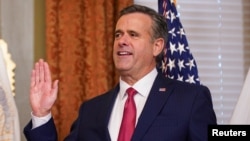
WASHINGTON -- CIA Director John Ratcliffe made an unannounced visit to Moscow on August 25, US officials confirmed to RFE/RL, a rare trip that comes as Washington's efforts to end Russia's war against Ukraine have stalled and tensions over Moscow's relationship with Iran have intensified.
The reason for Ratcliffe's visit, the first publicly known trip he has made to Russia since becoming CIA director under President Donald Trump, was not immediately clear.
US officials familiar with his travel confirmed he flew to Moscow but declined to disclose the substance of his meetings or say whom he met. The CIA and White House did not immediately comment publicly.
A day later, Kremlin spokesman Dmitry Peskov confirmed Ratcliffe's visit to the Russian capital, saying that he met with the country's intelligence officials. Peskov added that Russian President Vladimir Putin had been briefed on the talks.
First reported by CBS News, the visit was signaled by flight-tracking data showing a US military transport aircraft traveling from the United States through Latvia to Moscow. The plane, which appeared to have originated at Joint Base Andrews in Maryland, landed at Moscow's Vnukovo Airport early on August 25 and departed Russia later the same day, according to flight-tracking data.
The unusual movement raised questions about why the head of the US intelligence agency would make a rare in-person trip to Russia at such a delicate moment. The most recent known visit to Moscow by a CIA chief was by Ratcliffe's predecessor William Burns, who met with Putin in November 2021, three months before Putin launched the full-scale invasion of Ukraine.

The nature of the journey suggested the stakes were high, Glen Howard, a Russia expert who is chairman of the Saratoga Foundation, a US-based think tank, told RFE/RL.
"CIA directors don't go to Moscow unless it is to ask something," Howard said, adding that they do not "travel all the way to Russia unless it is important."
"Burns went there in November 2021 before the Russian invasion to warn them not to invade Ukraine," he said.
Senior US intelligence officials have maintained contacts with their Russian counterparts during the war, but face-to-face meetings at this level remain rare.
Carrots And Sticks?
One possible explanation is Ukraine, particularly the administration's effort to determine whether Moscow can still be persuaded to negotiate an end to the war. US-brokered efforts have stalled despite Trump's summit with Putin in Alaska in August 2025.
"I would hope on top of his list would be a direct demand that Vladimir Putin end this war of naked aggression against Ukraine," Bradley Bowman, senior director of the Center on Military and Political Power at the Washington-based Foundation for Defense of Democracies, told RFE/RL.

Bowman, a former national-security adviser to members of the Senate Armed Services and Foreign Relations committees, said Washington should make clear that failure to end the war would bring increasingly painful measures against Russia, while the United States and its allies continue helping Ukraine defend itself.
Bowman also pointed to another potential subject: Russia's support for Iran.
Russia And Iran
"I hope he would also be saying that Vladimir Putin better stop providing satellite launch assistance to Iran," Bowman said, adding Moscow should also stop providing support that could help Iran target US forces, including targeting information, drone-related assistance, and other military capabilities.
Russia has extensive military and commercial ties with Iran. Ratcliffe's trip came a day after US Treasury Secretary Scott Bessent announced a new push to "sever every economic lifeline that sustains this tyrannical regime until Tehran stands alone" and said countries would be given timelines to "shut down" activity that props it up.
Howard likewise suggested Iran could be central to Ratcliffe's mission, although he stressed this was his speculation rather than established fact. In his view, Ratcliffe could be seeking to persuade Moscow to stop supplying or assisting Iran, potentially turning the trip into an unusually direct warning to the Kremlin.

Bowman cited reporting that Russia has provided targeting information to Iran and transferred drone tactics and techniques developed during the war in Ukraine. He argued Moscow's support could be one reason Iran has been able to maintain military resilience and resist pressure to negotiate.
A Rare Trip At A Delicate Moment
Ratcliffe's trip to Moscow was notable because of his own reputation as a Russia hawk. Howard pointed to Ratcliffe's previous advocacy for keeping CIA advisers in Ukraine to assist with intelligence and targeting, even as the Pentagon was moving to reduce its advisory presence there.
That, Howard argued, suggests Ratcliffe has a particularly strong line to Trump. "He has the ear of the president," Howard said.
Moscow, meanwhile, has accused the United States of providing strong support for Ukrainian strikes on Russia.
Without provident evidence, Foreign Minister Sergei Lavrov said earlier this month Russia had sent the State Department questions "on the matter of intelligence data and the fact that the US is far more deeply involved in organizing and executing strikes deep within Russian territory."
Americans Behind Bars
Some observers speculated that the fate of Americans imprisoned or detained in Russia could be part of the purpose of the visit.
The CIA has played an important role in previous efforts to win the release and return of jailed Americans, including the 2024 exchange that freed Wall Street Journal reporter Evan Gershkovich, RFE/RL journalist Alsu Kurmasheva, and former US Marine Paul Whelan.
Ratcliffe also played a role in negotiations surrounding the release of Ksenia Karelina, a Russian-American citizen who spent more than a year imprisoned in Russia after being accused by Russian authorities of supporting Ukraine.
"There is a serious responsibility for any US government official talking with any country that is wrongfully detaining an American citizen at every possible opportunity to bring that up," Bowman said.

An unanswered question is whether Ratcliffe's trip represents an escalation in tensions, a diplomatic opening, or an intelligence channel being used for a specific transaction.
Washington is pushing for an end to Russia's war against Ukraine, but Putin -- while appearing eager to keep the US involved in diplomatic efforts -- has rejected calls by the US and Kyiv for talks to begin with the front lines frozen in place, instead insisting Ukraine hand over territory Moscow's forces have been unable to seize in battle.

