




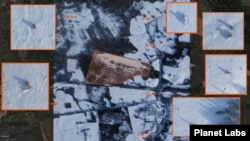
Several air defense and electronic warfare installations appear to have cropped up around a site in Belarus where Russia may have deployed a nuclear-capable, hypersonic missile system called Oreshnik, recent satellite imagery indicates.
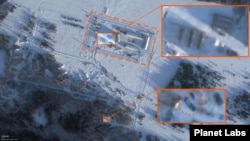
An analysis of images captured by Planet Labs on February 17 suggests that six positions that appear to hold equipment designed to protect facilities from aircraft, drones, and missile strikes now ring the former site of the Soviet-era Krychev-6 military airfield near the village of Krychau, close to the Russian border in eastern Belarus.
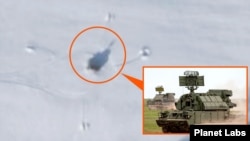
While the imagery does not allow for definitive identification, some of the equipment resembles the Russian Tor-M2 antiaircraft missile system or the Pantsir antiaircraft missile and gun system, while others resemble Krasukha or Moskva-1 electronic warfare systems. One of the positions looks like it may have been fitted with an S-300 missile system.
The equipped positions stand within a five-kilometer radius of the Krychau site, where new construction began in August 2025. A previous examination by RFE/RL’s Belarus Service of satellite imagery captured between November and February pointed to a possible Oreshnik deployment there.
Russian President Vladimir Putin has boasted about the Oreshnik repeatedly since he launched the full-scale invasion of Ukraine, Belarus’s southern neighbor, just over four years ago. Russia has targeted Ukraine with the missile -- without a nuclear warhead -- at least twice.
Military allies Russia and Belarus have both said the missiles would be deployed in Belarus. On December 30, the defense ministries of the two countries posted video footage that they said showed an Oreshnik system being put on combat duty in Belarus, but they did not reveal the location.
'Political Considerations'
Anatoliy Khrapchynskiy, a Ukrainian aviation expert and deputy director of a company that makes radio electronic warfare devices, told RFE/RL the satellite images indicate that a comprehensive air defense network may be being installed around the Krychau site, which would make sense for an Oreshnik deployment.
"If Russia deploys an intercontinental ballistic missile or a complex like the Oreshnik, it will…build an air defense system to cover this facility, since it is of strategic importance [to Moscow],” he said, adding that such a network could include long-range systems such as the S-300 and short-range systems like the Pantsir or Tor.
“This basically coincides with what we see from the configuration of shadows from the equipment and its location on satellite images,” Khrapchynskiy said.
"We are talking about a closed military camp with a huge level of protection -- both ground and air. This level of cover is usually provided to really important facilities," he said.
With relations between Russia and the West extremely tense amid Moscow’s war against Ukraine, Putin and other Russian officials have used references to the Oreshnik as part of threatening messaging and nuclear saber-rattling.
Jeffrey Lewis, one of a trio of US researchers who named the Krychau site in late December as a possible location for an Oreshnik system, wrote at the time that a deployment there would "not result in any increase in the reach of the missile system," noting that many areas in Russia and its Kaliningrad exclave are closer to Western capitals.
"The decision to base the Oreshnik less than 5 km from the Russian border illustrates the degree to which the deployment reflects political considerations, rather than an effort to seek some specific military advantage," Lewis wrote.