



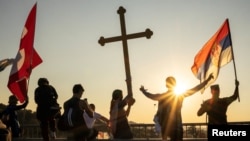
After 14 years dominating Serbian politics, Aleksandar Vucic faces the biggest challenge to his rule in parliamentary elections on October 25 from an opposition movement that has sprung from mass student protests.
But the campaign has been marked by growing concern about how fair the vote will be, with RFE/RL's Balkan Service uncovering some 500,000 people who were registered to vote without a full address -- raising fears of electoral fraud.
Serbia's last election, in 2023, was followed by protests after international observers reported irregularities including bussing in voters from neighboring Bosnia-Hercegovina and voter intimidation.
Vucic resigned as president in late September and, unable to run for a third term, is now aiming to be prime minister -- a role he held from 2012 until becoming head of state in 2017.



His rule has been marked by a balancing act in which he has sought to foster good relations with Western nations while also cozying up to Russia and China. But Chinese investment has come at a political price.
Tragedy At Novi Sad
The election comes just days before the second anniversary of the Novi Sad tragedy.
The deaths of 16 people when a renovated canopy at the city's railway station collapsed on November 1, 2024, triggered nationwide protests amid reports of corrupt practices at the construction site, a flagship government project led by Chinese businesses.
The government denied this and the protests were met with police violence and arrests. One of the most serious incidents occurred on March 15, 2025, when authorities allegedly used an unlawful sonic weapon against peaceful demonstrators.
Days after another student protest in June this year, Vucic announced he'd step down and hold early elections.
Polling to date suggests Serbia's electorate is largely divided between those supporting a broad coalition built around the ruling party and those backing the student movement.
"These are the first elections in more than a decade whose outcome is genuinely very uncertain," Vladimir Bilcik, a former European Parliament rapporteur for Serbia, told RFE/RL.
The students have no formal leaders, and their electoral list is made up of nonpartisan figures, most of them university professors. Their candidate list is led by cardiologist Ilija Srdanovic, although they have said this does not mean he would become prime minister should they win.
Fair Elections?
The Serbian government says it has since implemented all recommendations made by the OSCE's election observation mission following its criticism of the 2023 election. This was contradicted in an interim report by the OSCE, which has 300 observers in Serbia to monitor voting.
RFE/RL investigations have found irregularities at the very first stage of the electoral process: the voter register. RFE/RL found that more than half a million people listed in the register did not have a precise address recorded, lacking a street name or house number.
RFE/RL also found hundreds of registered voters listed at public facilities, including social welfare centers, and at houses that could not reasonably accommodate so many residents.
These findings have drawn public scrutiny because election observers have previously raised suspicions that the authorities organized the "mass migration" of voters -- Serbian citizens from neighboring countries allegedly registered at addresses in Serbia to gain voting rights there, potentially benefiting the ruling party.
RFE/RL investigations have also found that the number of eligible voters for Serbian elections in Bosnia and Kosovo increased ahead of the vote. Both are places where ethnic Serbs are considered an important pool of support for Vucic's Progressive Party.
Four employees of institutions in Kosovo funded by Serbia have told RFE/RL they were being pressured to vote for the ruling party. Their identities or exact place of work cannot be revealed. In Serb-majority areas of Kosovo, various educational and healthcare institutions receive state funding from Serbia.
Domestic election observers have documented similar practices at workplaces in several Serbian municipalities.
The election is also taking place amid allegations of illegal surveillance and the arrest of government opponents, as Vucic has tightened his grip on the security services over his 14 years in power.
A statement issued by the US Senate's Foreign Relations Committee on October 21 pointed to reports of illegal surveillance of opposition members and attempts to discredit and undermine election observation missions.


Reporting by SHARE, a Serbian nonprofit focused on digital security, and researchers at Toronto University, alleged at least 16 cases of the Pegasus surveillance software -- which is illegal in Serbia -- being used in 2026.
The opposition and students accuse the authorities of conducting the surveillance, while government officials deny spying on their opponents.
Serbia has experienced a decline in freedoms over the past decade, a trend also noted in the latest report by international watchdog Freedom House.
Between East And West
Some US lawmakers have warned that Moscow could play an active role in Serbia's election, while the European Parliament has also raised concerns about Russian influence operations in the country.
"Russia is making available its best resources, tactics, and methods to monitor, suppress, and disrupt the citizens of Serbia as well as the powerful student movement that wants to restore the rule of law in the country," Republican Congressman Joe Wilson told RFE/RL.
Russian President Vladimir Putin has personally expressed his support for Vucic ahead of the election.
During the election campaign, Vucic pledged to continue his foreign policy course, including his refusal to heed EU calls to impose sanctions on Russia over its full-scale invasion of Ukraine.
The student movement has focused its campaign on fighting corruption, putting foreign policy on the back burner. But it has also opposed sanctions against Russia and reiterated support for Belgrade's official position of refusing to recognize Kosovo's independence.
Meanwhile, Serbia's EU integration has stalled, leaving the country -- once a front-runner alongside Montenegro -- near the back of the pack. No new chapter in Serbia's EU accession negotiations has been opened since late 2021.
Democratic backsliding, unresolved relations with Kosovo, and refusal to impose sanctions on Russia are among the main reasons for the impasse.