



Accessibility links

Breaking News

Syrian Forces Make Gains In Palmyra Offensive

A year ago, all was quiet at Palmyra. This picture, from March 14, 2014, shows locals with bicycles at the ancient oasis city.
1/9 A year ago, all was quiet at Palmyra. This picture, from March 14, 2014, shows locals with bicycles at the ancient oasis city.
Syrian authorities say Islamic State militants have advanced to within 2 kilometers of Palmyra, an ancient city with outstanding architectural heritage dating from the first century. The militants have caused significant damage to similar sites they have overrun in Iraq, posting videos of themselves destroying antiquities. UNESCO includes Palmyra on its list of World Heritage sites, describing it as one of the most important cultural centers of the ancient world -- a crossroads for local, Persian, Greek and Roman influences.
The remains of the Roman theatre date back to the 2nd century. Until recently, it was host to the annual Palmyra Festival.
2/9 The remains of the Roman theatre date back to the 2nd century. Until recently, it was host to the annual Palmyra Festival.
Syrian authorities say Islamic State militants have advanced to within 2 kilometers of Palmyra, an ancient city with outstanding architectural heritage dating from the first century. The militants have caused significant damage to similar sites they have overrun in Iraq, posting videos of themselves destroying antiquities. UNESCO includes Palmyra on its list of World Heritage sites, describing it as one of the most important cultural centers of the ancient world -- a crossroads for local, Persian, Greek and Roman influences.
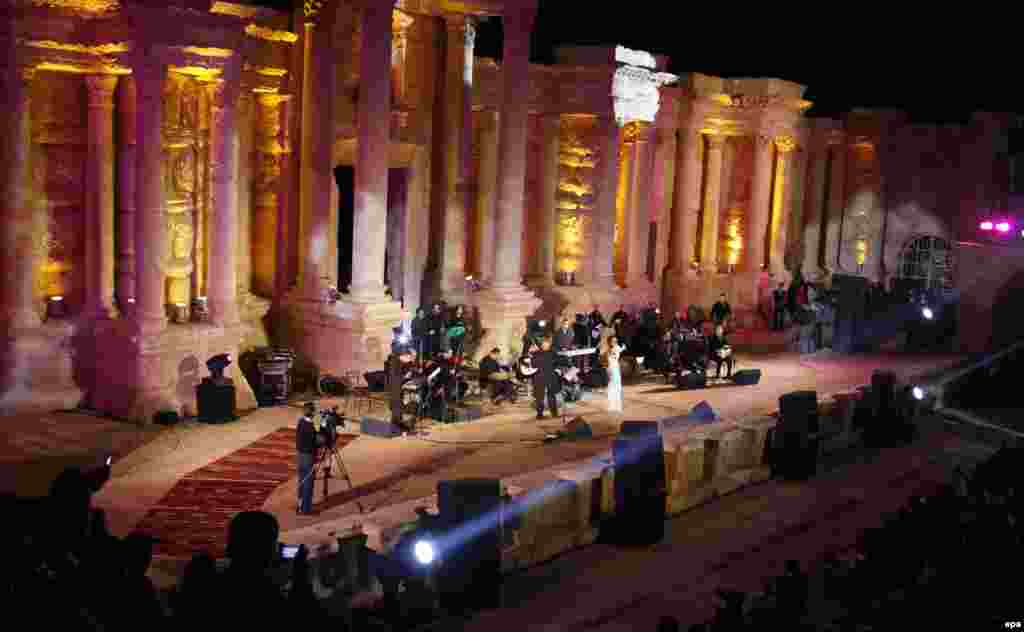
Lebanese singer Najwa Karam performs at the opening ceremony of the Palmyra Festival in 2010.
3/9 Lebanese singer Najwa Karam performs at the opening ceremony of the Palmyra Festival in 2010.
Syrian authorities say Islamic State militants have advanced to within 2 kilometers of Palmyra, an ancient city with outstanding architectural heritage dating from the first century. The militants have caused significant damage to similar sites they have overrun in Iraq, posting videos of themselves destroying antiquities. UNESCO includes Palmyra on its list of World Heritage sites, describing it as one of the most important cultural centers of the ancient world -- a crossroads for local, Persian, Greek and Roman influences.
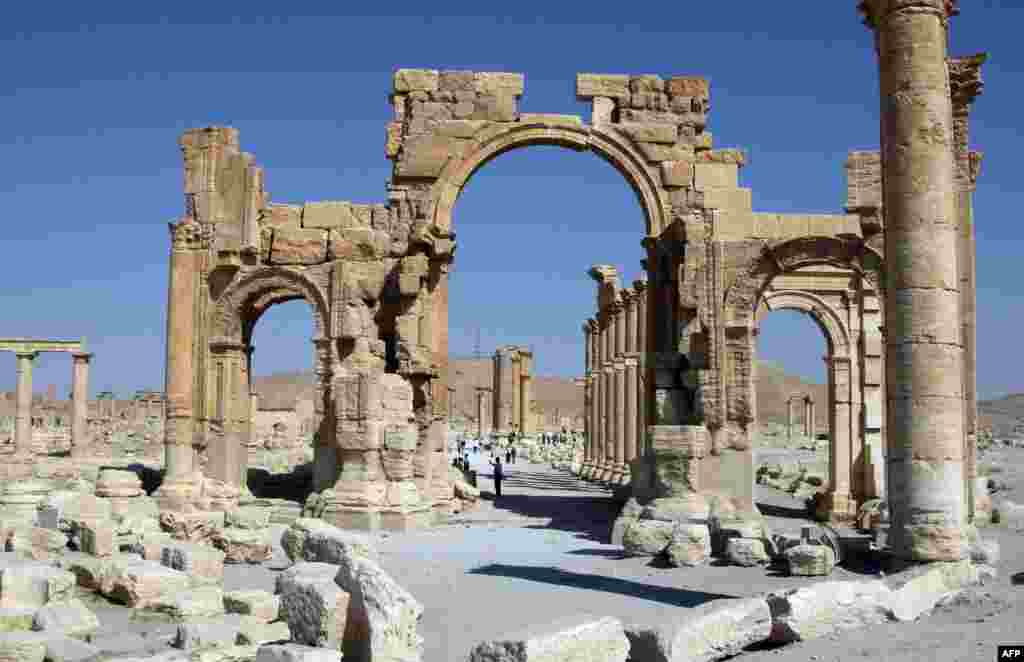
More Roman ruins. Palmyra became increasingly prosperous after the Romans took control at the beginning of the 1st century.
4/9 More Roman ruins. Palmyra became increasingly prosperous after the Romans took control at the beginning of the 1st century.
Syrian authorities say Islamic State militants have advanced to within 2 kilometers of Palmyra, an ancient city with outstanding architectural heritage dating from the first century. The militants have caused significant damage to similar sites they have overrun in Iraq, posting videos of themselves destroying antiquities. UNESCO includes Palmyra on its list of World Heritage sites, describing it as one of the most important cultural centers of the ancient world -- a crossroads for local, Persian, Greek and Roman influences.
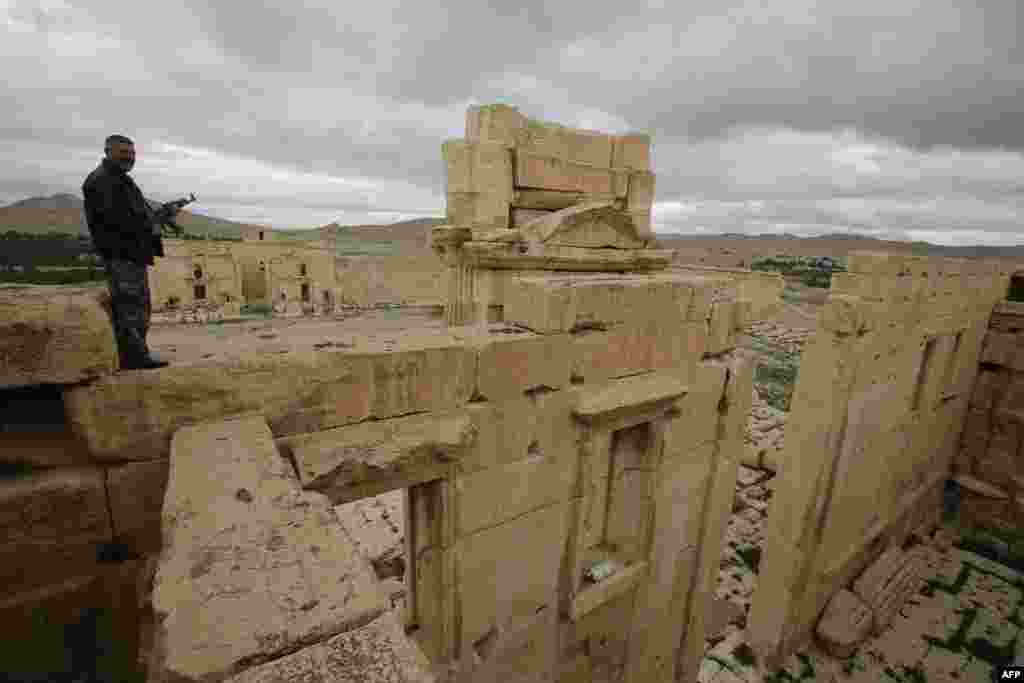
March 2014 - A Syrian policeman stands on the sanctury of Baal, one of three pagan gods worshipped in Palmyra in the 1st century.
5/9 March 2014 - A Syrian policeman stands on the sanctury of Baal, one of three pagan gods worshipped in Palmyra in the 1st century.
Syrian authorities say Islamic State militants have advanced to within 2 kilometers of Palmyra, an ancient city with outstanding architectural heritage dating from the first century. The militants have caused significant damage to similar sites they have overrun in Iraq, posting videos of themselves destroying antiquities. UNESCO includes Palmyra on its list of World Heritage sites, describing it as one of the most important cultural centers of the ancient world -- a crossroads for local, Persian, Greek and Roman influences.
Palmyra is believed to have been founded by King Solomon.
6/9 Palmyra is believed to have been founded by King Solomon.
Syrian authorities say Islamic State militants have advanced to within 2 kilometers of Palmyra, an ancient city with outstanding architectural heritage dating from the first century. The militants have caused significant damage to similar sites they have overrun in Iraq, posting videos of themselves destroying antiquities. UNESCO includes Palmyra on its list of World Heritage sites, describing it as one of the most important cultural centers of the ancient world -- a crossroads for local, Persian, Greek and Roman influences.
A 2nd century limestone relief excavated in 2008 from a cemetery in Palmyra. Shapes of 13 men and women, all from the same family, are engraved on it.
7/9 A 2nd century limestone relief excavated in 2008 from a cemetery in Palmyra. Shapes of 13 men and women, all from the same family, are engraved on it.
Syrian authorities say Islamic State militants have advanced to within 2 kilometers of Palmyra, an ancient city with outstanding architectural heritage dating from the first century. The militants have caused significant damage to similar sites they have overrun in Iraq, posting videos of themselves destroying antiquities. UNESCO includes Palmyra on its list of World Heritage sites, describing it as one of the most important cultural centers of the ancient world -- a crossroads for local, Persian, Greek and Roman influences.
From the same dig - the scene depicts two Palmyrian merchants and a child standing next to a camel.
8/9 From the same dig - the scene depicts two Palmyrian merchants and a child standing next to a camel.
Syrian authorities say Islamic State militants have advanced to within 2 kilometers of Palmyra, an ancient city with outstanding architectural heritage dating from the first century. The militants have caused significant damage to similar sites they have overrun in Iraq, posting videos of themselves destroying antiquities. UNESCO includes Palmyra on its list of World Heritage sites, describing it as one of the most important cultural centers of the ancient world -- a crossroads for local, Persian, Greek and Roman influences.
The sun sets behind ruined columns at Palmyra, November 2010.
9/9 The sun sets behind ruined columns at Palmyra, November 2010.
Syrian authorities say Islamic State militants have advanced to within 2 kilometers of Palmyra, an ancient city with outstanding architectural heritage dating from the first century. The militants have caused significant damage to similar sites they have overrun in Iraq, posting videos of themselves destroying antiquities. UNESCO includes Palmyra on its list of World Heritage sites, describing it as one of the most important cultural centers of the ancient world -- a crossroads for local, Persian, Greek and Roman influences.
Previous slide
Next slide

Syrian troops backed by Russian airstrikes have taken up strategic positions around the historic site of Palmyra, which is held by Islamic State militants.

Russia's defense ministry said on March 26 that Russian jets carried out 40 air sorties near Palmyra in the past day to support the government offensive, killing over 100 militants.

Syrian troops and allied militiamen have taken up positions in the three neighborhoods that are part of the modern town of Palmyra, according to the Syrian Observatory for Human Rights, a Britain-based monitoring group.

The statements come as the Syrian government's drive to retake the UNESCO heritage site from IS militants enters its fourth week.

At least 56 government soldiers are reported to have died in fighting this week.

Palmyra, world famous for its Roman-era ruins, fell to IS in May. IS later demolished some of the ancient city's best-known monuments, claiming they promote idolatry.

Retaking the town would be a major victory for President Bashar Assad's government, which has made steady gains in recent months against IS and opposition rebel groups.

Damascus has been assisted in large part by Russia's air campaign.

Earlier this month, Russian President Vladimir Putin ordered a surprise partial pullout of some Russian warplanes from Syria, but said that strikes against IS militants and the Al-Qaeda linked Al-Nusra Front would continue.

Those groups have been excluded from a U.S.-Russian brokered ceasefire that began on February 27 and has largely held.

If Syrian government forces retake Palmyra, they will be positioned to advance on the two largest cities held by IS, Deir Ezzor and Raqqa.

The IS group is on the back foot in Iraq and Syria, where forces on the ground have been backed by U.S.-led airstrikes against the extremists.

The U.S.-led international coalition estimates that the group has lost 40 percent of the territory it once held in Iraq and around 20 percent of its territory in Syria.

Based on reporting by AP and Reuters
  • 16x9 Image

    RFE/RL

    RFE/RL journalists report the news in 24 languages in 18 countries where a free press is banned by the government or not fully established. We provide what many people cannot get locally: uncensored news, responsible discussion, and open debate.

XS
SM
MD
LG